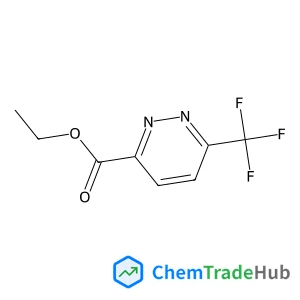
Ethyl 6-(trifluoromethyl)pyridazine-3-carboxylate
CAS Number:
1192155-06-8
Molecular Formula:
C8H7F3N2O2
Cai-Li Huang, Ling Jiao, Jing-Jing Zhang, Jian-Bing Zeng, Ke-Ke Yang, Yu-Zhong Wang
Thermally-induced shape memory multiblock poly(ether-ester)s (PBSEGs) comprising crystallisable poly(butylene succinate) (PBS) hard segments and poly(ethylene glycol) (PEG) soft segments, were synthesized by polycondensation from succinic acid, 1,4-butanediol and PEG diol. The copolymers were characterized by 1H-NMR, GPC, DSC and DMA. DSC analysis revealed that all PBSEGs prepared in this work are double-crystalline copolymers which ensure it to form separated crystalline domain determined the permanent shape and temporary shape respectively. The Tm of PEG segment (Tm,PEG) of the PBSEGs ranging from 27.54 to 51.04 °C, acting as the transition temperature (Ttrans), was controllable by varying the chain length of soft segment. The DMA test indicated that a large difference in modulus below and above the Ttrans of PBSEGs endows it with sufficient deformability at high temperature and high capacity for keeping deformation at low temperature. The mechanical properties of the copolymer films were assessed by tensile strength measurement. It showed that the copolymers were ductile which enabled remarkable reversible deformation. The shape memory properties of PBSEGs were evaluated by bending test, as expected, most copolymers possessed excellent shape memory effect. The contact angle tests demonstrated that the copolymers were more hydrophilic with the introduction of PEG segment, suggesting this biodegradable PBSEG multiblock copolymer with excellent shape-memory properties has great potential in application for biomaterials.
Laura Berstis, Kim K. Baldridge
DOI: 10.1039/C5CP01861G
Pengfei Huo, Thomas F. Miller III
DOI: 10.1039/C5CP02517F
Audrey Laventure, Guillaume De Grandpré, Armand Soldera, Olivier Lebel, Christian Pellerin
DOI: 10.1039/C5CP06630A
S. Balaji, K. Kannan, I. S. Moon
DOI: 10.1039/C5CP04151A
Benjamin J. Bergner, Christine Hofmann, Adrian Schürmann, Daniel Schröder, Klaus Peppler, Peter R. Schreiner, Jürgen Janek
DOI: 10.1039/C5CP04505C
Mohammad Alaghemandi
DOI: 10.1039/C5CP05125H
Guokui Liu, Heng Zhang, Gang Liu, Shiling Yuan, Chengbu Liu
DOI: 10.1039/C5CP05639J
Anita Dawes, Nigel John Mason, Helen Jane Fraser
DOI: 10.1039/C5CP05299H
DOI: 10.1039/C5CP90218E
Louis Y. P. Luk, E. Joel Loveridge, Rudolf K. Allemann
DOI: 10.1039/C5CP00794A
3-Fluoro-2-methylbenzylamine is an organic compound with the CAS number 771573-3...
Tert-butyl 2-(oxetan-3-ylidene)acetate is considered safe for its intended uses ...
Proper personal protective equipment (PPE) such as gloves, goggles, and a lab co...
2-Ethyl-4-methyl-1,3-thiazole is commonly synthesized via the reaction of thiour...
This compound should be stored in a cool, dry place away from direct sunlight an...
L-Lysine Acetate Salt (CAS: 52315-92-1) is subject to various regulatory guideli...
6-Fluoro-3-hydroxy-2-pyrazinecarboxamide (CAS: 259793-96-9) is generally conside...
1,1'-Sulfonylbis(1H-imidazole) is a crystalline solid with a molecular weight of...
4-Methyl-7-nitro-1H-indole-3-carbonitrile (CAS: 289483-82-5) is primarily used i...
Waste containing 5-Bromo-3-indolyl-beta-galactoside (CAS: 97753-82-7) should be ...

Polymer Chemistry welcomes submissions in all areas of polymer science that have a strong focus on macromolecular chemistry. Manuscripts may cover a broad range of fields, yet no direct application focus is required.