












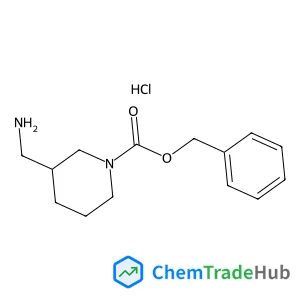
Benzyl 3-(aminomethyl)piperidine-1-carboxylate hydrochloride
CAS Number:
1186663-23-9
Molecular Formula:
C14H21ClN2O2
Guangyao Liu, Qian Qiu, Zesheng An
Thermosensitive polymeric materials based on copolymers of oligo(ethylene glycol) methacrylates are attracting significant attention in various materials sectors. The preparation of their thermosensitive microgels/nanogels via the aqueous dispersion polymerization process is, however, limited by low monomer loading and thus low solid content of the final colloids. Moreover, the preparation of nanogels by reversible addition-fragmentation chain transfer (RAFT) mediated dispersion polymerization has been further hampered by the poor RAFT control of the polymerization process. In this article, we report the development of thermosensitive copolymers based on poly(2-methoxyethyl acrylate-co-poly(ethylene glycol) methyl ether acrylate) (P(MEA-co-PEGA)) and their use for nanogel synthesis by RAFT dispersion polymerization in water. The thermosensitive copolymers exhibited sharp thermal transitions upon increasing thee temperature above their lower critical solution temperature. The use of MEA as the majority comonomer and poly(N,N′-dimethylacrylamide) as the RAFT agent and stabilizer for the synthesis of nanogels allowed monomer loadings of up to 20%, which significantly improved the solid content of the dispersion polymerization system. Moreover, the dispersion copolymerization of MEA with PEGA was under excellent RAFT control up to complete monomer conversion. The synthesized nanogels showed an unprecedented linear relationship between nanogel size and temperature, suggesting expanded applications of such responsive polymeric materials.
Luyan Liu, Chen Chen, Siyu Yang, Hua Xie, MaoGang Gong, Xiaoliang Xu
DOI: 10.1039/C5CP06305A
Robert S. Weatherup
DOI: 10.1039/C5CP04058B
Swagata Pahari, Sudip Roy
DOI: 10.1039/C5CP05735C
R. C. Hoffmann, M. Kaloumenos, D. Spiehl, E. Erdem, S. Repp, S. Weber, J. J. Schneider
DOI: 10.1039/C5CP05166E
Tiantian Hong, Zhifeng Liu, Weiguo Yan, Junqi Liu, Xueqi Zhang
DOI: 10.1039/C5CP05742F
Dan Xu, Yao-Hong Xue, Yan-Bo Sun
DOI: 10.1039/C5CP05449D
Anirban Mondal, Anurag Prakash Sunda, Sundaram Balasubramanian
DOI: 10.1039/C5CP05701A
Gil O. Rutter, David Quigley, Tiffany R. Walsh
DOI: 10.1039/C5CP05652G
Ananda K. Ghosh, Zahidul Islam, Jonathan Krueger, Thelma Abeysinghe, Amnon Kohen
DOI: 10.1039/C5CP01246E
3-Fluoro-2-methylbenzylamine is an organic compound with the CAS number 771573-3...
Tert-butyl 2-(oxetan-3-ylidene)acetate is considered safe for its intended uses ...
Proper personal protective equipment (PPE) such as gloves, goggles, and a lab co...
2-Ethyl-4-methyl-1,3-thiazole is commonly synthesized via the reaction of thiour...
This compound should be stored in a cool, dry place away from direct sunlight an...
L-Lysine Acetate Salt (CAS: 52315-92-1) is subject to various regulatory guideli...
6-Fluoro-3-hydroxy-2-pyrazinecarboxamide (CAS: 259793-96-9) is generally conside...
1,1'-Sulfonylbis(1H-imidazole) is a crystalline solid with a molecular weight of...
4-Methyl-7-nitro-1H-indole-3-carbonitrile (CAS: 289483-82-5) is primarily used i...
Waste containing 5-Bromo-3-indolyl-beta-galactoside (CAS: 97753-82-7) should be ...

Polymer Chemistry welcomes submissions in all areas of polymer science that have a strong focus on macromolecular chemistry. Manuscripts may cover a broad range of fields, yet no direct application focus is required.
![[4-Chloro-3-(diethylcarbamoyl)phenyl]boronic acid structure](https://static.chemtradehub.com/structs/871/871332-68-2-0e3b.webp "[4-Chloro-3-(diethylcarbamoyl)phenyl]boronic acid structure")




