












Naphtho[1,2-b:5,6-b′]dithiophene-based conjugated polymer as a new electron donor for bulk heterojunction organic solar cells
Literature Information
Publication Date
2012-01-06
DOI
10.1039/C2PY00424K
Impact Factor
5.582
Authors
Pranabesh Dutta, Hanok Park, Woo-Hyung Lee, Kyuri Kim, In Nam Kang, Soo-Hyoung Lee
View Original
Abstract
We report for the first time the synthesis and photovoltaic application of a naphtho[1,2-b:5,6-b′]dithiophene (NDT) containing donor–acceptor conjugated copolymer. The combination of a thiophene-bridge NDT building block with a quinoxaline acceptor unit results in a new copolymer that has an optical band gap of 1.77 eV, a HOMO level of −5.24 eV, and a hole mobility of 5.0 × 10⁻⁵ cm2 V−1 s−1. Preliminary characterization of the bulk-heterojunction solar cell device exhibits a PCE of around 1.5%.
Related Literature
Janus nanoparticles inside polymeric materials: interfacial arrangement toward functional hybrid materials
Qiuyan Yang, Katja Loos
2016-11-17
Review Article
DOI: 10.1039/C6PY01795A
Reduction- and thermo-sensitive core-cross-linked polypeptide hybrid micelles for triggered and intracellular drug release
Yuanfeng Gao
2017-01-06
Paper
DOI: 10.1039/C6PY01929C
A tumor-targeting dextran–apoprotein conjugate integrated with enediyne chromophore shows highly potent antitumor efficacy
Bin Li, Xiu-jun Liu, Liang Li, Sheng-hua Zhang, Yi Li, Dian-dong Li, Yong-su Zhen
2014-05-20
Paper
DOI: 10.1039/C4PY00532E
RAFT/MADIX emulsion copolymerization of vinyl acetate and N-vinylcaprolactam: towards waterborne physically crosslinked thermoresponsive particles
Laura Etchenausia, Abdel Khoukh, Elise Deniau Lejeune, Maud Save
2017-03-16
Paper
DOI: 10.1039/C7PY00221A
Rational design of soluble and clickable polymers prepared by conventional free radical polymerization of acetylene-functionalized acrylate
Yu Liu, Xiaochuan Shui, Meng Wang, Chenguang Zhang, Yuechuan Wang
2017-02-23
Paper
DOI: 10.1039/C6PY02104B
Catch and release: photocleavable cationic diblock copolymers as a potential platform for nucleic acid delivery
Matthew D. Green, Abbygail A. Foster, Chad T. Greco, Raghunath Roy, Rachel M. Lehr, Thomas H. Epps, III, Millicent O. Sullivan
2014-06-05
Communication
DOI: 10.1039/C4PY00638K
From particles to stabilizing blocks – polymerized ionic liquids in aqueous heterophase polymerization
Ran Yu, Klaus Tauer
2014-05-16
Paper
DOI: 10.1039/C4PY00458B
New violet to yellow light sensitive diketo pyrrolo–pyrrole photoinitiators: high performance systems with unusual bleaching properties and solubility in water
Mariem Bouzrati-Zerelli, Nicolas Zivic, Frédéric Dumur, Didier Gigmes, Bernadette Graff, Jean Pierre Fouassier, Jacques Lalevée
2017-02-28
Paper
DOI: 10.1039/C7PY00202E
Preparation of sulfonic acid functional proton conducting phosphazenes by covalent protection
Ferda Hacıvelioğlu
2017-04-17
Paper
DOI: 10.1039/C7PY00189D
Synthesis of highly branched polymers by reversible complexation-mediated copolymerization of vinyl and divinyl monomers
Hongjun Yang, Zhongrui Wang, Yulei Zheng, Wenyan Huang, Xiaoqiang Xue, Bibiao Jiang
2017-02-21
Paper
DOI: 10.1039/C7PY00174F
You might also like
Compound Q&A
Are there alternatives to 1-(4-Chlorophenyl)-N-hydroxymethanimine (CAS: 3848-36-0) in synthesis?
When considering alternatives to 1-(4-Chlorophenyl)-N-hydroxymethanimine (CAS: 3...
3848-36-01-(4-Chlorophenyl)-N...
Compound Q&A
How should (1R,9S,10S,12S,14E,16S,19R,20R,21S,22R)-3,9,21-Trihydroxy-5,10,12,14,16,20,22-heptamethyl-23,24-dioxatetracyclo[17.3.1.1~6,9~.0~2,7~]tetracosa-2,5,7,14-tetraen-4-one (CAS: 183202-73-5) be stored?
This compound should be stored in a cool, dry place away from direct sunlight. I...
183202-73-5(1R,9S,10S,12S,14E,1...
Compound Q&A
How is 3-(4-Bromophenyl)-5-(2-fluorophenyl)-1,2,4-oxadiazole (CAS: 419553-16-5) typically synthesized?
3-(4-Bromophenyl)-5-(2-fluorophenyl)-1,2,4-oxadiazole is synthesized through a m...
419553-16-53-(4-Bromophenyl)-5-...
Compound Q&A
How is 5-Chloro-2-(4-chlorophenyl)-4-methyl-6-[3-(1-piperidinyl)propoxy]pyrimidine (CAS: 1639220-19-1) typically synthesized?
5-Chloro-2-(4-chlorophenyl)-4-methyl-6-[3-(1-piperidinyl)propoxy]pyrimidine (CAS...
1639220-19-15-Chloro-2-(4-chloro...
Compound Q&A
What industries use 2-Chloro-4-(difluoromethoxy)pyridine (CAS: 1206978-15-5)?
2-Chloro-4-(difluoromethoxy)pyridine is used in the pharmaceutical industry for ...
1206978-15-52-Chloro-4-(difluoro...
Compound Q&A
What regulatory guidelines apply to 3-Chloro-6-methylpyridazine (CAS: 1121-79-5)?
3-Chloro-6-methylpyridazine (CAS: 1121-79-5) is classified under the Globally Ha...
1121-79-53-Chloro-6-methylpyr...
Compound Q&A
Are there alternatives to Methyl 4,5-dimethyl-2-nitrobenzoate in synthesis?
Several alternatives can be used in the synthesis of Methyl 4,5-dimethyl-2-nitro...
90922-74-0Methyl 4,5-dimethyl-...
Compound Q&A
Are there alternatives to (2E,2'E)-3,3'-(1,4-Phenylene)bisacrylaldehyde in synthesis?
Alternatives to (2E,2'E)-3,3'-(1,4-Phenylene)bisacrylaldehyde include other acry...
63405-68-5(2E,2'E)-3,3'-(1,4-P...
Compound Q&A
What is 3-Amino-5-chloropyridin-2-ol hydrochloride (CAS: 1261906-29-9)?
3-Amino-5-chloropyridin-2-ol hydrochloride is an organic compound with the CAS n...
1261906-29-93-Amino-5-chloropyri...
Compound Q&A
What precautions should be taken when handling 6,7-Difluoro-2,3-dihydro-4H-chromen-4-one (CAS: 1092349-93-3)?
When handling 6,7-Difluoro-2,3-dihydro-4H-chromen-4-one, it is essential to wear...
1092349-93-36,7-Difluoro-2,3-dih...
Source Journal
Polymer Chemistry

CiteScore:
8.6
Self-citation Rate:
7.3%
Articles per Year:
457
Polymer Chemistry welcomes submissions in all areas of polymer science that have a strong focus on macromolecular chemistry. Manuscripts may cover a broad range of fields, yet no direct application focus is required.
Recommended Compounds
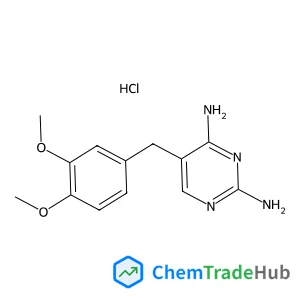
5-(3,4-Dimethoxybenzyl)-2,4-pyrimidinediamine hydrochloride (1:1)
CAS Number:
2507-23-5
Molecular Formula:
C13H17ClN4O2
Recommended Suppliers



Disclaimer
This page provides academic journal information for reference and research purposes only. We are not affiliated with any journal publishers and do not handle publication submissions. For publication-related inquiries, please contact the respective journal publishers directly.
If you notice any inaccuracies in the information displayed, please contact us at support@chemtradehub.com. We will promptly review and address your concerns.