












In situ synthesized Pd nanoparticles supported on B-MCM-41: an efficient catalyst for hydrogenation of nitroaromatics in supercritical carbon dioxide
Literature Information
Publication Date
2012-10-11
DOI
10.1039/C2GC36160D
Impact Factor
10.182
Authors
Maya Chatterjee, Takayuki Ishizaka, Toshishige Suzuki, Akira Suzuki, Hajime Kawanami
View Original
Abstract
In situ synthesis of Pd nanoparticles supported on boron (B)-substituted MCM-41 (B-MCM-41) with Si/B ratio varying from 100 to 5 was carried out by hydrothermal method using H3BO3 as B source. The textural properties as well as thermal stability of the resultant material were investigated by XRD, TEM, FTIR and TG-DTA. Highly ordered materials were obtained depending on the Si/B ratio, which also influenced the particle size of Pd as well as dispersion. Pd/B-MCM-41 was a promising catalyst for the hydrogenation of nitrobenzene in supercritical carbon dioxide with exceptionally faster reaction rate [turnover frequency (TOF) = 5.2 × 10⁵ h−1 (144 s−1)] and high yield of aniline (100%). The observed reaction rate was strongly influenced by the Pd particle size related to Si/B ratio and physical properties of CO2 such as pressure- and temperature-dependent solvent power. A comparison of catalytic activity with the Pd supported only on silica material of similar particle size inferred that the presence of even a small amount of B significantly changes the reaction rate from 70 (only Si) to 105 s−1 (Si/B = 100). In addition, TOF of Pd/B-MCM-41 was high when compared with other Pd catalysts supported on Al-MCM-41 and Ga-MCM-41 obtained by a similar method, and follows the order: B (144 s−1) > Ga (31.2 s−1) > Al (10.2 s−1). The remarkable advantage of the present catalytic system involves low metal content (∼1%), easy separation and it is successfully employed for the hydrogenation of substituted nitroaromatics, nitrile and phenol under mild reaction conditions. Furthermore, the catalyst was recyclable up to the 7th recycle without any loss of catalytic activity.
Recommended Journals
Related Literature
Spectral mapping of 3D multi-cellular tumor spheroids: time-resolved confocal microscopy
Somen Nandi, Rajdeep Chowdhury, Gaurav Das, Kankan Bhattacharyya
2016-06-07
Paper
DOI: 10.1039/C6CP02748B
How surface reparation prevents catalytic oxidation of carbon monoxide on atomic gold at defective magnesium oxide surfaces
Kai Töpfer, Jean Christophe Tremblay
2016-06-09
Paper
DOI: 10.1039/C6CP02339H
Experimentally probing the libration of interfacial water: the rotational potential of water is stiffer at the air/water interface than in bulk liquid
Yujin Tong, Tobias Kampfrath, R. Kramer Campen
2016-06-15
Paper
DOI: 10.1039/C6CP01004K
Dissolved chloride markedly changes the nanostructure of the protic ionic liquids propylammonium and ethanolammonium nitrate
Thomas Murphy, Samantha K. Callear, Gregory G. Warr, Rob Atkin
2016-02-08
Paper
DOI: 10.1039/C5CP06947E
Mesoporous SnO2 single crystals as an effective electron collector for perovskite solar cells
Xiaoli Zheng, Yang Bai, Zilong Wang
2015-06-09
Communication
DOI: 10.1039/C5CP01534K
Ultrafast and slow charge recombination dynamics of diketopyrrolopyrrole–NiO dye sensitized solar cells
Lei Zhang, Ludovic Favereau, Yoann Farré, Edgar Mijangos, Yann Pellegrin, Errol Blart, Fabrice Odobel, Leif Hammarström
2016-06-10
Paper
DOI: 10.1039/C6CP01762B
Crystallographic origin of cycle decay of the high-voltage LiNi0.5Mn1.5O4 spinel lithium-ion battery electrode
Cheng-Zhang Lu, Chia-Erh Liu, Vanessa K. Peterson, Shih-Chieh Liao, Jin-Ming Chen
2016-03-04
Paper
DOI: 10.1039/C6CP00947F
Enhanced photoelectrochemical performance of quantum dot-sensitized TiO2 nanotube arrays with Al2O3 overcoating by atomic layer deposition
Min Zeng, Xiange Peng, Jianjun Liao, Guizhen Wang, Yanfang Li, Jianbao Li, Yong Qin, Joshua Wilson, Aimin Song
2016-04-15
Paper
DOI: 10.1039/C6CP01299J
You might also like
Compound Q&A
What regulatory guidelines apply to 4-Amino-3-bromophenol (CAS: 74440-80-5)?
4-Amino-3-bromophenol (CAS: 74440-80-5) falls under the classification of a haza...
74440-80-54-Amino-3-bromopheno...
Compound Q&A
How should (17beta)-3-Oxoestr-4-en-17-yl acetate (CAS: 1425-10-1) be stored?
(17beta)-3-Oxoestr-4-en-17-yl acetate should be stored in a cool, dry place away...
1425-10-1(17beta)-3-Oxoestr-4...
Compound Q&A
What are the physical and chemical properties of 2-[(2,2-Diethoxyethyl)disulfanyl]-1,1-diethoxyethane (CAS: 76505-71-0)?
2-[(2,2-Diethoxyethyl)disulfanyl]-1,1-diethoxyethane (CAS: 76505-71-0) is a colo...
76505-71-02-[(2,2-Diethoxyethy...
Compound Q&A
What is the market or research trend for 1-(β-D-ribofuranosyl)-1H-imidazo[4,5-c]pyridin-4-amine?
The market and research for 1-(β-D-ribofuranosyl)-1H-imidazo[4,5-c]pyridin-4-ami...
6736-58-91-(beta-D-Ribofurano...
Compound Q&A
How should waste containing Conjugated Estrogen (CAS: 12126-59-9) be handled?
Waste containing Conjugated Estrogen (CAS: 12126-59-9) should be collected and d...
12126-59-9Conjugated Estrogen
Compound Q&A
What is the market or research trend for Bis(2,2,2-trifluoroethyl) (methoxycarbonylmethyl)phosphonate?
The market for Bis(2,2,2-trifluoroethyl) (methoxycarbonylmethyl)phosphonate (CAS...
88738-78-7Bis(2,2,2-trifluoroe...
Compound Q&A
Are there alternatives to 3,4'-Di-O-methylellagic acid (CAS: 57499-59-9) in synthesis?
There are several alternatives to 3,4'-Di-O-methylellagic acid (CAS: 57499-59-9)...
57499-59-93,4'-Di-O-methylella...
Compound Q&A
What regulatory guidelines apply to 2-Chloro-N,N-dimethylpyridin-4-amine (CAS: 59047-70-0)?
2-Chloro-N,N-dimethylpyridin-4-amine (CAS: 59047-70-0) is regulated under the Gl...
59047-70-02-Chloro-N,N-dimethy...
Compound Q&A
What is cerium(3+);oxygen(2-);vanadium(5+) (CAS: 13597-19-8)?
Cerium(3+);oxygen(2-);vanadium(5+) (CAS: 13597-19-8) is a complex inorganic comp...
13597-19-8cerium(3+);oxygen(2-...
Compound Q&A
Is 7-Chloro-1-iodoisoquinoline (CAS: 1203579-27-4) safe?
7-Chloro-1-iodoisoquinoline (CAS: 1203579-27-4) is generally considered safe whe...
1203579-27-47-Chloro-1-iodoisoqu...
Source Journal
Green Chemistry

CiteScore:
16.1
Self-citation Rate:
7.5%
Articles per Year:
944
Green Chemistry provides a unique forum for the publication of innovative research on the development of alternative green and sustainable technologies. The scope of Green Chemistry is based on, but not limited to, the definition proposed by Anastas and Warner (Green Chemistry: Theory and Practice, P T Anastas and J C Warner, Oxford University Press, Oxford, 1998). Green chemistry is the utilisation of a set of principles that reduces or eliminates the use or generation of hazardous substances in the design, manufacture and application of chemical products. Green Chemistry is at the frontiers of this continuously-evolving interdisciplinary science and publishes research that attempts to reduce the environmental impact of the chemical enterprise by developing a technology base that is inherently non-toxic to living things and the environment. Submissions on all aspects of research relating to the endeavour are welcome. The journal publishes original and significant cutting-edge research that is likely to be of wide general appeal. To be published, work must present a significant advance in green chemistry. Papers must contain a comparison with existing methods and demonstrate advantages over those methods before publication can be considered. For more information please see this Editorial. Coverage includes the following, but is not limited to: Design (e.g. biomimicry, design for degradation/recycling/reduced toxicity…) Reagents & Feedstocks (e.g. renewables, CO2, solvents, auxiliary agents, waste utilization…) Synthesis (e.g. organic, inorganic, synthetic biology…) Catalysis (e.g. homogeneous, heterogeneous, enzyme, whole cell…) Process (e.g. process design, intensification, separations, recycling, efficiency…) Energy (e.g. renewable energy, fuels, photovoltaics, fuel cells, energy storage, energy carriers…) Applications (e.g. electronics, dyes, consumer products, coatings, pharmaceuticals, preservatives, building materials, chemicals for industry/agriculture/mining…) Impact (e.g. safety, metrics, LCA, sustainability, (eco)toxicology…) Green chemistry is, by definition, a continuously-evolving frontier. Therefore, the inclusion of a particular material or technology does not, of itself, guarantee that a paper is suitable for the journal. To be suitable, the novel advance should have the potential for reduced environmental impact relative to the state of the art. Green Chemistry does not normally deal with research associated with 'end-of-pipe' or remediation issues.
Recommended Compounds
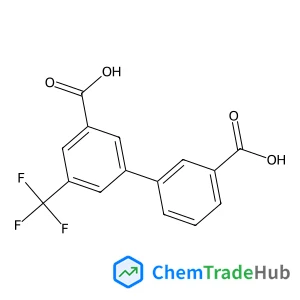
3-(3-Carboxyphenyl)-5-(trifluoromethyl)benzoic acid
CAS Number:
1261930-96-4
Molecular Formula:
C15H9F3O4

Recommended Suppliers





Disclaimer
This page provides academic journal information for reference and research purposes only. We are not affiliated with any journal publishers and do not handle publication submissions. For publication-related inquiries, please contact the respective journal publishers directly.
If you notice any inaccuracies in the information displayed, please contact us at support@chemtradehub.com. We will promptly review and address your concerns.