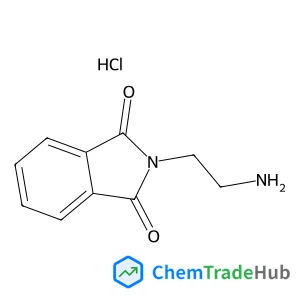
2-(2-Aminoethyl)-1H-isoindole-1,3(2H)-dione hydrochloride (1:1)
CAS Number:
30250-67-0
Molecular Formula:
C10H11ClN2O2
Lorenz Obrecht, Paul C. J. Kamer, Wouter Laan
The biphasic hydroformylation of linear alkenes using the Rh–TPPTS catalyst system is one of the cornerstones of aqueous biphasic catalysis, but due to mass-transfer limitations its application is restricted to short alkenes. This perspective provides an overview of various alternative approaches which have been developed to extend the aqueous biphasic methodology to the hydroformylation of higher alkenes.

Russian Journal of Bioorganic Chemistry

Current Opinion in Solid State & Materials Science

Russian Journal of General Chemistry

Nature Medicine

Drug Discovery Today

Journal of Peptide Science

Russian Journal of Organic Chemistry

Saudi Pharmaceutical Journal

Journal of Saudi Chemical Society

Russian Journal of Applied Chemistry
James C. Errey, Balaram Mukhopadhyay, K. P. Ravindranathan Kartha, Robert A. Field
DOI: 10.1039/B410184G
Varinder K. Aggarwal, Mike Butters, Paul W. Davies
DOI: 10.1039/B300719G
Richard T. Baker, Leila Naji, Karen Lochhead, John A. Chudek
DOI: 10.1039/B301039B
Rupa Hiremath, Stephen W. Varney, Jennifer A. Swift
DOI: 10.1039/B411649F
Ping Yin, Song Gao, Li-Min Zheng, Zheming Wang, Xin-Quan Xin
DOI: 10.1039/B212674E
Mizuki Tada, Toshiaki Taniike, Lakshmi M. Kantam, Yasuhiro Iwasawa
DOI: 10.1039/B410307F
Yu Wang, William B. Euler, Brett L. Lucht
DOI: 10.1039/B312537H
Xian-Zheng Zhang, Chih-Chang Chu
DOI: 10.1039/B301423A
Martin Oestreich, Fernando Sempere-Culler
DOI: 10.1039/B315758J
(1R,3S)-1,3-Cyclopentanediol finds applications in various industries. In the ph...
When handling N'-[4-(Dimethylamino)phenyl]-N,N-dimethyl-1,4-benzenediamine, it i...
There are several alternatives to 5-(2,4-Difluorophenyl)-2-methoxypyrimidine in ...
1-(3-Methoxyphenoxy)propan-2-ol (CAS: 382141-68-6) must comply with the Globally...
Tetrodotoxin Citrate is extremely dangerous and should be handled with extreme c...
2-Methyl-2-propanyl [(1R,3S)-3-hydroxycyclopentyl]carbamate (CAS: 225641-84-9) i...
Waste containing 4-(2-Hydroxyhexafluoroisopropyl)Benzoic Acid (CAS: 16261-80-6) ...
2-Methyl-2-proanyl {(2S)-1-[(benzyloxy)amino]-3-hydroxy-3-methyl-1-oxo-2-butanyl...
Benzeneethanamine, α-ethyl-, hydrochloride (1:1) is an organic compound with the...
In the synthesis of compounds similar to 3-{(E)-[4-(Dimethylamino)phenyl]diazeny...

Catalysis Science & Technology is committed to publishing research reporting high-quality, cutting-edge developments across the catalysis community at large. The journal places equal focus on publications from the heterogeneous, homogeneous, thermo-, electro-, photo-, organo- and biocatalysis communities. Works published in the journal feature a balanced mix of fundamental, technology-oriented, experimental, computational, digital and data-driven original research, thus appealing to catalysis practitioners in both academic and industrial environments. Original research articles published in the journal must demonstrate new catalytic discoveries and/or methodological advances that represent a significant advance on previously published work, from the molecular to the process scales. We welcome rigorous research in a wide range of timely or emerging applications related to the environment, health, energy and materials. Catalysis Science & Technology publishes Communications, Articles, Reviews and Perspectives. More details regarding manuscript types may be found in the Information for Authors section.