












The structural and bonding evolution in cysteine–gold cluster complexes
Literature Information
Publication Date
2012-11-28
DOI
10.1039/C2CP42830J
Impact Factor
3.676
Authors
Feng Zhou, Huchen Zhou, Haibin Su
View Original
Abstract
The bonding characteristics in cysteine–gold cluster complexes represented by thiolate (Aun·CysS (n = 1, 3, 5, 7)) and thiol (Aun·CysSH (n = 2, 4, 6, 8)) is investigated by density functional theory with 6-31G(d,p) and Lanl2DZ hybrid basis sets. The complexes exhibit very different bonding characteristic between these two forms. In the Aun·CysS complexes, the charge transfers from gold clusters to sulfur atoms. The number of S–Au bonds in the Aun·CysS complexes evolves from one to two when n is greater than three. For n equals three, i.e. Au3·CysS, its ground state only has one S–Au bond. While the only S–Au bond in Au1·CysS is mainly covalent, the nature of the S–Au bond in other thiolates is featured with the combination of covalent and donor–acceptor interactions. In particular, one stable isomer of Au3·CysS with two S–Au bonds, which is 2 kcal mol−1 higher in energy than the corresponding ground state, consists of one covalent and one donor–acceptor S–Au bond explicitly. Moreover, the localized three center two electron bonds are formed within the Au clusters, which facilitates the formation of the two S–Au bonds in Au5·CysS and Au7·CysS complexes. In the Aun·CysSH complexes, the donor–acceptor interaction prevails in the Au–SH bond by transferring lone pair electrons from the sulfur atom to the adjacent gold atom. Interestingly, the orbital with much more 6s-component in Au4·CysSH enhances the donor–acceptor bonding character, thus yields the strongest bonding among all the Aun·CysSH complexes studied in this paper. In general, the bonding strength between gold clusters and cysteine is positively correlated with the S–Au overlap-weighted bond order, but negatively correlated with the S–Au bond length. Lastly, the covalent and donor–acceptor S–Au bond strength is computed to be 48 and 18 kcal mol−1, respectively.
Related Literature
Push–pull (thio)barbituric acid derivatives in dye photosensitized radical and cationic polymerization reactions under 457/473 nm laser beams or blue LEDs
Mohamad-Ali Tehfe, Frédéric Dumur, Bernadette Graff, Fabrice Morlet-Savary, Didier Gigmes, Jean-Pierre Fouassier, Jacques Lalevée
2013-05-07
Paper
DOI: 10.1039/C3PY00372H
Helix oscillation of polyacetylene esters detected by dynamic 1H NMR, IR, and UV-vis methods in solution
Yoshiaki Yoshida, Yasuteru Mawatari, Asahi Motoshige, Ranko Motodshige, Toshifumi Hiraoki, Masayoshi Tabata
2013-03-18
Paper
DOI: 10.1039/C3PY00295K
Nitrogen-rich diaminotriazine-based porous organic polymers for small gas storage and selective uptake
Wei-Chao Song, Xiao-Kang Xu, Qiang Chen, Zhan-Zhong Zhuang, Xian-He Bu
2013-06-13
Paper
DOI: 10.1039/C3PY00590A
Tunable thermo-, pH- and light-responsive copolymer micelles
Wen Guo, Hui Zou
2013-05-14
Communication
DOI: 10.1039/C3PY00478C
Post-polymerization modification of reactive polymers derived from vinylcyclopropane: 1. synthesis and thermo-responsive behaviour
Denis H. Seuyep N., Gerrit A. Luinstra, Patrick Theato
2013-02-18
Paper
DOI: 10.1039/C3PY00109A
Polymerization of protecting-group-free peptidesvia ROMP
Jacquelin K. Kammeyer, Angela P. Blum, Lisa Adamiak, Nathan C. Gianneschi
2013-05-28
Communication
DOI: 10.1039/C3PY00526G
Ruthenium catalyzed equilibrium ring-opening metathesis polymerization of cyclopentene
Robert Tuba
2013-05-30
Paper
DOI: 10.1039/C3PY00584D
PEGylation of fluoridated hydroxyapatite (FAp):Ln3+nanorods for cell imaging
Xiaoyong Zhang, Junfeng Hui, Bin Yang, Yong Yang, Daidi Fan, Meiying Liu, Lei Tao, Yen Wei
2013-05-07
Paper
DOI: 10.1039/C3PY00489A
Atom transfer radical polymerization of hydrophilic monomers and its applications
Weiwei He, Hongjuan Jiang, Lifen Zhang, Zhenping Cheng, Xiulin Zhu
2013-01-30
Review Article
DOI: 10.1039/C3PY00122A
You might also like
Compound Q&A
Is 6-(3-Fluorophenyl)picolinic acid (CAS: 887982-40-3) safe?
6-(3-Fluorophenyl)picolinic acid is generally considered safe for laboratory use...
887982-40-36-(3-Fluorophenyl)pi...
Compound Q&A
What industries use (3R)-3-Pyrrolidinol (CAS: 2799-21-5)?
(3R)-3-Pyrrolidinol is used in the pharmaceutical industry as a precursor for dr...
2799-21-5(3R)-3-Pyrrolidinol
Compound Q&A
What precautions should be taken when handling (4R,5R)-4,5-Diethoxycarbonyl-2,2-dimethyldioxolane (CAS: 59779-75-8)?
When handling (4R,5R)-4,5-Diethoxycarbonyl-2,2-dimethyldioxolane (CAS: 59779-75-...
59779-75-8(4R,5R)-4,5-Diethoxy...
Compound Q&A
How is 1-(6-Chloroimidazo[1,2-b]pyridazin-3-yl)ethanone (CAS: 90734-71-7) typically synthesized?
1-(6-Chloroimidazo[1,2-b]pyridazin-3-yl)ethanone is often synthesized via a mult...
90734-71-71-(6-Chloroimidazo[1...
Compound Q&A
What is the market or research trend for N-Ethyl-3,4-dimethylbenzylamine (CAS: 39180-83-1)?
The market for N-Ethyl-3,4-dimethylbenzylamine (CAS: 39180-83-1) remains steady,...
39180-83-1N-Ethyl-3,4-dimethyl...
Compound Q&A
What is Tert-butyl 3-(pyrrolidin-1-yl)azetidine-1-carboxylate (CAS: 1019008-21-9)?
Tert-butyl 3-(pyrrolidin-1-yl)azetidine-1-carboxylate is a chemical compound wit...
1019008-21-9Tert-butyl 3-(pyrrol...
Compound Q&A
What regulatory guidelines apply to 1-Bromo-3-chloro-2,4-dimethoxybenzene (CAS: 1228956-93-1)?
1-Bromo-3-chloro-2,4-dimethoxybenzene (CAS: 1228956-93-1) falls under the classi...
1228956-93-11-Bromo-3-chloro-2,4...
Compound Q&A
Is 8-Bromo-2-methyl-3,4-dihydroisoquinolin-1(2H)-one (CAS: 1368622-07-4) safe?
The safety of 8-Bromo-2-methyl-3,4-dihydroisoquinolin-1(2H)-one (CAS: 1368622-07...
1368622-07-48-Bromo-2-methyl-3,4...
Compound Q&A
Is Benzyl [(3S)-2,6-dioxo-3-piperidinyl]carbamate (CAS: 22785-43-9) safe?
Benzyl [(3S)-2,6-dioxo-3-piperidinyl]carbamate is generally safe when handled wi...
22785-43-9Benzyl [(3S)-2,6-dio...
Compound Q&A
How should 1-{[4-(4,4,5,5-Tetramethyl-1,3,2-dioxaborolan-2-yl)phenyl]sulfonyl}pyrrolidine (CAS: 928657-21-0) be stored?
1-{[4-(4,4,5,5-Tetramethyl-1,3,2-dioxaborolan-2-yl)phenyl]sulfonyl}pyrrolidine s...
928657-21-01-{[4-(4,4,5,5-Tetra...
Source Journal
Physical Chemistry Chemical Physics

CiteScore:
5.5
Self-citation Rate:
10.3%
Articles per Year:
3036
Physical Chemistry Chemical Physics (PCCP) is an international journal co-owned by 19 physical chemistry and physics societies from around the world. This journal publishes original, cutting-edge research in physical chemistry, chemical physics and biophysical chemistry. To be suitable for publication in PCCP, articles must include significant innovation and/or insight into physical chemistry; this is the most important criterion that reviewers and Editors will judge against when evaluating submissions. The journal has a broad scope and welcomes contributions spanning experiment, theory, computation and data science. Topical coverage includes spectroscopy, dynamics, kinetics, statistical mechanics, thermodynamics, electrochemistry, catalysis, surface science, quantum mechanics, quantum computing and machine learning. Interdisciplinary research areas such as polymers and soft matter, materials, nanoscience, energy, surfaces/interfaces, and biophysical chemistry are welcomed if they demonstrate significant innovation and/or insight into physical chemistry. Joined experimental/theoretical studies are particularly appreciated when complementary and based on up-to-date approaches.
Recommended Compounds
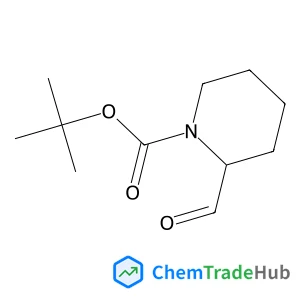
2-Methyl-2-propanyl (2R)-2-formyl-1-piperidinecarboxylate
CAS Number:
134526-69-5
Molecular Formula:
C11H19NO3
Recommended Suppliers





Disclaimer
This page provides academic journal information for reference and research purposes only. We are not affiliated with any journal publishers and do not handle publication submissions. For publication-related inquiries, please contact the respective journal publishers directly.
If you notice any inaccuracies in the information displayed, please contact us at support@chemtradehub.com. We will promptly review and address your concerns.