












Spectroscopic assessment of the role of hydrogen in surface defects, in the electronic structure and transport properties of TiO2, ZnO and SnO2 nanoparticles
Literature Information
Publication Date
2012-10-05
DOI
10.1039/C2CP42601C
Impact Factor
3.676
Authors
Artur Braun, Jong Bae Park, Mieczyslaw Rekas
View Original
Abstract
The interaction of metal oxides with gases is very important for the operation of energy devices such as fuel cells and gas sensors, and also relevant for materials synthesis and processing. The electronic transport properties of metal oxides for the aforementioned devices strongly depend on the chemistry of these gases and on the presence or absence of defects on the surface and in the bulk. The Debye screening length is in this respect a material specific property which becomes particularly significant when the material is comprised of nanoparticles. In the present study, poly-crystalline TiO2, ZnO and SnO2 nanoparticles were synthesized by a high temperature flame spray combustion process and investigated for their interaction with hydrogen. The chemistry of the reduced and oxidized surfaces of these metal oxides, where the interaction with gases takes place, was investigated in detail with X-ray photoelectron spectroscopy (XPS). The transitions found near EF with XPS are consistent with those found by diffuse reflectance spectroscopy (DRS) and were assigned to surface states originating from non-equilibrium oxygen vacancies. We show how the non-stoichiometric character of the metal oxide surface constitutes electronic surface defects, in particular oxygen vacancies which allow for additional transitions near the Fermi energy (EF). The concentration of these surface defects can be strongly reduced by thermal after-treatment under air or increased by Ar+-sputtering, after which significant spectral features appear near EF. Such prominent changes are particularly observed for TiO2 and SnO2, whereas the stoichiometry of the ZnO surface seems to be less responsive to such reducing and oxidizing conditions. Pronounced changes of the electrical conductivity upon changing from reducing to oxidizing conditions at elevated temperatures were monitored by electrochemical impedance spectroscopy (EIS). The lowering of the potential barrier for the charge transport particularly at lower temperatures already at reducing conditions is confirmed. The impedance response indicates that charge transfer is governed predominantly by one single process, i.e. by interaction of surface-like states localized within depletion layer with gas molecules. This implies that the free charge carriers in the material are determined by the intrinsic property like non-stoichiometry. Gas sensors made from such FSS nanoparticulate metal oxides showed well developed sensing characteristics of the hydrogen sensing at moderate temperatures.
Related Literature
Electrodeposition at polarisable liquid|liquid interfaces: The role of interfacial tension on nucleation kinetics
Christoffer Johans, Peter Liljeroth, Kyösti Kontturi
2002-02-13
Paper
DOI: 10.1039/B110182J
Molecular dynamics simulations of the dielectric relaxation behavior of polymers and their solutions at high temperatures
E. Saiz, E. Riande
2002-01-15
Paper
DOI: 10.1039/B106480K
Solvation dynamics of Coumarin 490 in methanol and acetonitrile reverse micelles
Partha Hazra, Nilmoni Sarkar
Paper
DOI: 10.1039/B109447E
Symmetry and distortive π-electrons in two- and three-dimensional conjugated systems
A. Rassat
2002-02-22
Paper
DOI: 10.1039/B109712C
A molecular level study of complex formation between putidaredoxin and cytochrome P450 by scanning tunnelling microscopy
R. Mukhopadhyay, L. L. Wong, K. K. Lo, T. Pochapsky, H. A. O. Hill
2002-01-17
Paper
DOI: 10.1039/B108107A
Elementary reactions of the antioxidant action of trans-stilbene derivatives: resveratrol, pinosylvin and 4-hydroxystilbene
Sandra Stojanović, Ortwin Brede
2002-01-29
Paper
DOI: 10.1039/B109063C
Conductometric and electrooptic relaxation spectrometry of lipid vesicle electroporation at high fields
T. Griese, S. Kakorin, E. Neumann
2002-02-20
Paper
DOI: 10.1039/B108193B
Mechanism of the magnetic field dependence for the liquid phase photoreaction in the nanotube of MCM-41
Masaharu Okazaki, Kazumi Toriyama, Kiichi Oda, Toshio Kasai
2002-02-22
Paper
DOI: 10.1039/B110851D
You might also like
Compound Q&A
What regulatory guidelines apply to 6-Bromo-2-methylimidazo[1,2-a]pyrimidine (CAS: 1111638-05-1)?
6-Bromo-2-methylimidazo[1,2-a]pyrimidine (CAS: 1111638-05-1) falls under various...
1111638-05-16-Bromo-2-methylimid...
Compound Q&A
Are there alternatives to 1-Pyrrolidineethanol, β-methyl-α-phenyl-, (αS,βR) (CAS: 123620-80-4) in synthesis?
While there are no direct alternatives, similar compounds like 1-Pyrrolidineetha...
123620-80-41-Pyrrolidineethanol...
Compound Q&A
Is 4-Methyl-2,6-bis(2-methyl-2-propanyl)phenyl methylcarbamate (CAS: 1918-11-2) safe?
4-Methyl-2,6-bis(2-methyl-2-propanyl)phenyl methylcarbamate (CAS: 1918-11-2) is ...
1918-11-24-Methyl-2,6-bis(2-m...
Compound Q&A
How should 2-(3-Bromo-4-fluorophenyl)-1,3-dioxolane (CAS: 77771-04-1) be stored?
2-(3-Bromo-4-fluorophenyl)-1,3-dioxolane (CAS: 77771-04-1) should be stored in a...
77771-04-12-(3-Bromo-4-fluorop...
Compound Q&A
What are the physical and chemical properties of 4,5,6,7-Tetrahydro-1H-indazole hydrochloride (CAS: 18161-11-0)?
4,5,6,7-Tetrahydro-1H-indazole hydrochloride is a white crystalline solid with a...
18161-11-04,5,6,7-Tetrahydro-1...
Compound Q&A
What is (2R)-1-Methoxy-3-phenyl-2-propanamine (CAS: 59919-07-2)?
(2R)-1-Methoxy-3-phenyl-2-propanamine is a chiral organic compound with the CAS ...
59919-07-2(2R)-1-Methoxy-3-phe...
Compound Q&A
What industries use Ethyl 1-(1-phenylethyl)-1H-imidazole-5-carboxylate (CAS: 56649-47-9)?
Ethyl 1-(1-phenylethyl)-1H-imidazole-5-carboxylate is used in various industries...
56649-47-9Ethyl 1-(1-phenyleth...
Compound Q&A
What regulatory guidelines apply to 4-[(1E,3S)-1-(4-Hydroxyphenyl)-1,4-pentadien-3-yl]phenol (CAS: 17676-24-3)?
4-[(1E,3S)-1-(4-Hydroxyphenyl)-1,4-pentadien-3-yl]phenol (CAS: 17676-24-3) falls...
17676-24-34-[(1E,3S)-1-(4-Hydr...
Compound Q&A
What industries use (S)-3-Amino-5-phenylpentanoic acid hydrochloride (CAS: 331846-97-0)?
(S)-3-Amino-5-phenylpentanoic acid hydrochloride is primarily used in the pharma...
331846-97-0(S)-3-Amino-5-phenyl...
Compound Q&A
How is 7-methoxy-1-benzothiophene-2-carboxylic acid (CAS: 88791-07-5) typically synthesized?
7-Methoxy-1-benzothiophene-2-carboxylic acid is typically synthesized by reactin...
88791-07-57-methoxy-1-benzothi...
Source Journal
Physical Chemistry Chemical Physics

CiteScore:
5.5
Self-citation Rate:
10.3%
Articles per Year:
3036
Physical Chemistry Chemical Physics (PCCP) is an international journal co-owned by 19 physical chemistry and physics societies from around the world. This journal publishes original, cutting-edge research in physical chemistry, chemical physics and biophysical chemistry. To be suitable for publication in PCCP, articles must include significant innovation and/or insight into physical chemistry; this is the most important criterion that reviewers and Editors will judge against when evaluating submissions. The journal has a broad scope and welcomes contributions spanning experiment, theory, computation and data science. Topical coverage includes spectroscopy, dynamics, kinetics, statistical mechanics, thermodynamics, electrochemistry, catalysis, surface science, quantum mechanics, quantum computing and machine learning. Interdisciplinary research areas such as polymers and soft matter, materials, nanoscience, energy, surfaces/interfaces, and biophysical chemistry are welcomed if they demonstrate significant innovation and/or insight into physical chemistry. Joined experimental/theoretical studies are particularly appreciated when complementary and based on up-to-date approaches.
Recommended Compounds
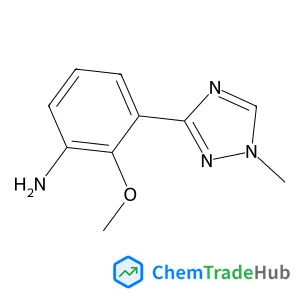
2-Methoxy-3-(1-methyl-1H-1,2,4-triazol-3-yl)aniline
CAS Number:
1609394-10-6
Molecular Formula:
C10H12N4O

Recommended Suppliers




Disclaimer
This page provides academic journal information for reference and research purposes only. We are not affiliated with any journal publishers and do not handle publication submissions. For publication-related inquiries, please contact the respective journal publishers directly.
If you notice any inaccuracies in the information displayed, please contact us at support@chemtradehub.com. We will promptly review and address your concerns.