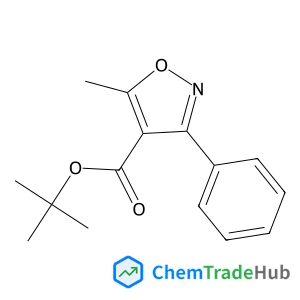
2-Methyl-2-propanyl 5-methyl-3-phenyl-1,2-oxazole-4-carboxylate
CAS Number:
211429-79-7
Molecular Formula:
C15H17NO3
Birger Bohn
The reversible gas-phase addition of OH radicals to the trimethylbenzenes was investigated in pulsed experiments utilizing VUV flash-photolysis resonance-fluorescence of H2O in the temperature range of 275–340 K. Triexponential OH decays were observed in the presence of the trimethylbenzenes, indicating the participation of more than one adduct species. Analytical solutions for the system of differential equations with two adduct isomers were derived, and the OH decay curves were evaluated based on this reaction model. This led to significant improvements of fit qualities and notable changes in OH rate constants compared to a previous model with a single adduct species. The detailed analysis was confined to 1,3,5-trimethylbenzene where reversible formation of two OH-aromatic ortho- and ipso-adduct isomers is feasible in accordance with the extended reaction model. Only after inclusion of additional isomerization reactions, consistent thermochemical data were obtained from the fitted rate constants. Reaction enthalpies of −83 ± 7 kJ mol−1 and −35 ± 22 kJ mol−1 were derived for the formation of one adduct isomer and the isomerization into the other, respectively. Based on literature data, the more and less stable adducts were assigned to ipso- and ortho-adduct isomers, respectively. The potential isomerization precluded the determination of primary yields of adduct isomers but formation of the ipso-adduct in any case is a minor process. For the rate constants of the OH + 1,3,5-trimethylbenzene reaction an Arrhenius expression kOH = 1.32 × 10⁻¹¹ cm3 s−1 exp(450 ± 50 K/T) was obtained. Based on the same approach, the rate constants of the OH reactions with 1,2,3-trimethylbenzene and 1,2,4-trimethylbenzene were derived as kOH = 3.61 × 10⁻¹² cm3 s−1 exp(620 ± 80 K/T) and kOH = 2.73 × 10⁻¹² cm3 s−1 exp(730 ± 70 K/T), respectively.
Sherdil Khan, Maximiliano J. M. Zapata, Marcelo B. Pereira, Renato V. Gonçalves, Lukas Strizik, Jairton Dupont, Marcos J. L. Santos, Sérgio R. Teixeira
DOI: 10.1039/C5CP03645C
Jeffrey J. Black, Thomas Murphy, Rob Atkin, Andrew Dolan, Leigh Aldous
DOI: 10.1039/C6CP02255C
Juan Eiros Zamora, Maria Papadaki, Andrew E. Messer, Steven B. Marston, Ian R. Gould
DOI: 10.1039/C6CP02610A
M. Mihaylov, S. Andonova, K. Chakarova, A. Vimont, E. Ivanova, N. Drenchev, K. Hadjiivanov
DOI: 10.1039/C5CP04139B
Inmaculada García Cuesta, Barnaby Pownall, Stefano Pelloni, Alfredo M. Sánchez de Merás
DOI: 10.1039/C5CP03732H
Hui Yu, Jose A. Sanchez-Rodriguez, Marvin Pollum, Carlos E. Crespo-Hernández, Sebastian Mai, Philipp Marquetand, Leticia González, Susanne Ullrich
DOI: 10.1039/C6CP01790H
Niels Boon, René van Roij
DOI: 10.1039/C5CP02945G
Saurabh Chauhan, David F. Watson
DOI: 10.1039/C6CP03813A
Guoguang Wu, Weitao Zheng, Fubin Gao, Hang Yang, Yang Zhao, Jingzhi Yin, Wei Zheng, Wancheng Li, Baolin Zhang, Guotong Du
DOI: 10.1039/C6CP03199D
Ki Chul Kim
DOI: 10.1039/C6CP02692C
When handling 4-Methyl-6-(trifluoromethyl)quinoline (CAS: 40716-16-3), safety go...
4-(3,5-Difluorophenyl)aniline is an aromatic organic compound with the CAS numbe...
5-{[4-(Trifluoromethyl)phenyl]sulfanyl}-1,2,3-thiadiazole-4-carboxylic acid can ...
The market for 4-Benzylaniline hydrochloride (CAS: 6317-57-3) is steadily growin...
[3-(Diethylsulfamoyl)phenyl]boronic acid is generally considered safe when handl...
3-Bromo-2,5-dimethoxyaniline is mainly used in the pharmaceutical and chemical i...
N-Methyl-1-(5-methyl-1H-indol-3-yl)methanamine (CAS: 915922-67-7) is subject to ...
This compound is primarily used in the pharmaceutical industry for the synthesis...
2-Methyl-2-propanyl [(1S,3R)-3-aminocyclohexyl]carbamate (CAS: 1298101-47-9) sho...
Ethyl 2-bromo-4,4,4-trifluorobutanoate (CAS: 367-33-9) is utilized in the pharma...

Physical Chemistry Chemical Physics (PCCP) is an international journal co-owned by 19 physical chemistry and physics societies from around the world. This journal publishes original, cutting-edge research in physical chemistry, chemical physics and biophysical chemistry. To be suitable for publication in PCCP, articles must include significant innovation and/or insight into physical chemistry; this is the most important criterion that reviewers and Editors will judge against when evaluating submissions. The journal has a broad scope and welcomes contributions spanning experiment, theory, computation and data science. Topical coverage includes spectroscopy, dynamics, kinetics, statistical mechanics, thermodynamics, electrochemistry, catalysis, surface science, quantum mechanics, quantum computing and machine learning. Interdisciplinary research areas such as polymers and soft matter, materials, nanoscience, energy, surfaces/interfaces, and biophysical chemistry are welcomed if they demonstrate significant innovation and/or insight into physical chemistry. Joined experimental/theoretical studies are particularly appreciated when complementary and based on up-to-date approaches.
![[3-(2,6-Dichlorophenyl)-5-isopropyl-1,2-oxazol-4-yl]methanol structure](https://static.chemtradehub.com/structs/278/278597-30-1-5c79.webp "[3-(2,6-Dichlorophenyl)-5-isopropyl-1,2-oxazol-4-yl]methanol structure")