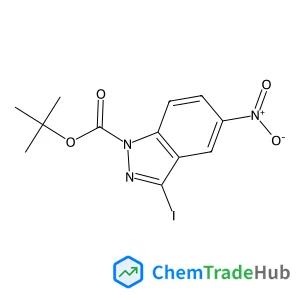
Tert-butyl 3-iodo-5-nitro-1H-indazole-1-carboxylate
CAS Number:
459133-69-8
Molecular Formula:
C12H12IN3O4
Panwang Zhou, Jianyong Liu, Songqiu Yang, Junsheng Chen, Keli Han, Guozhong He
The ground and excited state geometries, the excitation and emission energies for a series of fluorescein derivatives in aqueous solutions have been investigated using time-dependent density functional theory (TD-DFT) with B3LYP and a long-range corrected CAM-B3LYP functional. The RI-CC2 method was employed to confirm the CAM-B3LYP results. As far as we know, the excited state geometries for a series of fluorescein derivatives were optimized for the first time, and the conformational changes upon photoexcitation were discussed. Importantly, the previous proposed photo induced electron transfer (PeT) mechanism for dictating the fluorescence quantum yield (Φfl) of fluorescein derivatives was not fully supported by our calculations. Internal conversion may still be the most likely mechanism for dictating the Φfl of fluorescein derivatives, which indicates a need for further experimental and theoretical studies on the excited state dynamics of fluorescein derivatives.
Yafei Jiang, Hongwei Tan, Jimin Zheng, Xichen Li, Guangju Chen, Zongchao Jia
DOI: 10.1039/C5CP03342J
Pradyumna Mulpur, Sairam Yadavilli, Praharsha Mulpur, Neeharika Kondiparthi, Venkataramaniah Kamisetti
DOI: 10.1039/C5CP04268B
L. Vereecken, W. J. Bloss
DOI: 10.1039/C5CP03862F
Ki Chul Kim
DOI: 10.1039/C6CP02692C
Mouni Roy, Milan Kanti Naskar
DOI: 10.1039/C6CP02442D
Lucia Amidani, Pieter Glatzel, Paola Luches
DOI: 10.1039/C6CP04407G
Demian Marchione, Martin R. S. McCoustra
DOI: 10.1039/C6CP01787H
Lars Borchardt, Winfried Nickel, Mirian Casco, Irena Senkovska, Volodymyr Bon, Dirk Wallacher, Nico Grimm, Simon Krause, Joaquín Silvestre-Albero
DOI: 10.1039/C6CP03993F
Christoph Kerzig, Martin Goez
DOI: 10.1039/C6CP03742A
Marnik Bercx, Nasrin Sarmadian, Rolando Saniz, Bart Partoens, Dirk Lamoen
DOI: 10.1039/C6CP03468C
When handling 4-Methyl-6-(trifluoromethyl)quinoline (CAS: 40716-16-3), safety go...
4-(3,5-Difluorophenyl)aniline is an aromatic organic compound with the CAS numbe...
5-{[4-(Trifluoromethyl)phenyl]sulfanyl}-1,2,3-thiadiazole-4-carboxylic acid can ...
The market for 4-Benzylaniline hydrochloride (CAS: 6317-57-3) is steadily growin...
[3-(Diethylsulfamoyl)phenyl]boronic acid is generally considered safe when handl...
3-Bromo-2,5-dimethoxyaniline is mainly used in the pharmaceutical and chemical i...
N-Methyl-1-(5-methyl-1H-indol-3-yl)methanamine (CAS: 915922-67-7) is subject to ...
This compound is primarily used in the pharmaceutical industry for the synthesis...
2-Methyl-2-propanyl [(1S,3R)-3-aminocyclohexyl]carbamate (CAS: 1298101-47-9) sho...
Ethyl 2-bromo-4,4,4-trifluorobutanoate (CAS: 367-33-9) is utilized in the pharma...

Physical Chemistry Chemical Physics (PCCP) is an international journal co-owned by 19 physical chemistry and physics societies from around the world. This journal publishes original, cutting-edge research in physical chemistry, chemical physics and biophysical chemistry. To be suitable for publication in PCCP, articles must include significant innovation and/or insight into physical chemistry; this is the most important criterion that reviewers and Editors will judge against when evaluating submissions. The journal has a broad scope and welcomes contributions spanning experiment, theory, computation and data science. Topical coverage includes spectroscopy, dynamics, kinetics, statistical mechanics, thermodynamics, electrochemistry, catalysis, surface science, quantum mechanics, quantum computing and machine learning. Interdisciplinary research areas such as polymers and soft matter, materials, nanoscience, energy, surfaces/interfaces, and biophysical chemistry are welcomed if they demonstrate significant innovation and/or insight into physical chemistry. Joined experimental/theoretical studies are particularly appreciated when complementary and based on up-to-date approaches.