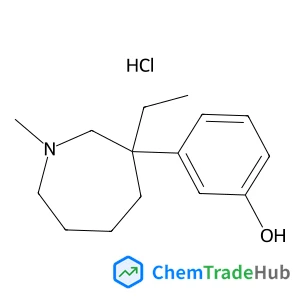
3-(3-Ethyl-1-methyl-3-azepanyl)phenol hydrochloride (1:1)
CAS Number:
59263-76-2
Molecular Formula:
C15H24ClNO
Andreas M. Wenge, Andreas Schmaunz, Uwe Kensy, Bernhard Dick
Excitation of tert-butylnitrite into the first and second UV absorption bands leads to efficient dissociation into the fragment radicals NO and tert-butoxy in their electronic ground states 2Π and 2E, respectively. Velocity distributions and angular anisotropies for the NO fragment in several hundred rotational and vibrational quantum states were obtained by velocity-map imaging and the recently developed 3D-REMPI method. Excitation into the well resolved vibronic progression bands (k = 0, 1, 2) of the NO stretch mode in the S1 ← S0 transition produces NO fragments mostly in the vibrational state with v = k, with smaller fractions in v = k − 1 and v = k − 2. It is concluded that dissociation occurs on the purely repulsive PES of S1 without barrier. All velocity distributions from photolysis via the S1(nπ*) state are monomodal and show high negative anisotropy (β ≈ −1). The rotational distributions peak near j = 30.5 irrespective of the vibronic state S1(k) excited and the vibrational state v of the NO fragment. On average 46% of the excess energy is converted to kinetic energy, 23% and 31% remain as internal energy in the NO fragment and the t-BuO radical, respectively. Photolysis via excitation into the S2 ← S0 transition at 227 nm yields NO fragments with about equal populations in v = 0 and v = 1. The rotational distributions have a single maximum near j = 59.5. The velocity distributions are monomodal with positive anisotropy β ≈ 0.8. The average fractions of the excess energy distributed into translation, internal energy of NO, and internal energy of t-BuO are 39%, 23%, and 38%, respectively. In all cases ∼8500 cm−1 of energy remain in the internal degrees of freedom of the t-BuO fragment. This is mostly assigned to rotational energy. An ab initio calculation of the dynamic reaction path shows that not only the NO fragment but also the t-BuO fragment gain large angular momentum during dissociation on the purely repulsive potential energy surface of S2.
Guoxing Wu, Alaa Eldin A. Salem, Lei Su, Bing Shi Li
DOI: 10.1039/D2AN90082C
Fan Li, Juan Zhang, Xuni Cao, Lihua Wang, Di Li, Shiping Song, Bangce Ye, Chunhai Fan
DOI: 10.1039/B900900K
Andrea Dorsa, Qing Xie, Martin Wagner, Xiaoji G. Xu
DOI: 10.1039/D2AN01103D
André Luiz Coelho Conceição, Marcelo Antoniassi, Martin Eduardo Poletti
DOI: 10.1039/B821434D
Yuze Luo, Zefeng Wang, Junqin Li, Wenhua Yi, Ke Yang, Chunlei Ou, Le Deng, Dinggeng He
DOI: 10.1039/D2AN01441F
Devesh Barshilia, Akhil Chandrakanth Komaram, Pin-Chuan Chen
DOI: 10.1039/D2AN01092E
Lin Mei, Yanmei Shi, Yange Shi, Pengpeng Yan, Chunlei Lin, Yue Sun, Bingjie Wei, Jing Li
DOI: 10.1039/D2AN01432G
Jacek Klaudiusz Pijanka, Ying Yang, Paul Dumas, Sirinart Chio-Srichan, Michel Manfait, Ganesh Dhruvananda Sockalingum
DOI: 10.1039/B821112D
Ya-Ting Chen, Bin Li, Jia-Liang Chen, Xun-Cheng Su
DOI: 10.1039/D2AN01632J
When handling 4-(2-Furylmethyl)thiomorpholine 1,1-dioxide (CAS: 79206-94-3), it ...
When handling 4-Chloro-N-[2-(4-morpholinyl)ethyl]benzamide (CAS: 71320-77-9), it...
Waste containing this compound (CAS: 62921-74-8) should be handled according to ...
Waste containing (S)-Methyl 2-amino-3-cyclohexylpropanoate should be collected i...
This compound can be synthesized using a multi-step process involving the conjug...
There are several alternatives to (2E)-3-(3,4-Dichlorophenyl)acrylic acid in syn...
Ethyl 6-(2-nitrophenyl)imidazo[2,1-b][1,3]thiazole-3-carboxylate (CAS: 925437-84...
Waste containing 2-(1,3-Thiazol-2-yl)ethanamine (CAS: 18453-07-1) should be coll...
Methyl 5-iodo-2-methylbenzoate can be synthesized through the iodination of meth...
5-Chloro[1,2,4]triazolo[1,5-a]pyridine is commonly synthesized via the condensat...

Physical Chemistry Chemical Physics (PCCP) is an international journal co-owned by 19 physical chemistry and physics societies from around the world. This journal publishes original, cutting-edge research in physical chemistry, chemical physics and biophysical chemistry. To be suitable for publication in PCCP, articles must include significant innovation and/or insight into physical chemistry; this is the most important criterion that reviewers and Editors will judge against when evaluating submissions. The journal has a broad scope and welcomes contributions spanning experiment, theory, computation and data science. Topical coverage includes spectroscopy, dynamics, kinetics, statistical mechanics, thermodynamics, electrochemistry, catalysis, surface science, quantum mechanics, quantum computing and machine learning. Interdisciplinary research areas such as polymers and soft matter, materials, nanoscience, energy, surfaces/interfaces, and biophysical chemistry are welcomed if they demonstrate significant innovation and/or insight into physical chemistry. Joined experimental/theoretical studies are particularly appreciated when complementary and based on up-to-date approaches.