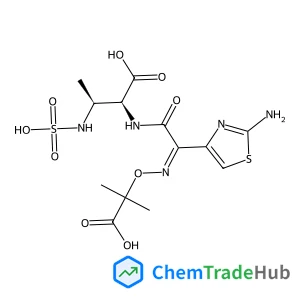
Aztreonam USP Related Compound A (Open-ring Aztreonam)
CAS Number:
87500-74-1
Molecular Formula:
C13H19N5O9S2
Jürgen Hafner, Sébastien Lebègue, János G. Ángyán
Periodic dispersion corrected DFT calculations have been performed to study the spin-crossover transition of Fe(phen)2(NCS)2 in the molecular and in the crystalline state. We show that London dispersion interactions play a crucial role in the cohesion of the crystals. Based on calculations of vibrational eigenstates of the isolated molecule and of the crystalline phase in both the low- and high-spin states, the transition entropies and enthalpies have been calculated. We demonstrate that, due to the stabilization of the low-spin state by intermolecular dispersion forces, the transition enthalpy at the transition temperature is larger for the crystalline phase in comparison with an isolated molecule. The effective coordination number of the nitrogen atoms of the ligands around the iron atom has been identified as the order parameter driving the quasi-reversible low-spin to high-spin transition in the crystal. Finally, using constrained geometry relaxations at fixed values of the coordination number, we computed the energy barrier of the LS to HS transition and found it to be in a reasonable agreement with the experimental value.
Raymond Wai-Yin Sun, Rong Chen, Nancy P.-Y. Chung, Chi-Ming Ho, Chen-Lung Steve Lin, Chi-Ming Che
DOI: 10.1039/B510984A
Wei Zhang, Kazuyoshi Yoshimura, Yan Ouyang, Zong-Hui Jiang, Shi-Ping Yan, Peng Cheng
DOI: 10.1039/B506465A
Dimitri M. Khramov, Christopher W. Bielawski
DOI: 10.1039/B508679E
Weijun Niu, Brett Rambo, Mark D. Smith, John J. Lavigne
DOI: 10.1039/B507475D
Kathleen M. McKenzie, Michael M. Meijler, Colin A. Lowery, Grant E. Boldt, Kim D. Janda
DOI: 10.1039/B509396A
Joshua R. Dunetz, Rocco P. Ciccolini, Morgan Fröling, Scott M. Paap, Andrew J. Allen, Jefferson W. Tester, Rick L. Danheiser
DOI: 10.1039/B508151C
Noriyoshi Matsumi, Ayano Mori, Kenji Sakamoto, Hiroyuki Ohno
DOI: 10.1039/B507805A
Hari M. R. Gardimalla, Deendayal Mandal, Philip D. Stevens, Max Yen, Yong Gao
DOI: 10.1039/B504128G
Masa-aki Morikawa, Nobuo Kimizuka
DOI: 10.1039/B507818K
6-(3-Fluorophenyl)picolinic acid is generally considered safe for laboratory use...
(3R)-3-Pyrrolidinol is used in the pharmaceutical industry as a precursor for dr...
When handling (4R,5R)-4,5-Diethoxycarbonyl-2,2-dimethyldioxolane (CAS: 59779-75-...
1-(6-Chloroimidazo[1,2-b]pyridazin-3-yl)ethanone is often synthesized via a mult...
The market for N-Ethyl-3,4-dimethylbenzylamine (CAS: 39180-83-1) remains steady,...
Tert-butyl 3-(pyrrolidin-1-yl)azetidine-1-carboxylate is a chemical compound wit...
1-Bromo-3-chloro-2,4-dimethoxybenzene (CAS: 1228956-93-1) falls under the classi...
The safety of 8-Bromo-2-methyl-3,4-dihydroisoquinolin-1(2H)-one (CAS: 1368622-07...
Benzyl [(3S)-2,6-dioxo-3-piperidinyl]carbamate is generally safe when handled wi...
1-{[4-(4,4,5,5-Tetramethyl-1,3,2-dioxaborolan-2-yl)phenyl]sulfonyl}pyrrolidine s...

Physical Chemistry Chemical Physics (PCCP) is an international journal co-owned by 19 physical chemistry and physics societies from around the world. This journal publishes original, cutting-edge research in physical chemistry, chemical physics and biophysical chemistry. To be suitable for publication in PCCP, articles must include significant innovation and/or insight into physical chemistry; this is the most important criterion that reviewers and Editors will judge against when evaluating submissions. The journal has a broad scope and welcomes contributions spanning experiment, theory, computation and data science. Topical coverage includes spectroscopy, dynamics, kinetics, statistical mechanics, thermodynamics, electrochemistry, catalysis, surface science, quantum mechanics, quantum computing and machine learning. Interdisciplinary research areas such as polymers and soft matter, materials, nanoscience, energy, surfaces/interfaces, and biophysical chemistry are welcomed if they demonstrate significant innovation and/or insight into physical chemistry. Joined experimental/theoretical studies are particularly appreciated when complementary and based on up-to-date approaches.