












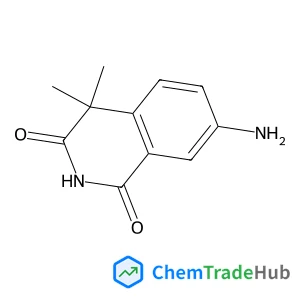
1,3(2H,4H)-Isoquinolinedione, 7-amino-4,4-dimethyl-
CAS Number:
14576-22-8
Molecular Formula:
C11H12N2O2
R. W. M. Davidson, G. W. Simpson, J. Chiefari, M. J. Fuchter
Reversible addition fragmentation chain transfer (RAFT) polymerisation provides a highly controlled means to assemble copolymers of different architectures for a variety of applications, including drug delivery. Polymers consisting of a butyl methacrylate-co-methacrylic acid p(BMA-co-MAA) hydrophobic block and a poly(ethylene glycol) methyl ether methacrylate p(PEGMA-475) hydrophilic block were synthesised via RAFT polymerisation and self-assembled into micelles. A range of micelle particles of different sizes were obtained by varying the composition of the block copolymers. The micelles were crosslinked to form nanoparticles and fluorescently labelled to study cellular internalisation. The prepared nanoparticles were extensively taken up by primary murine macrophages and a promising candidate was identified. To demonstrate effective delivery of a cell impenetrable cargo a fluorescent dye, 4′,6-diamidino-2-phenylindole (DAPI), was encapsulated inside the nanoparticles and successfully delivered to macrophages. The nanoparticles’ stability at increased temperatures and at low concentrations, the tunability of their synthesis and their extensive internalisation by macrophages and performance makes them highly promising delivery vehicles for a range of therapeutics and imaging agents.
Ruiqing Sun, Ping Liu, Yingjia Dong, Qingli Yang, Yongchao Ma
DOI: 10.1039/D3AY01850D
Fengjiao Hao, Yuanyuan Luo, Fengshou Dong, Xinglu Pan, Xiaohu Wu, Yongquan Zheng, Jun Xu
DOI: 10.1039/D3AY01473H
Mahdi Golsanamlou
DOI: 10.1039/D3AY00828B
Liuwei Gu, Yinghao Li, Xiaojie Kong, Ke Zhang, Yuling Qin, Xiaobo Zhou, Haiwei Ji, Guo Li, Li Wu
DOI: 10.1039/D3BM01576A
DOI: 10.1039/D3AY01817B
Faisal K. Algethami, Basant H. Koraim, Ehab A. Abdelrahman, Yasmeen G. Abou El-Reash, Mahmoud S. Rizk
DOI: 10.1039/D3AY01320K
4-Nitrophenyl phosphate disodium salt hexahydrate is primarily used as a substra...
2-(Trifluoromethyl)-1,3-oxazole-4-carboxylic Acid (CAS: 1060816-01-4) is widely ...
2-Fluoro-4-biphenylcarboxylic acid should be stored in a cool, dry place at room...
Prednisolone-21-Carboxylic Acid is primarily used in the pharmaceutical industry...
4-(Hydrazinomethyl)-1,2,3-benzenetriol (CAS: 3614-72-0) should be stored in a co...
4-Amino-1-methyl-1H-pyrazole-5-carboxylic acid hydrochloride (CAS: 92534-70-8) i...
Dehydropachymic acid (CAS: 77012-31-8) is regulated by various agencies. It fall...
The market and research trends for 6-[(2,2-Dimethylpropanoyl)amino]nicotinic aci...
1,10-Phenanthroline-2,9-dicarbaldehyde should be stored in a cool, dry place awa...
5-Carbamoyl-11-oxo-10,11-dihydro-5H-dibenzo[b,f]azepin-10-yl acetate can be synt...

Polymer Chemistry welcomes submissions in all areas of polymer science that have a strong focus on macromolecular chemistry. Manuscripts may cover a broad range of fields, yet no direct application focus is required.

![[(1S,2S,3R,4S,7R,9S,10S,12R,15S)-4,12-Diacetyloxy-15-[(2R,3S)-3-benzamido-3-phenyl-2-(2,2,2-trichloroethoxycarbonyloxy)propanoyl]oxy-1,9-dihydroxy-10,14,17,17-tetramethyl-11-oxo-6-oxatetracyclo[11.3.1.03,10.04,7]heptadec-13-en-2-yl] benzoate structure](https://static.chemtradehub.com/structs/100/100431-55-8-7104.webp "[(1S,2S,3R,4S,7R,9S,10S,12R,15S)-4,12-Diacetyloxy-15-[(2R,3S)-3-benzamido-3-phenyl-2-(2,2,2-trichloroethoxycarbonyloxy)propanoyl]oxy-1,9-dihydroxy-10,14,17,17-tetramethyl-11-oxo-6-oxatetracyclo[11.3.1.03,10.04,7]heptadec-13-en-2-yl] benzoate structure")
phosphoryl}methyl 4-methylbenzenesulfonate structure](https://static.chemtradehub.com/structs/864/864068-45-1-ba7c.webp "{[3-(Hexadecyloxy)propoxy](hydroxy)phosphoryl}methyl 4-methylbenzenesulfonate structure")



