












Polymer dynamics in responsive microgels: influence of cononsolvency and microgel architecture
Literature Information
Publication Date
2012-01-17
DOI
10.1039/C2CP23328B
Impact Factor
3.676
Authors
C. Scherzinger, O. Holderer, D. Richter, W. Richtering
View Original
Abstract
The dynamics of polymers on the nm and ns scales inside responsive microgels was probed by means of Neutron Spin Echo (NSE) experiments. Four different microgels were studied: poly(N-isopropylacrylamide) (PNIPAM) and poly(N,N-diethylacrylamide) (PDEAAM) microgels, a P(NIPAM-co-DEAAM) copolymer microgel and a core–shell microgel with a PDEAAM core and a PNIPAM shell. These four different microgel systems were investigated in a D2O/CD3OD solvent mixture with a molar CD3OD fraction of xMeOD = 0.2 at 10 °C. The PNIPAM and the P(NIPAM-co-DEAAM) microgels are in the collapsed state under these conditions. They behave as solid diffusing objects with only very small additional contributions from internal motions. The PDEAAM particle is swollen under these conditions and mainly Zimm segmental dynamics can be detected in the intermediate scattering function at high momentum transfer. A cross-over to a collective diffusive motion is found for smaller q-values. The shell of the PDEAAM-core–PNIPAM-shell particle is collapsed, which leads to a static contribution to S(q,t); the core, however, is swollen and Zimm segmental dynamics are observed. However, the contributions of the Zimm segmental dynamics to the scattering function are smaller as compared to the pure PDEAAM particle. Interestingly the values of the apparent solvent viscosities inside the microgels as obtained from the NSE experiments are higher than for the bulk solvent. In addition different values were obtained for the PDEAAM microgel, and the PDEAAM-core of the PDEAAM-core–PNIPAM-shell particle, respectively. We attribute the strongly increased viscosity in the PDEAAM particle to enhanced inhomogeneities, which are induced by the swelling of the particle. The different viscosity inside the PDEAAM-core of the PDEAAM-core–PNIPAM-shell microgel could be due to a confinement effect: the collapsed PNIPAM-shell restricts the swelling of the PDEAAM-core and may modify the hydrodynamic interactions in this restricted environment inside the microgel.
Related Literature
Assembly of a visible light photoreactor: an inexpensive tool for bottlebrush polymer synthesis via photoiniferter polymerization
Kyle J. Arrington, John B. Matson
2017-11-30
Communication
DOI: 10.1039/C7PY01741C
Thermoresponse and self-assembly of an ABC star quarterpolymer with O2 and redox dual-responsive Y junctions
Xiaoqi Zhao, Wentao Wu, Jian Zhang, Wenxue Dai, Youliang Zhao
2018-02-13
Paper
DOI: 10.1039/C8PY00085A
Synthesis of enzyme-responsive phosphoramidate dendrimers for cancer drug delivery
Zhen Zhang, Yongcun Zhou, Zhuxian Zhou, Ying Piao, Nagendra Kalva, Xiangrui Liu, Jianbin Tang, Youqing Shen
2017-12-18
Paper
DOI: 10.1039/C7PY01492A
Strategies to combine ROP with ATRP or RAFT polymerization for the synthesis of biodegradable polymeric nanoparticles for biomedical applications
Mattia Sponchioni, Nicolò Manfredini, Matteo Maraldi, Davide Moscatelli
2018-07-09
Review Article
DOI: 10.1039/C8PY00649K
Visible light-induced iniferter polymerization of methacrylates enhanced by continuous flow
Maarten Rubens, Phanumat Latsrisaeng
2017-08-16
Paper
DOI: 10.1039/C7PY01157A
Polyallene-based amphiphilic triblock copolymer via successive free radical polymerization and ATRP
Hao Guo, Xiaoyu Huang
2017-11-27
Paper
DOI: 10.1039/C7PY01407D
Temperature-responsive hydrogels via the electrostatic interaction of amphiphilic diblock copolymers with pendant-ion groups
Hye Yun Lee, Seung Hun Park, Jae Ho Kim, Moon Suk Kim
2017-10-17
Paper
DOI: 10.1039/C7PY01460K
Exploiting CH/π interactions in robust supramolecular adhesives
Taiki Yamate, Takayuki Fujiwara, Toru Yamaguchi, Hiroshi Suzuki, Motohiro Akazome
2018-07-20
Paper
DOI: 10.1039/C8PY00592C
You might also like
Compound Q&A
What are the main uses of (3.beta.)-3-Hydroxy-N,N-dimethyl-chol-5-en-24-amide (CAS: 79066-03-8)?
(3.beta.)-3-Hydroxy-N,N-dimethyl-chol-5-en-24-amide (CAS: 79066-03-8) is primari...
79066-03-8(3.beta.)-3-Hydroxy-...
Compound Q&A
What regulatory guidelines apply to 5-(aminomethyl)-2-methoxyphenol (CAS: 89702-89-6)?
5-(Aminomethyl)-2-methoxyphenol (CAS: 89702-89-6) is classified under GHS as a s...
89702-89-65-(aminomethyl)-2-me...
Compound Q&A
What is Thieno[2,3-c]pyridin-7(6H)-one (CAS: 28981-13-7)?
Thieno[2,3-c]pyridin-7(6H)-one (CAS: 28981-13-7) is a heterocyclic organic compo...
28981-13-7Thieno[2,3-c]pyridin...
Compound Q&A
Is 1-[(6-Methoxy-3-pyridinyl)methyl]-4-piperidinamine dihydrochloride (CAS: 1185311-28-7) safe?
1-[(6-Methoxy-3-pyridinyl)methyl]-4-piperidinamine dihydrochloride is generally ...
1185311-28-71-[(6-Methoxy-3-pyri...
Compound Q&A
What regulatory guidelines apply to [(2E)-3-Phenyl-2-propen-1-yl]phosphonic acid (CAS: 146404-58-2)?
[(2E)-3-Phenyl-2-propen-1-yl]phosphonic acid (CAS: 146404-58-2) is regulated und...
146404-58-2[(2E)-3-Phenyl-2-pro...
Compound Q&A
What regulatory guidelines apply to 6-Bromo-7-methoxyquinoline (CAS: 1620515-86-7)?
6-Bromo-7-methoxyquinoline (CAS: 1620515-86-7) falls under the scope of the Glob...
1620515-86-76-Bromo-7-methoxyqui...
Compound Q&A
What industries use (2R)-1-(1-Benzofuran-2-yl)-N-propyl-2-pentanamine (CAS: 260550-89-8)?
This compound is primarily used in the pharmaceutical industry for the developme...
260550-89-8(2R)-1-(1-Benzofuran...
Compound Q&A
What are the main uses of 1-Ethyl-7-[2-methyl-6-(4H-1,2,4-triazol-3-yl)-3-pyridinyl]-3,5-dihydropyrazino[2,3-b]pyrazin-2(1H)-one (CAS: 1228013-15-7)?
1-Ethyl-7-[2-methyl-6-(4H-1,2,4-triazol-3-yl)-3-pyridinyl]-3,5-dihydropyrazino[2...
1228013-15-71-Ethyl-7-[2-methyl-...
Compound Q&A
Are there alternatives to {5-(Acryloylamino)-2-[(dimethylamino)methyl]phenyl}boronic acid (CAS: 1217500-78-1) in synthesis?
Alternative reagents such as 2-[(dimethylamino)methyl]phenylboronic acid or rela...
1217500-78-1{5-(Acryloylamino)-2...
Compound Q&A
What is 3-(Piperidin-4-yloxy)pyridine (CAS: 310881-48-2)?
3-(Piperidin-4-yloxy)pyridine (CAS: 310881-48-2) is an organic compound with the...
310881-48-23-(Piperidin-4-yloxy...
Source Journal
Physical Chemistry Chemical Physics

CiteScore:
5.5
Self-citation Rate:
10.3%
Articles per Year:
3036
Physical Chemistry Chemical Physics (PCCP) is an international journal co-owned by 19 physical chemistry and physics societies from around the world. This journal publishes original, cutting-edge research in physical chemistry, chemical physics and biophysical chemistry. To be suitable for publication in PCCP, articles must include significant innovation and/or insight into physical chemistry; this is the most important criterion that reviewers and Editors will judge against when evaluating submissions. The journal has a broad scope and welcomes contributions spanning experiment, theory, computation and data science. Topical coverage includes spectroscopy, dynamics, kinetics, statistical mechanics, thermodynamics, electrochemistry, catalysis, surface science, quantum mechanics, quantum computing and machine learning. Interdisciplinary research areas such as polymers and soft matter, materials, nanoscience, energy, surfaces/interfaces, and biophysical chemistry are welcomed if they demonstrate significant innovation and/or insight into physical chemistry. Joined experimental/theoretical studies are particularly appreciated when complementary and based on up-to-date approaches.
Recommended Compounds
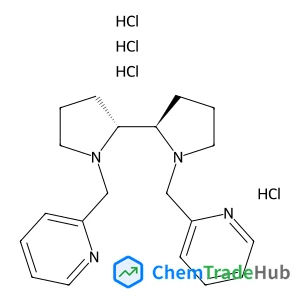
(2R,2'R)-1,1'-Bis(2-pyridinylmethyl)-2,2'-bipyrrolidine tetrahydrochloride
CAS Number:
1228077-88-0
Molecular Formula:
C20H30Cl4N4

(4aS,10aS)-7-Isopropyl-1,4a-dimethyl-5,8-dioxo-3,4,4a,5,8,9,10,10a-octahydro-2-phenanthrenecarboxylic acid
CAS Number:
142950-86-5
Molecular Formula:
C20H24O4
![4-[(4-Bromophenyl)sulfonyl]thiomorpholine structure](https://static.chemtradehub.com/structs/223/223555-81-5-2d67.webp "4-[(4-Bromophenyl)sulfonyl]thiomorpholine structure")
Recommended Suppliers




Disclaimer
This page provides academic journal information for reference and research purposes only. We are not affiliated with any journal publishers and do not handle publication submissions. For publication-related inquiries, please contact the respective journal publishers directly.
If you notice any inaccuracies in the information displayed, please contact us at support@chemtradehub.com. We will promptly review and address your concerns.