












Generation of a carbon dots/ammonium persulfate redox initiator couple for free radical frontal polymerization
Literature Information
Publication Date
2017-12-21
DOI
10.1039/C7PY01969F
Impact Factor
5.582
Authors
View Original
Abstract
We report a new redox initiator couple of ammonium persulfate (APS)/carbon dots (CDs) with high initiation efficiency used in frontal polymerization (FP). The CDs also served as fluorescent reagents, and had good dispersion and a relatively high absolute quantum yield (>60%). The initiation efficiency and possible mechanism of CDs/peroxydisulfate (S2O82−) initiators were investigated. The electron transfer between the CDs and S2O82− made decomposition of the latter into free radicals easier. Besides, electron transfer occurred between the CDs and vinyl monomers, prompting the CDs to be applied to initiate monomers alone. Therefore, the combined effects of the CDs and APS made vinyl monomers more prone to be triggered in FP, thereby lowering the reaction temperature considerably. This research might provide a promising avenue to discover other polymerization initiators with high efficiency for the synthesis of versatile materials.
Related Literature
Cocatalyst engineering to weaken the charge screening effect over Au–Bi4Ti3O12 for piezocatalytic pure water splitting
Rui Lei, Xianzhi Fu, Naxin Chen, Yifeng Chen, Wenhui Feng, Ping Liu
2022-11-08
Paper
DOI: 10.1039/D2CY01422J
Arsonium ylides (with some mention also of arsinimines, stibonium and bismuthonium ylides)
Review Article
DOI: 10.1039/CS9871600045
Conversion of glucose and cellulose into value-added products in water and ionic liquids
Jinliang Song, Honglei Fan, Jun Ma, Buxing Han
2013-07-31
Tutorial Review
DOI: 10.1039/C3GC41141A
Machine learning for non-additive intermolecular potentials: quantum chemistry to first-principles predictions
Richard S. Graham, Richard J. Wheatley
2022-05-24
Communication
DOI: 10.1039/D2CC01820A
Mechanistic study of the complex photooxidation of allyl methyl sulfide (AMS): reaction paths and products of addition under different atmospheric conditions
Alejandro L. Cardona, María B. Blanco, Mariano A. Teruel, Oscar N. Ventura
2023-05-05
Paper
DOI: 10.1039/D3EA00010A
Simple silver(i)-salt catalyzed selective hydroboration of isocyanates, pyridines, and quinolines
Vipin K. Pandey, Sangita Sahoo, Arnab Rit
2022-04-05
Communication
DOI: 10.1039/D2CC00491G
C–H bond chlorination using nickel(ii) complexes of tetradentate amido-quinoline ligands
Sanjay Adhikari, Aniruddha Sarkar, Basab Bijayi Dhar
2022-02-28
Communication
DOI: 10.1039/D2CC00639A
N-Alkylation of amines with alcohols over nanosized zeolite beta
Marri Mahender Reddy, Macharla Arun Kumar, Peraka Swamy, Mameda Naresh, Kodumuri Srujana, Lanka Satyanarayana, Akula Venugopal, Nama Narender
2013-09-09
Paper
DOI: 10.1039/C3GC41345D
Solvent-dependent self-assembly of N-annulated perylene diimides. From dimers to supramolecular polymers
Cristina Naranjo, Azahara Doncel-Giménez, Rafael Gómez, Juan Aragó, Enrique Ortí, Luis Sánchez
2023-08-29
Edge Article
DOI: 10.1039/D3SC03372D
Magnetic properties of charge-transfer complexes based on TEMPO radicals
Paper
DOI: 10.1039/A606293H
You might also like
Compound Q&A
What are the main uses of 4-Nitrophenyl phosphate disodium salt hexahydrate (CAS: 333338-18-4)?
4-Nitrophenyl phosphate disodium salt hexahydrate is primarily used as a substra...
333338-18-44-Nitrophenyl phosph...
Compound Q&A
What are the main uses of 2-(Trifluoromethyl)-1,3-oxazole-4-carboxylic Acid (CAS: 1060816-01-4)?
2-(Trifluoromethyl)-1,3-oxazole-4-carboxylic Acid (CAS: 1060816-01-4) is widely ...
1060816-01-42-(Trifluoromethyl)-...
Compound Q&A
How should 2-Fluoro-4-biphenylcarboxylic acid (CAS: 137045-30-8) be stored?
2-Fluoro-4-biphenylcarboxylic acid should be stored in a cool, dry place at room...
137045-30-82-Fluoro-4-biphenylc...
Compound Q&A
What industries use Prednisolone-21-Carboxylic Acid (CAS: 61549-70-0)?
Prednisolone-21-Carboxylic Acid is primarily used in the pharmaceutical industry...
61549-70-0Prednisolone-21-Carb...
Compound Q&A
How should 4-(Hydrazinomethyl)-1,2,3-benzenetriol (CAS: 3614-72-0) be stored?
4-(Hydrazinomethyl)-1,2,3-benzenetriol (CAS: 3614-72-0) should be stored in a co...
3614-72-04-(Hydrazinomethyl)-...
Compound Q&A
What industries use 4-Amino-1-methyl-1H-pyrazole-5-carboxylic acid hydrochloride (CAS: 92534-70-8)?
4-Amino-1-methyl-1H-pyrazole-5-carboxylic acid hydrochloride (CAS: 92534-70-8) i...
92534-70-84-Amino-1-methyl-1H-...
Compound Q&A
What regulatory guidelines apply to dehydropachymic acid (CAS: 77012-31-8)?
Dehydropachymic acid (CAS: 77012-31-8) is regulated by various agencies. It fall...
77012-31-8Dehydropachymic acid
Compound Q&A
What is the market or research trend for 6-[(2,2-Dimethylpropanoyl)amino]nicotinic acid (CAS: 898561-66-5)?
The market and research trends for 6-[(2,2-Dimethylpropanoyl)amino]nicotinic aci...
898561-66-56-[(2,2-Dimethylprop...
Compound Q&A
How should 1,10-Phenanthroline-2,9-dicarbaldehyde (CAS: 57709-62-3) be stored?
1,10-Phenanthroline-2,9-dicarbaldehyde should be stored in a cool, dry place awa...
57709-62-31,10-Phenanthroline-...
Compound Q&A
How is 5-Carbamoyl-11-oxo-10,11-dihydro-5H-dibenzo[b,f]azepin-10-yl acetate (CAS: 113952-21-9) typically synthesized?
5-Carbamoyl-11-oxo-10,11-dihydro-5H-dibenzo[b,f]azepin-10-yl acetate can be synt...
113952-21-95-Carbamoyl-11-oxo-1...
Source Journal
Polymer Chemistry

CiteScore:
8.6
Self-citation Rate:
7.3%
Articles per Year:
457
Polymer Chemistry welcomes submissions in all areas of polymer science that have a strong focus on macromolecular chemistry. Manuscripts may cover a broad range of fields, yet no direct application focus is required.
Recommended Compounds
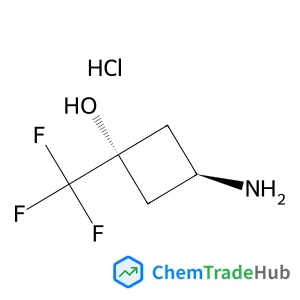
cis-3-Amino-1-(trifluoromethyl)cyclobutanol hydrochloride (1:1)
CAS Number:
1408075-16-0
Molecular Formula:
C5H9ClF3NO


Recommended Suppliers




Disclaimer
This page provides academic journal information for reference and research purposes only. We are not affiliated with any journal publishers and do not handle publication submissions. For publication-related inquiries, please contact the respective journal publishers directly.
If you notice any inaccuracies in the information displayed, please contact us at support@chemtradehub.com. We will promptly review and address your concerns.