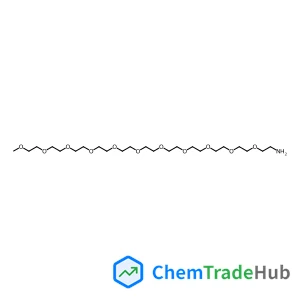
2,5,8,11,14,17,20,23,26,29,32-Undecaoxatetratriacontan-34-amine
CAS Number:
854601-60-8
Molecular Formula:
C23H49NO11
Lin Lin, Li Chen, Chaoliang He, Xiuli Zhuang, Xuesi Chen
A series of disulfide-core-cross-linked poly(ethylene glycol)-poly(amino acid)s star copolymers were synthesized through one-step ring-opening polymerization of L-phenylalanine N-carboxyanhydride (L-Phe NCA) and L-cystine N-carboxyanhydride (L-Cys NCA) with amino group terminated poly(ethylene glycol) monomethyl ether (mPEG-NH2) as macroinitiator. The reduction-responsive PEG-poly(amino acid)s nanogels (NGs) were prepared by directly dispersing the resultant PEG-poly(amino acid)s in phosphate buffer solution at pH 7.4. Dynamic light scattering (DLS) measurements showed that the reducible NG swelled in response to 10 mM glutathione (GSH). Doxorubicin (DOX), an anthracycline anticancer drug, was loaded into the NGs. The in vitro release results revealed that the release behaviors could be adjusted by GSH concentration, and poly(amino acid)s content and composition. The intracellular DOX release results showed that enhanced intracellular DOX release occurred in GSH pretreated Henrietta Lacks (HeLa) cells. In vitro methyl thiazolyl tetrazolium (MTT) assays indicated that the NGs were biocompatible, and DOX-loaded NG showed higher cellular proliferation inhibition towards GSH pretreated HeLa cells than that of non-pretreated cells. Therefore, the NGs can efficiently deliver anticancer drugs into tumor cells and inhibit cell proliferation, rendering highly promising for targeted intracellular delivery of operative chemotherapeutic drugs in cancer therapy.
Aleksandr Chernatynskiy, Xiao-Feng Zhao
DOI: 10.1039/D1CP03544D
DOI: 10.1039/D1CP02273C
Marwa H. Farag, Arkajit Mandal
DOI: 10.1039/D1CP00943E
Kaline Nascimento da Silva
DOI: 10.1039/D1CP02490F
Niranjan Kumar, Roman S. Pleshkov, Aleksey V. Nezhdanov, Vladimir N. Polkovnikov, Nikolay I. Chkhalo, Aleksandr I. Mashin
DOI: 10.1039/D1CP02815D
J. F. Vianna, K. S. Bezerra, A. H. Lima Costa, E. D. Barbosa, J. X. Lima Neto, J. I. N. Oliveira, V. N. Freire, U. L. Fulco
DOI: 10.1039/D1CP02853G
Muhammad G. Salim, Luke A. Thimons, Min A. Kim, Brennan Carr, Michelle Montgomery, Nathan Tolman, Tevis D. B. Jacobs, Haitao Liu
DOI: 10.1039/D1CP03238K
Yanan Wang, Tomoya Taguchi, Huan Li, Ai Suzuki, Yanting Zhang, Akari Miura, Mitsuki Ikeda, Hidenori Goto, Ritsuko Eguchi, Takafumi Miyazaki, Yen-Fa Liao, Hirofumi Ishii, Yoshihiro Kubozono
DOI: 10.1039/D1CP00042J
Fernando J. A. L. Cruz, José P. B. Mota
DOI: 10.1039/D1CP00893E
K. V. S. Dheeraj, Sarith P. Sathian
DOI: 10.1039/D1CP02771A
3-Fluoro-2-methylbenzylamine is an organic compound with the CAS number 771573-3...
Tert-butyl 2-(oxetan-3-ylidene)acetate is considered safe for its intended uses ...
Proper personal protective equipment (PPE) such as gloves, goggles, and a lab co...
2-Ethyl-4-methyl-1,3-thiazole is commonly synthesized via the reaction of thiour...
This compound should be stored in a cool, dry place away from direct sunlight an...
L-Lysine Acetate Salt (CAS: 52315-92-1) is subject to various regulatory guideli...
6-Fluoro-3-hydroxy-2-pyrazinecarboxamide (CAS: 259793-96-9) is generally conside...
1,1'-Sulfonylbis(1H-imidazole) is a crystalline solid with a molecular weight of...
4-Methyl-7-nitro-1H-indole-3-carbonitrile (CAS: 289483-82-5) is primarily used i...
Waste containing 5-Bromo-3-indolyl-beta-galactoside (CAS: 97753-82-7) should be ...

Polymer Chemistry welcomes submissions in all areas of polymer science that have a strong focus on macromolecular chemistry. Manuscripts may cover a broad range of fields, yet no direct application focus is required.
![(1S,4aR,5R,7S,7aS)-1-(beta-D-Glucopyranosyloxy)-5-hydroxy-7-methyl-1,4a,5,6,7,7a-hexahydrocyclopenta[c]pyran-7-yl alpha-D-galactopyranoside structure](https://static.chemtradehub.com/structs/817/81720-07-2-4ffd.webp "(1S,4aR,5R,7S,7aS)-1-(beta-D-Glucopyranosyloxy)-5-hydroxy-7-methyl-1,4a,5,6,7,7a-hexahydrocyclopenta[c]pyran-7-yl alpha-D-galactopyranoside structure")