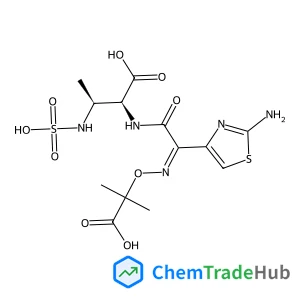
Aztreonam USP Related Compound A (Open-ring Aztreonam)
CAS Number:
87500-74-1
Molecular Formula:
C13H19N5O9S2
Stéphane Mazières, Caroll Vergelati, Cécile Corriol, Mathias Destarac
Well-defined triblock copolymers comprising a poly(butylene terephthalate) (PBT) mid-block and three different hydrophobic blocks (poly(tert-butyl acrylate) P(t-BA), poly(n-butyl acrylate) P(n-BA) and poly(tert-butyl acrylamide) P(t-BAm)) were successfully prepared by the combination of step-growth and RAFT/MADIX polymerizations. Two different synthetic strategies were investigated for the preparation of O-ethylxanthate-terminated PBT RAFT/MADIX agent. Firstly α,ω-dihydroxy-PBT synthesized by a step-growth polymerization was transformed into the corresponding dixanthate-functionalized PBT according to a two-step procedure. An alternative approach was performed by using a hydroxyl-functional xanthate as chain stopper in a single step-growth polymerization process. In both cases, the presence of xanthate terminal groups was confirmed by NMR spectroscopy and MALDI-TOF mass spectrometry. The resulting PBT with xanthate end-groups was used as a macro-chain transfer agent for the RAFT/MADIX polymerization of n-BA, t-BA and t-BAm. The synthesis of well-defined PBT-based triblock copolymers was confirmed by SEC analysis.

Molecular Diversity

Physical Chemistry Chemical Physics

European Journal of Organic Chemistry

Environmental Toxicology and Pharmacology

Nature Reviews Drug Discovery

Journal of Enzyme inhibition and Medicinal Chemistry

Foundations of Chemistry

Journal of Medical Biochemistry

CrystEngComm

Contact Lens & Anterior Eye
Jiadao Wang, Shuai Chen, Darong Chen
DOI: 10.1039/C5CP05045F
P. Vaqueiro, R. A. R. Al Orabi, G. Guélou, A. V. Powell, R. I. Smith, J.-P. Song, D. Wee, M. Fornari
DOI: 10.1039/C5CP06192J
Raffaele Borrelli, Amedeo Capobianco, Alessandro Landi, Andrea Peluso
DOI: 10.1039/C5CP01190F
Sara Del Galdo, Paolo Marracino, Marco D'Abramo, Andrea Amadei
DOI: 10.1039/C5CP05891K
Min-Sik Park, Jeonghun Kim, Ki Jae Kim, Jong-Won Lee, Jung Ho Kim
DOI: 10.1039/C5CP05936D
Monica Kosa, Hannah Noa Barad, Vijay Singh, David A. Keller, Klimentiy Shimanovich, Sven Rühle, Assaf Y. Anderson, Arie Zaban, Dan Thomas Major
DOI: 10.1039/C5CP05987A
Yong Seok Hwang, Valery I. Levitas
DOI: 10.1039/C5CP04443J
Federico A. O. Rasse-Suriani, M. Paula Denofrio, Juan G. Yañuk, M. Micaela Gonzalez, Ezequiel Wolcan, Marco Seifermann, Rosa Erra-Balsells, Franco M. Cabrerizo
DOI: 10.1039/C5CP05866J
3-Fluoro-2-methylbenzylamine is an organic compound with the CAS number 771573-3...
Tert-butyl 2-(oxetan-3-ylidene)acetate is considered safe for its intended uses ...
Proper personal protective equipment (PPE) such as gloves, goggles, and a lab co...
2-Ethyl-4-methyl-1,3-thiazole is commonly synthesized via the reaction of thiour...
This compound should be stored in a cool, dry place away from direct sunlight an...
L-Lysine Acetate Salt (CAS: 52315-92-1) is subject to various regulatory guideli...
6-Fluoro-3-hydroxy-2-pyrazinecarboxamide (CAS: 259793-96-9) is generally conside...
1,1'-Sulfonylbis(1H-imidazole) is a crystalline solid with a molecular weight of...
4-Methyl-7-nitro-1H-indole-3-carbonitrile (CAS: 289483-82-5) is primarily used i...
Waste containing 5-Bromo-3-indolyl-beta-galactoside (CAS: 97753-82-7) should be ...

Polymer Chemistry welcomes submissions in all areas of polymer science that have a strong focus on macromolecular chemistry. Manuscripts may cover a broad range of fields, yet no direct application focus is required.