












Bis(phosphinimino)methanide borohydride complexes of the rare-earth elements as initiators for the polymerization of methyl methacrylate: combined experimental and computational investigations
Literature Information
Publication Date
2011-05-24
DOI
10.1039/C1PY00133G
Impact Factor
5.582
Authors
Sophie M. Guillaume, Pierre Brignou, Nicolas Susperregui, Laurent Maron, Magdalena Kuzdrowska, Peter W. Roesky
View Original
Abstract
Rare earth borohydride complexes are known as efficient initiators for the polymerization of both apolar and polar monomers. Significant contribution of the phosphiniminomethanide ligand on the reactivity of group 3 derivatives was previously established in the polymerization of ε-caprolactone. Investigations of the capability of bis(phosphinimino)methanide rare earth metal bisborohydrides, [{CH(PPh2NSiMe3)2}La(BH4)2(THF)] (1) and [{CH(PPh2NSiMe3)2}Ln(BH4)2] (Ln = Y (2), Lu (3)) to polymerize methyl methacrylate (MMA) both experimentally and computationally, are reported here. All three metallic compounds allowed the preparation of PMMA at room temperature. However, the overall performances of 1–3 remain quite poor based on experimental observations. DFT investigations on the insertion of the first two MMA molecules revealed that the incoming of the first MMA molecule was the most important step regardless of the nature of the metal center. The nucleophilic attack of MMA leads to the formation of a first adduct B followed by the unprecedented trapping of the liberated BH3 group by the nitrogen of the phosphiniminomethanide ligand to afford the active enolate species C. The unique significant role played by the phosphiniminomethanide ligand has thus been clearly unveiled and evidenced computationally. This whole first insertion of the MMA process is both kinetically and thermodynamically favorable. Trapping of the BH3 by the ancillary ligand appeared to make the second MMA insertion more energetically favorable than the first one, especially for lanthanum. The ketoenolate thus formed, Prod., is thermodynamically and kinetically favorable. In the case of yttrium, steric considerations, in addition to energetically comparable first and second MMA insertions, support the experimentally observed difficulty to polymerize MMA. DFT calculations closely corroborate experimental findings.
Related Literature
Interface-mediated protein aggregation
Fei Tao, Qian Han, Peng Yang
2023-11-01
Feature Article
DOI: 10.1039/D3CC04311H
The Minimum Protein Staple? – Towards ‘bio’-Baldwin's rules via inter-phosphosite linking in the MEK1 activation loop
Sébastien R. G. Galan, Ritu Raj, Lyn H. Jones
2023-12-01
Edge Article
DOI: 10.1039/D3SC04631A
Electrochemical energy storage in an organic supercapacitor via a non-electrochemical proton charge assembly
Sanchayita Mukhopadhyay, Mruthyunjayachari Chattanahalli Devendrachari, Rahul Mahadeo Mendhe, Harish Makri Nimbegondi Kotresh, Chathakudath Prabhakaran Vinod, Musthafa Ottakam Thotiyl
2023-12-19
Edge Article
DOI: 10.1039/D3SC05639B
Significant hydrogen generation via photo-mechanical coupling in flexible methylammonium lead iodide nanowires
Yucheng Zhang, Jiawei Huang, Mengya Zhu, Zhouyang Zhang, Kaiqi Nie, Zhiguo Wang, Xiaxia Liao, Longlong Shu, Tingfang Tian, Zhao Wang, Yang Lu, Linfeng Fei
2024-01-03
Edge Article
DOI: 10.1039/D3SC05434A
Low-cost flexible textile electrocatalyst for overall water splitting
Zhen Liu, Jiamin Lan, Xinnian Xia, Tong Ren, Xuxu Wang, Weijian Xu
2023-10-05
Communication
DOI: 10.1039/D3CC04506D
Mechanistic insights into radical formation and functionalization in copper/N-fluorobenzenesulfonimide radical-relay reactions
Joshua A. Buss, Si-Jie Chen, Christopher J. Cramer, Shannon S. Stahl
2023-12-12
Edge Article
DOI: 10.1039/D3SC03597B
A metal-free strategy to construct fluoroalkyl–olefin linkages using fluoroalkanes
Kaushik Chakrabarti, Michael M. Wade Wolfe, Shuo Guo, Joseph W. Tucker, Jisun Lee, Nathaniel K. Szymczak
2023-12-22
Edge Article
DOI: 10.1039/D3SC05616C
You might also like
Compound Q&A
What is 3-Fluoro-2-methylbenzylamine (CAS: 771573-36-5)?
3-Fluoro-2-methylbenzylamine is an organic compound with the CAS number 771573-3...
771573-36-53-Fluoro-2-methylben...
Compound Q&A
Is Tert-butyl 2-(oxetan-3-ylidene)acetate (CAS: 1207175-03-8) safe?
Tert-butyl 2-(oxetan-3-ylidene)acetate is considered safe for its intended uses ...
1207175-03-8Tert-butyl 2-(oxetan...
Compound Q&A
What precautions should be taken when handling 4-Acetyl-2-fluorobenzonitrile (CAS: 214760-18-6)?
Proper personal protective equipment (PPE) such as gloves, goggles, and a lab co...
214760-18-64-Acetyl-2-fluoroben...
Compound Q&A
How is 2-Ethyl-4-methyl-1,3-thiazole (CAS: 15679-12-6) typically synthesized?
2-Ethyl-4-methyl-1,3-thiazole is commonly synthesized via the reaction of thiour...
15679-12-62-Ethyl-4-methyl-1,3...
Compound Q&A
How should 5',5''-([2,2'-Bithiophene]-5,5'-diyl)bis(([1,1':3',1''-terphenyl]-4,4''-dicarboxylic acid)) (CAS: 1227780-71-3) be stored?
This compound should be stored in a cool, dry place away from direct sunlight an...
1227780-71-35',5''''-([2,2'-Bith...
Compound Q&A
What regulatory guidelines apply to L-Lysine Acetate Salt (CAS: 52315-92-1)?
L-Lysine Acetate Salt (CAS: 52315-92-1) is subject to various regulatory guideli...
52315-92-1L-LYSINE ACETATE SAL...
Compound Q&A
Is 6-Fluoro-3-hydroxy-2-pyrazinecarboxamide (CAS: 259793-96-9) safe?
6-Fluoro-3-hydroxy-2-pyrazinecarboxamide (CAS: 259793-96-9) is generally conside...
259793-96-96-Fluoro-3-hydroxy-2...
Compound Q&A
What are the physical and chemical properties of 1,1'-Sulfonylbis(1H-imidazole) (CAS: 7189-69-7)?
1,1'-Sulfonylbis(1H-imidazole) is a crystalline solid with a molecular weight of...
7189-69-71,1'-Sulfonylbis(1H-...
Compound Q&A
What industries use 4-methyl-7-nitro-1H-indole-3-carbonitrile (CAS: 289483-82-5)?
4-Methyl-7-nitro-1H-indole-3-carbonitrile (CAS: 289483-82-5) is primarily used i...
289483-82-54-methyl-7-nitro-1H-...
Compound Q&A
How should waste containing 5-Bromo-3-indolyl-beta-galactoside (CAS: 97753-82-7) be handled?
Waste containing 5-Bromo-3-indolyl-beta-galactoside (CAS: 97753-82-7) should be ...
97753-82-75-Bromo-3-indolyl-be...
Source Journal
Polymer Chemistry

CiteScore:
8.6
Self-citation Rate:
7.3%
Articles per Year:
457
Polymer Chemistry welcomes submissions in all areas of polymer science that have a strong focus on macromolecular chemistry. Manuscripts may cover a broad range of fields, yet no direct application focus is required.
Recommended Compounds
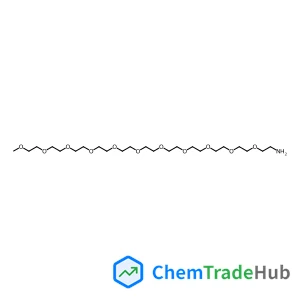
2,5,8,11,14,17,20,23,26,29,32-Undecaoxatetratriacontan-34-amine
CAS Number:
854601-60-8
Molecular Formula:
C23H49NO11
Recommended Suppliers





Disclaimer
This page provides academic journal information for reference and research purposes only. We are not affiliated with any journal publishers and do not handle publication submissions. For publication-related inquiries, please contact the respective journal publishers directly.
If you notice any inaccuracies in the information displayed, please contact us at support@chemtradehub.com. We will promptly review and address your concerns.