


CVDgraphene electrochemistry: biologically relevant molecules
Literature Information
Publication Date
2011-10-12
DOI
10.1039/C1CP22648G
Impact Factor
3.676
Authors
Dale A. C. Brownson, Maria Gómez-Mingot, Craig E. Banks
View Original
Abstract
We investigate the electrochemical properties of CVD grown graphene towards the detection of various biologically prevalent analytes including L-ascorbic acid (AA), dopamine hydrochloride (DA), β-nicotinamide adenine dinucleotide (NADH), uric acid (UA) and epinephrine (EP). We find that the observed electrochemical response of the CVD-graphene towards these select analytes does not originate from the graphene, however, from various other contributions including the presence of ‘graphitic islands’ on the surface of the CVD-graphene which dominate its electrochemistry. In the systems studied within, it appears at best, CVD-graphene acts akin to that of an edge plane pyrolytic graphite (EPPG) electrode constructed from highly ordered pyrolytic graphite. However, in other cases, the response of the CVD-graphene is worse than that of an EPPG electrode, which is likely due to the low O/C ratio.
Recommended Journals

Organic Process Research & Development

Journal of Peptide Science

Russian Journal of Applied Chemistry

Saudi Pharmaceutical Journal

Chemical Communications

Journal of Saudi Chemical Society

Russian Journal of Bioorganic Chemistry

Russian Journal of Organic Chemistry

Crystallography Reports

Russian Journal of Coordination Chemistry
Related Literature
Strategy for polymorphic control by enzymatic reaction and antisolvent crystallization: effect of aminoacylase on metastable β-glycine formation
Jen-Chieh Hsueh, Kuan Lin Yeh, Hung Lin Lee, Tu Lee
2021-09-21
Paper
DOI: 10.1039/D1RE00335F
Hydrogels locked by molecular recognition aiming at responsiveness and functionality
Guosong Chen, Ming Jiang
2012-10-08
Review Article
DOI: 10.1039/C2PY20693E
Polymerization of long chain [meth]acrylates by Cu(0)-mediated and catalytic chain transfer polymerisation (CCTP): high fidelity end group incorporation and modification
Athina Anastasaki, Christopher Waldron, Vasiliki Nikolaou, Paul Wilson, Ronan McHale, Timothy Smith, David M. Haddleton
2013-06-10
Paper
DOI: 10.1039/C3PY00618B
Quaternized amino poly(glycerol-methacrylate)s for enhanced pDNA delivery
Zhixiang Liang, Xinshi Wu, Ying-Wei Yang, Cui Li, Guolin Wu, Hui Gao
2013-04-03
Paper
DOI: 10.1039/C3PY00210A
Insertion metathesis depolymerization
Michael D. Schulz, Rachel R. Ford, Kenneth B. Wagener
2013-05-22
Communication
DOI: 10.1039/C3PY00531C
Modular synthesis and dielectric properties of high-performance fluorinated poly(arylene ether-1,3,4-oxadiazole)s
Kuo Han, Kui Xu, Matthew R. Gadinski, Qing Wang
2013-02-26
Communication
DOI: 10.1039/C3PY00174A
Practical polymerization of functionalized lactones and carbonates with Sn(OTf)2 in metal catalysed ring-opening polymerization methods
David M. Stevens, Harry A. Watson, Marc-Andre LeBlanc, Ray Y. Wang, Joanne Chou, Westley S. Bauer, Eva Harth
2013-02-11
Paper
DOI: 10.1039/C3PY21119C
You might also like
Compound Q&A
What are the main uses of 4-Nitrophenyl phosphate disodium salt hexahydrate (CAS: 333338-18-4)?
4-Nitrophenyl phosphate disodium salt hexahydrate is primarily used as a substra...
333338-18-44-Nitrophenyl phosph...
Compound Q&A
What are the main uses of 2-(Trifluoromethyl)-1,3-oxazole-4-carboxylic Acid (CAS: 1060816-01-4)?
2-(Trifluoromethyl)-1,3-oxazole-4-carboxylic Acid (CAS: 1060816-01-4) is widely ...
1060816-01-42-(Trifluoromethyl)-...
Compound Q&A
How should 2-Fluoro-4-biphenylcarboxylic acid (CAS: 137045-30-8) be stored?
2-Fluoro-4-biphenylcarboxylic acid should be stored in a cool, dry place at room...
137045-30-82-Fluoro-4-biphenylc...
Compound Q&A
What industries use Prednisolone-21-Carboxylic Acid (CAS: 61549-70-0)?
Prednisolone-21-Carboxylic Acid is primarily used in the pharmaceutical industry...
61549-70-0Prednisolone-21-Carb...
Compound Q&A
How should 4-(Hydrazinomethyl)-1,2,3-benzenetriol (CAS: 3614-72-0) be stored?
4-(Hydrazinomethyl)-1,2,3-benzenetriol (CAS: 3614-72-0) should be stored in a co...
3614-72-04-(Hydrazinomethyl)-...
Compound Q&A
What industries use 4-Amino-1-methyl-1H-pyrazole-5-carboxylic acid hydrochloride (CAS: 92534-70-8)?
4-Amino-1-methyl-1H-pyrazole-5-carboxylic acid hydrochloride (CAS: 92534-70-8) i...
92534-70-84-Amino-1-methyl-1H-...
Compound Q&A
What regulatory guidelines apply to dehydropachymic acid (CAS: 77012-31-8)?
Dehydropachymic acid (CAS: 77012-31-8) is regulated by various agencies. It fall...
77012-31-8Dehydropachymic acid
Compound Q&A
What is the market or research trend for 6-[(2,2-Dimethylpropanoyl)amino]nicotinic acid (CAS: 898561-66-5)?
The market and research trends for 6-[(2,2-Dimethylpropanoyl)amino]nicotinic aci...
898561-66-56-[(2,2-Dimethylprop...
Compound Q&A
How should 1,10-Phenanthroline-2,9-dicarbaldehyde (CAS: 57709-62-3) be stored?
1,10-Phenanthroline-2,9-dicarbaldehyde should be stored in a cool, dry place awa...
57709-62-31,10-Phenanthroline-...
Compound Q&A
How is 5-Carbamoyl-11-oxo-10,11-dihydro-5H-dibenzo[b,f]azepin-10-yl acetate (CAS: 113952-21-9) typically synthesized?
5-Carbamoyl-11-oxo-10,11-dihydro-5H-dibenzo[b,f]azepin-10-yl acetate can be synt...
113952-21-95-Carbamoyl-11-oxo-1...
Source Journal
Physical Chemistry Chemical Physics

CiteScore:
5.5
Self-citation Rate:
10.3%
Articles per Year:
3036
Physical Chemistry Chemical Physics (PCCP) is an international journal co-owned by 19 physical chemistry and physics societies from around the world. This journal publishes original, cutting-edge research in physical chemistry, chemical physics and biophysical chemistry. To be suitable for publication in PCCP, articles must include significant innovation and/or insight into physical chemistry; this is the most important criterion that reviewers and Editors will judge against when evaluating submissions. The journal has a broad scope and welcomes contributions spanning experiment, theory, computation and data science. Topical coverage includes spectroscopy, dynamics, kinetics, statistical mechanics, thermodynamics, electrochemistry, catalysis, surface science, quantum mechanics, quantum computing and machine learning. Interdisciplinary research areas such as polymers and soft matter, materials, nanoscience, energy, surfaces/interfaces, and biophysical chemistry are welcomed if they demonstrate significant innovation and/or insight into physical chemistry. Joined experimental/theoretical studies are particularly appreciated when complementary and based on up-to-date approaches.
Recommended Compounds
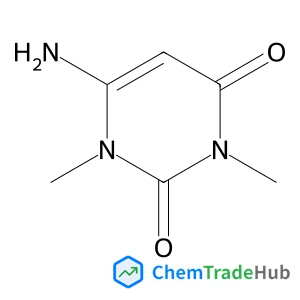
6-amino-1,3-dimethyl-1,2,3,4-tetrahydropyrimidine-2,4-dione
CAS Number:
6642-31-5
Molecular Formula:
C6H9N3O2

Recommended Suppliers







Disclaimer
This page provides academic journal information for reference and research purposes only. We are not affiliated with any journal publishers and do not handle publication submissions. For publication-related inquiries, please contact the respective journal publishers directly.
If you notice any inaccuracies in the information displayed, please contact us at support@chemtradehub.com. We will promptly review and address your concerns.