












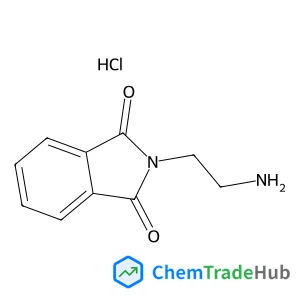
2-(2-Aminoethyl)-1H-isoindole-1,3(2H)-dione hydrochloride (1:1)
CAS Number:
30250-67-0
Molecular Formula:
C10H11ClN2O2
Muthuramalingam Prakash, Venkatesan Subramanian
The gas phase structure, stability, spectra, and proton transfer properties of monoprotic carborane acid–water clusters [CB11FmH11−m(OH2)1]–(H2O)n (where m = 0, 5, and 10; n = 1–6) have been calculated using density functional theory (DFT) with the Becke's three-parameter hybrid exchange functional and Lee–Yang–Parr correlation functional (B3LYP) using 6-31+G* basis set. Results reveal that Eigen cation defects are found in CBWn (where n = 2–6) clusters and these clusters are significantly more stable than the non-Eigen geometry. In addition to the conventional hydrogen bond (H-bond) the role of dihydrogen bond (DHB) and halogen bond (XB) in the stabilization of these clusters can be observed from the molecular graphs derived from the atoms in molecules (AIM) analysis. Spectral information shows the features of Eigen cation and proton oscillation involved in the proton transfer process. The dissociation of proton from the perfluoro derivatives with two water molecules is more favorable when compared to the other derivatives.
Bhavani Shankar Chinta, Harikrishna Sanapa, Kamala Prasad Vasikarla, Beeraiah Baire
DOI: 10.1039/C8OB00434J
Stéphane Sengmany, Anthony Ollivier, Erwan Le Gall, Eric Léonel
DOI: 10.1039/C8OB00500A
Yabo Deng, Yongzhen Li, Yalan Wang, Shuo Sun, Sichao Ma, Pengfei Jia, Wenguang Li, Kairong Wang, Wenjin Yan
DOI: 10.1039/D1QO01392K
Guo-Shu Chen, Jia-Hui Li, Shu-Jie Chen, Wen-Xia Lin, Hai Ren, Dong-Sheng Deng, Yun-Lin Liu
DOI: 10.1039/D1QO01078F
Jian Huang, Wei Chen, Jiazhi Liang, Qin Yang, Zhihong Deng, Zhibin Song, Yiyuan Peng
DOI: 10.1039/D1QO01186C
Agnieszka Cholewiak, Kamil Adamczyk, Michał Kopyt, Adrian Kasztelan, Piotr Kwiatkowski
DOI: 10.1039/C8OB00561C
Xinxin Han, Xin Liu, Yueyun Bao, Hunahuan Song, Yu-Rou Zhao, Xiaoying Wang, Junjie Zhang, Le Liu, Xin-Hua Duan, Jinbo Hu, Mingyou Hu
DOI: 10.1039/D1QO01654G
Kiran Bajaj, Devesh S. Agarwal, Rajeev Sakhuja, Girinath G. Pillai
DOI: 10.1039/C8OB00676H
(1R,3S)-1,3-Cyclopentanediol finds applications in various industries. In the ph...
When handling N'-[4-(Dimethylamino)phenyl]-N,N-dimethyl-1,4-benzenediamine, it i...
There are several alternatives to 5-(2,4-Difluorophenyl)-2-methoxypyrimidine in ...
1-(3-Methoxyphenoxy)propan-2-ol (CAS: 382141-68-6) must comply with the Globally...
Tetrodotoxin Citrate is extremely dangerous and should be handled with extreme c...
2-Methyl-2-propanyl [(1R,3S)-3-hydroxycyclopentyl]carbamate (CAS: 225641-84-9) i...
Waste containing 4-(2-Hydroxyhexafluoroisopropyl)Benzoic Acid (CAS: 16261-80-6) ...
2-Methyl-2-proanyl {(2S)-1-[(benzyloxy)amino]-3-hydroxy-3-methyl-1-oxo-2-butanyl...
Benzeneethanamine, α-ethyl-, hydrochloride (1:1) is an organic compound with the...
In the synthesis of compounds similar to 3-{(E)-[4-(Dimethylamino)phenyl]diazeny...

Physical Chemistry Chemical Physics (PCCP) is an international journal co-owned by 19 physical chemistry and physics societies from around the world. This journal publishes original, cutting-edge research in physical chemistry, chemical physics and biophysical chemistry. To be suitable for publication in PCCP, articles must include significant innovation and/or insight into physical chemistry; this is the most important criterion that reviewers and Editors will judge against when evaluating submissions. The journal has a broad scope and welcomes contributions spanning experiment, theory, computation and data science. Topical coverage includes spectroscopy, dynamics, kinetics, statistical mechanics, thermodynamics, electrochemistry, catalysis, surface science, quantum mechanics, quantum computing and machine learning. Interdisciplinary research areas such as polymers and soft matter, materials, nanoscience, energy, surfaces/interfaces, and biophysical chemistry are welcomed if they demonstrate significant innovation and/or insight into physical chemistry. Joined experimental/theoretical studies are particularly appreciated when complementary and based on up-to-date approaches.
![N-[(1S,2R,4S)-2-Amino-4-(dimethylcarbamoyl)cyclohexyl]-N'-(5-chloro-2-pyridinyl)ethanediamide structure](https://static.chemtradehub.com/structs/480/480452-37-7-0898.webp "N-[(1S,2R,4S)-2-Amino-4-(dimethylcarbamoyl)cyclohexyl]-N'-(5-chloro-2-pyridinyl)ethanediamide structure")
![N-[(5,6-Dichloro-1H-benzimidazol-2-yl)methyl]-9-(1-methyl-1H-pyrazol-4-yl)-2-(4-morpholinyl)-9H-purin-6-amine structure](https://static.chemtradehub.com/structs/238/2387704-62-1-25f4.webp "N-[(5,6-Dichloro-1H-benzimidazol-2-yl)methyl]-9-(1-methyl-1H-pyrazol-4-yl)-2-(4-morpholinyl)-9H-purin-6-amine structure")





