












Role of spatial ionic distribution on the energetics of hydrophobic assembly and properties of the water/hydrophobe interface
Literature Information
Publication Date
2012-01-09
DOI
10.1039/C1CP20839J
Impact Factor
3.676
Authors
Brad A. Bauer, Shuching Ou, Sandeep Patel
View Original
Abstract
We present results from all-atom molecular dynamics simulations of large-scale hydrophobic plates solvated in NaCl and NaI salt solutions. As observed in studies of ions at the air–water interface, the density of iodide near the water–plate interface is significantly enhanced relative to chloride and in the bulk. This allows for the partial hydration of iodide while chloride remains more fully hydrated. In 1 M solutions, iodide directly pushes the hydrophobes together (contributing −2.51 kcal mol−1) to the PMF. Chloride, however, strengthens the water-induced contribution to the PMF by ∼−2.84 kcal mol−1. These observations are enhanced in 3 M solutions, consistent with the increased ion density in the vicinity of the hydrophobes. The different salt solutions influence changes in the critical hydrophobe separation distance and characteristic wetting/dewetting transitions. These differences are largely influenced by the ion-specific expulsion of iodide from bulk water. Results of this study are of general interest to the study of ions at interfaces and may lend insight to the mechanisms underlying the Hofmeister series.
Related Literature
A one-pot strategy to improve end-capping efficacy in Stille poly-condensations
Jared D. Harris, Kenneth R. Carter
2018-01-19
Paper
DOI: 10.1039/C7PY01761H
A novel self-healing electrochromic film based on a triphenylamine cross-linked polymer
Rongzong Zheng, Jiaqiang Zhang, Chunyang Jia, Zhongquan Wan, Yaru Fan, Xiaolong Weng, Jianliang Xie, Longjiang Deng
2017-10-18
Paper
DOI: 10.1039/C7PY01434A
Synthesis of PEVE-b-P(CTFE-alt-EVE) block copolymers by sequential cationic and radical RAFT polymerization
Marc Guerre, Mineto Uchiyama, Gérald Lopez, Bruno Améduri, Masami Kamigaito, Vincent Ladmiral
2017-12-08
Paper
DOI: 10.1039/C7PY01924F
Effective macrophage delivery using RAFT copolymer derived nanoparticles
R. W. M. Davidson, G. W. Simpson, J. Chiefari, M. J. Fuchter
2017-11-28
Paper
DOI: 10.1039/C7PY01363A
Thermoresponse and self-assembly of an ABC star quarterpolymer with O2 and redox dual-responsive Y junctions
Xiaoqi Zhao, Wentao Wu, Jian Zhang, Wenxue Dai, Youliang Zhao
2018-02-13
Paper
DOI: 10.1039/C8PY00085A
Macrocycle-based topological azo-polymers: facile synthesis and unusual photoresponsive properties‡
Wei Song, Ruiyu Jiang, Lei Zhu
2016-12-22
Paper
DOI: 10.1039/C6PY01743F
In situ synthesis of diblock copolymer nano-assemblies via dispersion RAFT polymerization induced self-assembly and Ag/copolymer composite nanoparticles thereof
Mengting Tan, Yan Shi, Zhifeng Fu, Wantai Yang
2018-02-05
Paper
DOI: 10.1039/C7PY01905J
Highly efficient luminescent side-chain polymers with short-spacer attached tetraphenylethylene AIEgens via RAFT polymerization capable of naked eye explosive detection
Qian Li, Xiao Li, Zhongying Wu, Yuhao Sun, Jianglin Fang, Dongzhong Chen
2018-07-02
Paper
DOI: 10.1039/C8PY00710A
You might also like
Compound Q&A
What are the main uses of (3.beta.)-3-Hydroxy-N,N-dimethyl-chol-5-en-24-amide (CAS: 79066-03-8)?
(3.beta.)-3-Hydroxy-N,N-dimethyl-chol-5-en-24-amide (CAS: 79066-03-8) is primari...
79066-03-8(3.beta.)-3-Hydroxy-...
Compound Q&A
What regulatory guidelines apply to 5-(aminomethyl)-2-methoxyphenol (CAS: 89702-89-6)?
5-(Aminomethyl)-2-methoxyphenol (CAS: 89702-89-6) is classified under GHS as a s...
89702-89-65-(aminomethyl)-2-me...
Compound Q&A
What is Thieno[2,3-c]pyridin-7(6H)-one (CAS: 28981-13-7)?
Thieno[2,3-c]pyridin-7(6H)-one (CAS: 28981-13-7) is a heterocyclic organic compo...
28981-13-7Thieno[2,3-c]pyridin...
Compound Q&A
Is 1-[(6-Methoxy-3-pyridinyl)methyl]-4-piperidinamine dihydrochloride (CAS: 1185311-28-7) safe?
1-[(6-Methoxy-3-pyridinyl)methyl]-4-piperidinamine dihydrochloride is generally ...
1185311-28-71-[(6-Methoxy-3-pyri...
Compound Q&A
What regulatory guidelines apply to [(2E)-3-Phenyl-2-propen-1-yl]phosphonic acid (CAS: 146404-58-2)?
[(2E)-3-Phenyl-2-propen-1-yl]phosphonic acid (CAS: 146404-58-2) is regulated und...
146404-58-2[(2E)-3-Phenyl-2-pro...
Compound Q&A
What regulatory guidelines apply to 6-Bromo-7-methoxyquinoline (CAS: 1620515-86-7)?
6-Bromo-7-methoxyquinoline (CAS: 1620515-86-7) falls under the scope of the Glob...
1620515-86-76-Bromo-7-methoxyqui...
Compound Q&A
What industries use (2R)-1-(1-Benzofuran-2-yl)-N-propyl-2-pentanamine (CAS: 260550-89-8)?
This compound is primarily used in the pharmaceutical industry for the developme...
260550-89-8(2R)-1-(1-Benzofuran...
Compound Q&A
What are the main uses of 1-Ethyl-7-[2-methyl-6-(4H-1,2,4-triazol-3-yl)-3-pyridinyl]-3,5-dihydropyrazino[2,3-b]pyrazin-2(1H)-one (CAS: 1228013-15-7)?
1-Ethyl-7-[2-methyl-6-(4H-1,2,4-triazol-3-yl)-3-pyridinyl]-3,5-dihydropyrazino[2...
1228013-15-71-Ethyl-7-[2-methyl-...
Compound Q&A
Are there alternatives to {5-(Acryloylamino)-2-[(dimethylamino)methyl]phenyl}boronic acid (CAS: 1217500-78-1) in synthesis?
Alternative reagents such as 2-[(dimethylamino)methyl]phenylboronic acid or rela...
1217500-78-1{5-(Acryloylamino)-2...
Compound Q&A
What is 3-(Piperidin-4-yloxy)pyridine (CAS: 310881-48-2)?
3-(Piperidin-4-yloxy)pyridine (CAS: 310881-48-2) is an organic compound with the...
310881-48-23-(Piperidin-4-yloxy...
Source Journal
Physical Chemistry Chemical Physics

CiteScore:
5.5
Self-citation Rate:
10.3%
Articles per Year:
3036
Physical Chemistry Chemical Physics (PCCP) is an international journal co-owned by 19 physical chemistry and physics societies from around the world. This journal publishes original, cutting-edge research in physical chemistry, chemical physics and biophysical chemistry. To be suitable for publication in PCCP, articles must include significant innovation and/or insight into physical chemistry; this is the most important criterion that reviewers and Editors will judge against when evaluating submissions. The journal has a broad scope and welcomes contributions spanning experiment, theory, computation and data science. Topical coverage includes spectroscopy, dynamics, kinetics, statistical mechanics, thermodynamics, electrochemistry, catalysis, surface science, quantum mechanics, quantum computing and machine learning. Interdisciplinary research areas such as polymers and soft matter, materials, nanoscience, energy, surfaces/interfaces, and biophysical chemistry are welcomed if they demonstrate significant innovation and/or insight into physical chemistry. Joined experimental/theoretical studies are particularly appreciated when complementary and based on up-to-date approaches.
Recommended Compounds
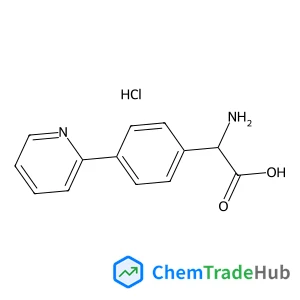
2-Amino-2-(4-(pyridin-2-YL)phenyl)acetic acid hydrochloride
CAS Number:
1135818-89-1
Molecular Formula:
C13H13ClN2O2
Recommended Suppliers





Disclaimer
This page provides academic journal information for reference and research purposes only. We are not affiliated with any journal publishers and do not handle publication submissions. For publication-related inquiries, please contact the respective journal publishers directly.
If you notice any inaccuracies in the information displayed, please contact us at support@chemtradehub.com. We will promptly review and address your concerns.