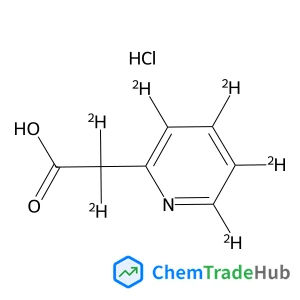
2,2-dideuterio-2-(3,4,5,6-tetradeuterio-2-pyridyl)acetic acid;hydrochloride
CAS Number:
1329799-67-8
Molecular Formula:
C7H2ClD6NO2
Jared D. Harris, Kenneth R. Carter
Herein we examine the end-capping efficacy of several end-capping reagents (ECRs) in the Stille polymerization of 2,7-dibromo-9,9-bis(2-ethylhexyl)fluorene (Fl) and 2,5-bis(trimethylstannyl)-thieno[3,2-b]thiophene (TT). Polymerizations were carried out in a one-pot fashion where the molar ratio of TT relative to Fl was biased, ideally generating bis(trimethylstannyl) macromolecules. Various ECRs (bromobenzene, 4-bromotoluene, 4-(trifluoromethyl) bromobenzene, 4,4′-bromobiphenyl, 2-bromo-9,9-dimethylfluorene, iodobenzene, 4-iodotoluene, and 4,4′-iodobiphenyl) differing in reactivity were employed in the one-pot reaction. Polymers were characterized using GPC, 1H NMR, and end-capping efficacy was evaluated with MALDI-ToF MS. The iodo derivatives were found to disrupt propagation, severely inhibiting molecular weight. The bromo ECRs varied in end-capping efficiency: bromofluorene ∼ bromobiphenyl > trifluoromethylbromobenzene ∼ bromobenzene > bromotoluene. Additionally, we demonstrate a strong efficiency dependence on initial monomer concentration and demonstrate this method's superiority over post-polymerization end-capping.
Chen Chen, Qi Xiao, Leyi Xiao, Mengge Feng, Fangzhe Liu, Ke Yao, Yu Cui, Tiange Zhang
DOI: 10.1039/D3BM01584J
Fengjiao Hao, Yuanyuan Luo, Fengshou Dong, Xinglu Pan, Xiaohu Wu, Yongquan Zheng, Jun Xu
DOI: 10.1039/D3AY01473H
Tomohiro Narukawa, Satoki Okabayashi, Koichi Chiba
DOI: 10.1039/D3AY01574B
Xu Wang, Shirong Ai, Aihua Xiong, Weiqi Zhou, Liang He, Jie Teng, Xiang Geng, Ruimei Wu
DOI: 10.1039/D3AY01604H
Daiki Asakawa, Ryoma Yamamoto, Nobuyasu Hanari, Kazumi Saikusa
DOI: 10.1039/D3AY01450A
Yin-Sheng Xu, Yingying Cui, Zeng-Ying Qiao
DOI: 10.1039/D3BM01138K
Huiyan Cao, Chenchen Zhu, Fangyuan Chen, Jiaqi Ye, Bin-Chun Li, Peng Yang, Mingqiang Qiao, Zhuoyu Li
DOI: 10.1039/D3BM01779F
Arina S. Ivkina, Mikhail V. Zyuzin, Sergei A. Shipilovskikh
DOI: 10.1039/D3BM01651J
Martina Banchelli, Sara Tombelli, Marella de Angelis, Cristiano D'Andrea, Cosimo Trono, Francesco Baldini, Ambra Giannetti, Paolo Matteini
DOI: 10.1039/D3AY01661G
4-Nitrophenyl phosphate disodium salt hexahydrate is primarily used as a substra...
2-(Trifluoromethyl)-1,3-oxazole-4-carboxylic Acid (CAS: 1060816-01-4) is widely ...
2-Fluoro-4-biphenylcarboxylic acid should be stored in a cool, dry place at room...
Prednisolone-21-Carboxylic Acid is primarily used in the pharmaceutical industry...
4-(Hydrazinomethyl)-1,2,3-benzenetriol (CAS: 3614-72-0) should be stored in a co...
4-Amino-1-methyl-1H-pyrazole-5-carboxylic acid hydrochloride (CAS: 92534-70-8) i...
Dehydropachymic acid (CAS: 77012-31-8) is regulated by various agencies. It fall...
The market and research trends for 6-[(2,2-Dimethylpropanoyl)amino]nicotinic aci...
1,10-Phenanthroline-2,9-dicarbaldehyde should be stored in a cool, dry place awa...
5-Carbamoyl-11-oxo-10,11-dihydro-5H-dibenzo[b,f]azepin-10-yl acetate can be synt...

Polymer Chemistry welcomes submissions in all areas of polymer science that have a strong focus on macromolecular chemistry. Manuscripts may cover a broad range of fields, yet no direct application focus is required.
![(3R,5R)-1-[(Benzyloxy)carbonyl]-5-methyl-3-piperidinecarboxylic acid structure](https://static.chemtradehub.com/structs/126/1269757-29-0-c552.webp "(3R,5R)-1-[(Benzyloxy)carbonyl]-5-methyl-3-piperidinecarboxylic acid structure")
![S-[2,3-Bis(palmitoyloxy)propyl]-N-[(9H-fluoren-9-ylmethoxy)(hydroxy)methylene]cysteine structure](https://static.chemtradehub.com/structs/210/210532-98-2-f6a7.webp "S-[2,3-Bis(palmitoyloxy)propyl]-N-[(9H-fluoren-9-ylmethoxy)(hydroxy)methylene]cysteine structure")