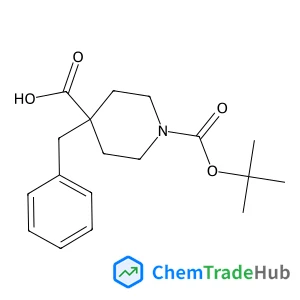
4-Benzyl-1-(tert-butoxycarbonyl)piperidine-4-carboxylic acid
CAS Number:
170838-87-6
Molecular Formula:
C18H25NO4
The fabrication of large molecular devices, directly on surfaces in UHV conditions, by covalent coupling of smaller precursors has become in the past years an attractive solution for Molecular Electronics. This review presents the state-of-the-art and an analysis of the potential of this new field, from Ullmann type C–C coupling, cyclodehydrogenation, and reactions involving heteroelements to 2D polymerisation on insulating thin films. Mechanistic insights are also mentioned, giving preliminary explanations on the influence of the substrate and the 2D confinement. Potential perspectives for further developments are then evoked.
Maria Luisa Perrotta, Francesca Macedonio, Lidietta Giorno, Wanqin Jin, Annarosa Gugliuzza, Elena Tocci
DOI: 10.1039/D0CP00928H
Benjamin A. Link, Ammon J. Sindt, Linda S. Shimizu, Thanh D. Do
DOI: 10.1039/C9CP06938K
Kwang-Hyon Kim
DOI: 10.1039/D0CP00150C
DOI: 10.1039/D0CP01502D
Michael Gradzielski
DOI: 10.1039/D0CP01076F
Andika Asyuda, Xianglong Wan, Michael Zharnikov
DOI: 10.1039/D0CP01740J
Bhaskar Rana, John M. Herbert
DOI: 10.1039/D0CP05216G
Mariagrazia Fortino, Elisabetta Collini, Alfonso Pedone, Julien Bloino
DOI: 10.1039/D0CP00034E
Antonio Gennaro, Alexander Karabanov, Alexey Potapov, Walter Köckenberger
DOI: 10.1039/D0CP00892C
Arusha Acharyya, Dayoung Shin, Thomas Troxler, Feng Gai
DOI: 10.1039/D0CP00397B
This compound is mainly used as an intermediate in the synthesis of antipsychoti...
Waste containing 1-(D-Ribofuranosyl)-1,4-dihydro-3-pyridinecarboxamide (CAS: 191...
2-Methyl-2-propanyl 3-bromo-3-(hydroxymethyl)-1-azetidinecarboxylate (CAS: 20079...
N-(4-Chloro-2-pyridinyl)acetamide (CAS: 245056-66-0) is a chemical compound with...
5-Chloro-2-hydroxybenzoic acid, also known as 5-chlorosalicylic acid, is an arom...
When handling 1,1-Dichloro-1-fluoroethane (CAS: 1717-00-6), it is important to u...
Fmoc-(2S,3R)-3-phenylpyrrolidine-2-carboxylic acid is a white crystalline solid ...
4-Amino-5-bromo-2-pyridinecarboxylic acid is primarily used as a precursor in th...
Handling this compound should be done with personal protective equipment (PPE) i...
When handling 8-bromo-2,2-dimethyl-3,4-dihydro-2H-1,4-benzoxazin-3-one, use prop...

Physical Chemistry Chemical Physics (PCCP) is an international journal co-owned by 19 physical chemistry and physics societies from around the world. This journal publishes original, cutting-edge research in physical chemistry, chemical physics and biophysical chemistry. To be suitable for publication in PCCP, articles must include significant innovation and/or insight into physical chemistry; this is the most important criterion that reviewers and Editors will judge against when evaluating submissions. The journal has a broad scope and welcomes contributions spanning experiment, theory, computation and data science. Topical coverage includes spectroscopy, dynamics, kinetics, statistical mechanics, thermodynamics, electrochemistry, catalysis, surface science, quantum mechanics, quantum computing and machine learning. Interdisciplinary research areas such as polymers and soft matter, materials, nanoscience, energy, surfaces/interfaces, and biophysical chemistry are welcomed if they demonstrate significant innovation and/or insight into physical chemistry. Joined experimental/theoretical studies are particularly appreciated when complementary and based on up-to-date approaches.
![2,6-Bis({(2R)-2-[hydroxy(diphenyl)methyl]-1-pyrrolidinyl}methyl)-4-methylphenol structure](https://static.chemtradehub.com/structs/877/877395-58-9-70bf.webp "2,6-Bis({(2R)-2-[hydroxy(diphenyl)methyl]-1-pyrrolidinyl}methyl)-4-methylphenol structure")