












Crystallization of alkane melts induced by carbon nanotubes and graphenenanosheets: a molecular dynamics simulation study
Literature Information
Publication Date
2011-08-01
DOI
10.1039/C1CP20695H
Impact Factor
3.676
Authors
Jun-Sheng Yang, Chuan-Lu Yang, Mei-Shan Wang, Bao-Dong Chen, Xiao-Guang Ma
View Original
Abstract
The crystallization of alkane melts on carbon nanotubes (CNT) and the surface of graphene nanosheets (GNS) is investigated using molecular dynamics (MD) simulations. The crystallization process of the alkane melts is analyzed in terms of the bond-orientational order parameter, atomic radial distribution for the CNT/alkane, atomic longitudinal distribution for the GNS/alkane, and diffusion properties. The dimensional effects of the different carbon-based nanostructures on the crystallization of alkane melts are shown. It is found that one-dimensional CNT has a stronger ability to induce the crystallization of the polymer than that of two-dimensional GNS, which provides a support at molecular level for the experimental observation [Liet al., J. Am. Chem. Soc., 2006, 128, 1692 and Xu et al., Macromolecules, 2010, 43, 5000]. From the MD simulations, we also find that the crystallization of alkane molecules has been completed with the highly cooperative processes of adsorption and orientation.
Related Literature
Epoxidation of styrene by TBHP to styrene oxide using barium oxide as a highly active/selective and reusable solid catalyst
Vasant R. Choudhary, Rani Jha, Prabhas Jana
2006-06-30
Communication
DOI: 10.1039/B604937K
Facile and regioselective mono- or diesterification of glycerol derivatives over recyclable phosphazene organocatalyst
Ghizlane Kharchafi, François Jérôme, Jean-Paul Douliez, Joël Barrault
2006-06-22
Paper
DOI: 10.1039/B603091B
Syntheses of three members of A(II)M(IV)(PO4)2: luminescence properties of PbGe(PO4)2 and its Eu3+-doped powders
Wei-Long Zhang, Chen-Sheng Lin, Zhang-Zhen He, Hao Zhang, Zhong-Zhen Luo, Wen-Dan Cheng
2013-07-05
Paper
DOI: 10.1039/C3CE40936H
Ten years of green chemistry at the Gordon Research Conferences: frontiers of science
Romas Kazlauskas, Gary Sheldrake
2006-07-17
Focus
DOI: 10.1039/B608918F
Efficient dehydration of bio-based 2,3-butanediol to butanone over boric acid modified HZSM-5 zeolites
Wengui Zhang, Xiaojun Ji
2012-10-29
Paper
DOI: 10.1039/C2GC36324K
An efficient preparation of indolizines through a tandem palladium-catalyzed cross-coupling reaction and cycloisomerization
Hyunseok Kim, Kwangmoo Lee, Sunggak Kim, Phil Ho Lee
2010-08-03
Communication
DOI: 10.1039/C0CC01945C
Microwave-assisted hydrolysis of crystalline cellulose catalyzed by biomass char sulfonic acids
Youyu Wu, Zaihui Fu, Dulin Yin, Qiong Xu, Fenglan Liu, Chunli Lu, Liqiu Mao
2010-02-24
Paper
DOI: 10.1039/B917807D
Plasma parameter and film casting optimization for the determination of particulate matter in a sol–gel matrix by radiofrequency glow discharge optical emission spectrometry (rf-GD-OES)
Tim M. Brewer, W. Clay Davis, R. Kenneth Marcus
2005-12-12
Paper
DOI: 10.1039/B511260E
You might also like
Compound Q&A
What regulatory guidelines apply to 4-Amino-3-bromophenol (CAS: 74440-80-5)?
4-Amino-3-bromophenol (CAS: 74440-80-5) falls under the classification of a haza...
74440-80-54-Amino-3-bromopheno...
Compound Q&A
How should (17beta)-3-Oxoestr-4-en-17-yl acetate (CAS: 1425-10-1) be stored?
(17beta)-3-Oxoestr-4-en-17-yl acetate should be stored in a cool, dry place away...
1425-10-1(17beta)-3-Oxoestr-4...
Compound Q&A
What are the physical and chemical properties of 2-[(2,2-Diethoxyethyl)disulfanyl]-1,1-diethoxyethane (CAS: 76505-71-0)?
2-[(2,2-Diethoxyethyl)disulfanyl]-1,1-diethoxyethane (CAS: 76505-71-0) is a colo...
76505-71-02-[(2,2-Diethoxyethy...
Compound Q&A
What is the market or research trend for 1-(β-D-ribofuranosyl)-1H-imidazo[4,5-c]pyridin-4-amine?
The market and research for 1-(β-D-ribofuranosyl)-1H-imidazo[4,5-c]pyridin-4-ami...
6736-58-91-(beta-D-Ribofurano...
Compound Q&A
How should waste containing Conjugated Estrogen (CAS: 12126-59-9) be handled?
Waste containing Conjugated Estrogen (CAS: 12126-59-9) should be collected and d...
12126-59-9Conjugated Estrogen
Compound Q&A
What is the market or research trend for Bis(2,2,2-trifluoroethyl) (methoxycarbonylmethyl)phosphonate?
The market for Bis(2,2,2-trifluoroethyl) (methoxycarbonylmethyl)phosphonate (CAS...
88738-78-7Bis(2,2,2-trifluoroe...
Compound Q&A
Are there alternatives to 3,4'-Di-O-methylellagic acid (CAS: 57499-59-9) in synthesis?
There are several alternatives to 3,4'-Di-O-methylellagic acid (CAS: 57499-59-9)...
57499-59-93,4'-Di-O-methylella...
Compound Q&A
What regulatory guidelines apply to 2-Chloro-N,N-dimethylpyridin-4-amine (CAS: 59047-70-0)?
2-Chloro-N,N-dimethylpyridin-4-amine (CAS: 59047-70-0) is regulated under the Gl...
59047-70-02-Chloro-N,N-dimethy...
Compound Q&A
What is cerium(3+);oxygen(2-);vanadium(5+) (CAS: 13597-19-8)?
Cerium(3+);oxygen(2-);vanadium(5+) (CAS: 13597-19-8) is a complex inorganic comp...
13597-19-8cerium(3+);oxygen(2-...
Compound Q&A
Is 7-Chloro-1-iodoisoquinoline (CAS: 1203579-27-4) safe?
7-Chloro-1-iodoisoquinoline (CAS: 1203579-27-4) is generally considered safe whe...
1203579-27-47-Chloro-1-iodoisoqu...
Source Journal
Physical Chemistry Chemical Physics

CiteScore:
5.5
Self-citation Rate:
10.3%
Articles per Year:
3036
Physical Chemistry Chemical Physics (PCCP) is an international journal co-owned by 19 physical chemistry and physics societies from around the world. This journal publishes original, cutting-edge research in physical chemistry, chemical physics and biophysical chemistry. To be suitable for publication in PCCP, articles must include significant innovation and/or insight into physical chemistry; this is the most important criterion that reviewers and Editors will judge against when evaluating submissions. The journal has a broad scope and welcomes contributions spanning experiment, theory, computation and data science. Topical coverage includes spectroscopy, dynamics, kinetics, statistical mechanics, thermodynamics, electrochemistry, catalysis, surface science, quantum mechanics, quantum computing and machine learning. Interdisciplinary research areas such as polymers and soft matter, materials, nanoscience, energy, surfaces/interfaces, and biophysical chemistry are welcomed if they demonstrate significant innovation and/or insight into physical chemistry. Joined experimental/theoretical studies are particularly appreciated when complementary and based on up-to-date approaches.
Recommended Compounds
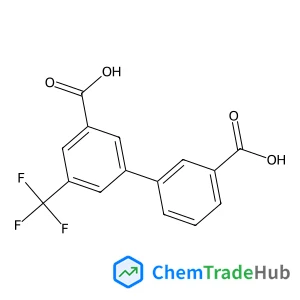
3-(3-Carboxyphenyl)-5-(trifluoromethyl)benzoic acid
CAS Number:
1261930-96-4
Molecular Formula:
C15H9F3O4
Recommended Suppliers







Disclaimer
This page provides academic journal information for reference and research purposes only. We are not affiliated with any journal publishers and do not handle publication submissions. For publication-related inquiries, please contact the respective journal publishers directly.
If you notice any inaccuracies in the information displayed, please contact us at support@chemtradehub.com. We will promptly review and address your concerns.