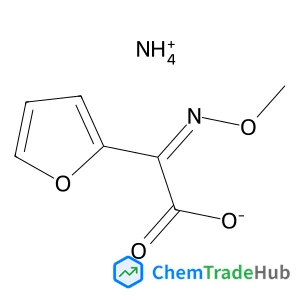
Ammonium (Z)-2-(furan-2-yl)-2-(methoxyimino)acetate
CAS Number:
97148-39-5
Molecular Formula:
C7H10N2O4
Johannes C. van den Heuvel
The ZnO(0001)–Zn terminated crystal face was studied after reduction at high temperatures by combination of STM, STS, XPS and TDS. The clean ZnO(0001)–Zn surface exhibits triangular reconstruction in UHV, while after exposure to 10−5 mbar H2 at RT this reconstruction is lifted and a rough surface has formed. The roughness as well as the metallic character of the surface increased with the applied low-pressure reduction temperature up to 800 K. XPS revealed that exposure to 1 bar H2 at RT led to the formation of OH groups; at higher temperatures progressive metallization of the ZnO surface was found to occur. Analysis of the thermal desorption results showed that huge amounts of H2 dissolved into the ZnO crystal. The results obtained under these conditions were in good accordance with thermodynamic calculations. The experimental ratio between the absorbed amount of H2 at RT and 800 K amounts to 1000. The ratio calculated from increasing diffusion coefficients with temperature only amounts to 6. This emphasizes the importance of ZnO as a H supplier by spillover, and proves that metallic Zn boosts dissociative adsorption of H2. This surface modification of the ZnO structure during the reduction promotes an enhanced activity of the Cu/ZnO catalyst at elevated temperatures.
Ivan Popov, Alexander Puzenko, Airat Khamzin, Yuri Feldman
DOI: 10.1039/C4CP04271A
Shuanglong Chen, Mingguang Yao, Ye Yuan, Fengxian Ma, Zhaodong Liu, Ran Liu, Wen Cui, Xue Yang, Bo Liu, Bo Zou, Tian Cui, Bingbing Liu
DOI: 10.1039/C3CP55164D
Ruimin Wang, Chengjun Lei, Changbiao Li, Huayan Lan, Huaibin Zheng, Yanpeng Zhang
DOI: 10.1039/C4CP02001D
Yibo Zhao, Huige Wei, Xingru Yan, Wei Wu, Yiran Wang, Zhanhu Guo
DOI: 10.1039/C4CP03144J
Tangui Le Bahers, Eric Brémond, Ilaria Ciofini
DOI: 10.1039/C3CP55032J
Katsuya Mutoh, Yuki Nakagawa, Sayaka Hatano, Yoichi Kobayashi
DOI: 10.1039/C4CP04606D
Celesta Fong, Lynne J. Waddington, Anita J. Hill
DOI: 10.1039/C4CP03822C
Edoardo Mosconi, Claudio Quarti, Tanja Ivanovska, Giampiero Ruani, Filippo De Angelis
DOI: 10.1039/C4CP00569D
Jie Li, Yibin Jiang, Juan Cheng, Yilin Zhang, Huimin Su, Jacky W. Y. Lam, Herman H. Y. Sung, Kam Sing Wong, Hoi Sing Kwok
DOI: 10.1039/C4CP04052J
1H-Indazole-6-carbonitrile finds applications in pharmaceuticals, where it serve...
Waste containing Dioctyl (2E)-2-butenedioate (CAS: 2997-85-5) should be collecte...
Sodium [(1,2-benzoxazol-3-ylmethyl)sulfonyl]azanide is primarily used in pharmac...
Dimethyl 4-(4,4,5,5-tetramethyl-1,3,2-dioxaborolan-2-yl)-2,6-pyridinedicarboxyla...
Waste containing 2-Fluoro-6-hydrazinopyridine (CAS: 80714-39-2) should be manage...
6-Formyl-2-pyridinecarboxylic acid is an organic compound with the molecular for...
Research trends for this compound indicate a focus on its potential applications...
9H-Tribenzo[b,d,f]azepine is typically synthesized via a multi-step process invo...
1-Cyclopropyl-7-ethoxy-6-fluoro-8-methoxy-4-oxo-1,4-dihydro-3-quinolinecarboxyli...
Waste containing Methyl 3-oxo-1,2,3,4-tetrahydro-6-quinoxalinecarboxylate (CAS: ...

Physical Chemistry Chemical Physics (PCCP) is an international journal co-owned by 19 physical chemistry and physics societies from around the world. This journal publishes original, cutting-edge research in physical chemistry, chemical physics and biophysical chemistry. To be suitable for publication in PCCP, articles must include significant innovation and/or insight into physical chemistry; this is the most important criterion that reviewers and Editors will judge against when evaluating submissions. The journal has a broad scope and welcomes contributions spanning experiment, theory, computation and data science. Topical coverage includes spectroscopy, dynamics, kinetics, statistical mechanics, thermodynamics, electrochemistry, catalysis, surface science, quantum mechanics, quantum computing and machine learning. Interdisciplinary research areas such as polymers and soft matter, materials, nanoscience, energy, surfaces/interfaces, and biophysical chemistry are welcomed if they demonstrate significant innovation and/or insight into physical chemistry. Joined experimental/theoretical studies are particularly appreciated when complementary and based on up-to-date approaches.
![Sodium (2Z)-7-{[(2R)-2-amino-2-carboxyethyl]sulfanyl}-2-({[(1S)-2,2-dimethylcyclopropyl]carbonyl}amino)-2-heptenoate structure](https://static.chemtradehub.com/structs/811/81129-83-1-441c.webp "Sodium (2Z)-7-{[(2R)-2-amino-2-carboxyethyl]sulfanyl}-2-({[(1S)-2,2-dimethylcyclopropyl]carbonyl}amino)-2-heptenoate structure")