












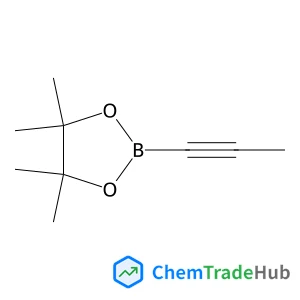
4,4,5,5-Tetramethyl-2-(1-propyn-1-YL)-1,3,2-dioxaborolane
CAS Number:
347389-75-7
Molecular Formula:
C9H15BO2
Gülsün Gökağaç
Carbon-supported PtRu nanoparticles (Ru/Pt: 0.25) were prepared by three different methods; simultaneous reduction of PtCl4 and RuCl3 (catalyst I) and changing the reduction order of PtCl4 and RuCl3 (catalysts II and III) to enhance the performance of the anodic catalysts for methanol and ethanol oxidation. Structure, microstructure and surface characterizations of all the catalysts were carried out by X-ray diffraction (XRD), transmission electron microscopy (TEM) coupled with energy dispersive X-ray spectroscopy (EDS) and X-ray photoelectron spectroscopy (XPS). The results of the XRD analysis showed that all catalysts had a face-centered cubic (fcc) structure with different and smaller lattice parameters than that of pure platinum, showing that the Ru incorporates into the Pt fcc structure by different ratios in all the catalysts. The typical particle sizes of all catalysts were in the range of 2–3 nm. The most active and stable catalyst for methanol and ethanol oxidation is catalyst III, in which a large amount (more than 90%) of PtRu alloy formation was observed. It has been found that this catalyst is about 8.0 and 33.4 times more active at ∼0.60 V towards the methanol and ethanol oxidation reactions, respectively, compared to the commercial Pt catalyst.
Hong Dao Li, Guo-Wei Lee, Po-Chun Huang, Po-Wei Yang, Yu-Ting Liu, Yen-Fa Liao, Horng-Tay Jeng, Deng-Sung Lin, Tsang-Lang Lin
DOI: 10.1039/C5CP01103E
Xiang Xiao, Guangming Jiang, Yuxin Zhang, Wen Cui, Jinzhu Ma
DOI: 10.1039/C5CP02460A
R. Rahul, R. K. Singh, B. Bera, R. Devivaraprasad, M. Neergat
DOI: 10.1039/C5CP00692A
Y. Yamauchi
DOI: 10.1039/C5CP02466H
Richard P. Matthews, Tom Welton, Patricia A. Hunt
DOI: 10.1039/C5CP00459D
Tatsuya Shinagawa, Kazuhiro Takanabe
DOI: 10.1039/C5CP02330K
Sandeep Kumar Mishra, N. Suryaprakash
DOI: 10.1039/C5CP01505G
Zhenzhen Feng, Yuli Yan, Guangbiao Zhang, Jueming Yang, Chao Wang
DOI: 10.1039/C5CP00972C
Danny Schlüns, Kevin Klahr, Christian Mück-Lichtenfeld, Lucas Visscher, Johannes Neugebauer
DOI: 10.1039/C4CP04936E
Zhe Gui, Eleanor Gillette, Jonathon Duay, Junkai Hu, Nam Kim, Sang Bok Lee
DOI: 10.1039/C5CP01814E
2-Methylbenzene-1,4-diamine dihydrochloride (CAS: 615-45-2) should be stored in ...
(1S,4S)-2,5-Diazabicyclo[2.2.1]heptane dihydrobromide is generally considered sa...
(6-Chloropyridazin-3-YL)methanamine finds applications in the pharmaceutical ind...
2-Fluoro-3-methylphenol is primarily used in the synthesis of pharmaceuticals, p...
When handling 3-Methoxy-4-nitrobenzonitrile, it is important to wear appropriate...
When handling 1,3-Oxazolo[4,5-b]pyridine-2(3H)-thione (CAS: 211949-57-4), it is ...
4-Ethynylbenzamide (CAS: 90347-86-7) falls under various regulatory guidelines i...
3-(2-Ethylphenyl)-2-thioxo-4-imidazolidinone is primarily used as an intermediat...
(2-Fluoro-6-methoxyphenyl)acetic acid, also known as 4-fluoro-3-methoxybenzoic a...
Market trends for 2-[4-(Hydroxymethyl)phenoxy]ethanol (CAS: 102196-18-9) indicat...

Physical Chemistry Chemical Physics (PCCP) is an international journal co-owned by 19 physical chemistry and physics societies from around the world. This journal publishes original, cutting-edge research in physical chemistry, chemical physics and biophysical chemistry. To be suitable for publication in PCCP, articles must include significant innovation and/or insight into physical chemistry; this is the most important criterion that reviewers and Editors will judge against when evaluating submissions. The journal has a broad scope and welcomes contributions spanning experiment, theory, computation and data science. Topical coverage includes spectroscopy, dynamics, kinetics, statistical mechanics, thermodynamics, electrochemistry, catalysis, surface science, quantum mechanics, quantum computing and machine learning. Interdisciplinary research areas such as polymers and soft matter, materials, nanoscience, energy, surfaces/interfaces, and biophysical chemistry are welcomed if they demonstrate significant innovation and/or insight into physical chemistry. Joined experimental/theoretical studies are particularly appreciated when complementary and based on up-to-date approaches.
![(3R,4aR,7aS,9aR,10S,11R,13aR,13bS,15aS,15bR)-3,11-Dihydroxy-10-(hydroxymethyl)-4,4,7a,10,13a,15b-hexamethyl-1,2,3,4,4a,7,7a,8,9,9a,10,11,12,13,13a,13b,14,15,15a,15b-icosahydro-5H-naphtho[2',1':4,5]cyc
lohepta[1,2-a]naphthalen-5-one structure](https://static.chemtradehub.com/structs/538/53800-21-8-9f18.webp "(3R,4aR,7aS,9aR,10S,11R,13aR,13bS,15aS,15bR)-3,11-Dihydroxy-10-(hydroxymethyl)-4,4,7a,10,13a,15b-hexamethyl-1,2,3,4,4a,7,7a,8,9,9a,10,11,12,13,13a,13b,14,15,15a,15b-icosahydro-5H-naphtho[2',1':4,5]cyc
lohepta[1,2-a]naphthalen-5-one structure")
![1H-Imidazo[4,5-c]pyridine-7-carboxylic acid structure](https://static.chemtradehub.com/structs/123/1234616-39-7-1344.webp "1H-Imidazo[4,5-c]pyridine-7-carboxylic acid structure")
![trans-2-{[(Tert-butoxy)carbonyl]amino}cyclobutane-1-carboxylic acid structure](https://static.chemtradehub.com/structs/951/951173-25-4-27cd.webp "trans-2-{[(Tert-butoxy)carbonyl]amino}cyclobutane-1-carboxylic acid structure")






