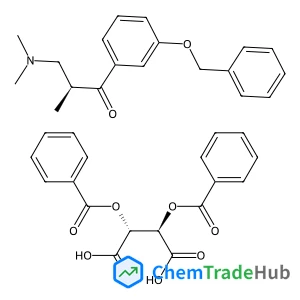
(S)-1-(3-(Benzyloxy)phenyl)-3-(dimethylamino)-2-methylpropan-1-one (2r,3r)-2,3-bis(benzoyloxy)succinate
CAS Number:
1004315-81-4
Molecular Formula:
C37H37NO10
Xiang Xiao, Guangming Jiang, Yuxin Zhang, Wen Cui, Jinzhu Ma
Uniform one-dimensional defective La(OH)3 nanorods were synthesized by a facile, fast and scalable method. This simple method avoids treatment at high temperature, utility of surfactants or templates, and can be finished within a short time. The results indicate that oxygen-vacancies were formed in La(OH)3 nanorods, which could extend the photoresponse range. The XPS, PL, solid state ESR measurements and DFT calculations revealed the pivotal role of oxygen-vacancy in the formation of an impurity level in the band gap of La(OH)3. The as-prepared La(OH)3 nanorods exhibited efficient photocatalytic activity in the removal of NO at the ppb-level under ultraviolet illumination. The highly enhanced photocatalytic activity of La(OH)3 nanorods could be ascribed to the synergy of the lower impurity level below the conduction band and the high separation efficiency of photogenerated electron–hole pairs. DMPO-ESR spin trapping results imply that the hydroxyl radicals are the main reactive species that are responsible for NO photooxidation. On the basis of combined experimental and theoretical investigation, an oxygen vacancy-mediated photocatalysis mechanism of defective La(OH)3 nanorods was proposed. This work could not only provide a fast and environmentally friendly approach for the synthesis of nanostructured photocatalysts, but also new insights into the understanding of the role of vacancy in semiconductor photocatalysis.

Russian Journal of Coordination Chemistry

Current Opinion in Colloid & Interface Science

New Journal of Chemistry

Drug Discovery Today

Russian Chemical Bulletin

Russian Journal of Applied Chemistry

Chemical Communications

Organic Process Research & Development

Russian Journal of General Chemistry

Current Opinion in Solid State & Materials Science
Yuan Cheng, Huilin Pan
DOI: 10.1039/C3CP53036A
Igor Dolamic, Birte Varnholt, Thomas Bürgi
DOI: 10.1039/C3CP53845A
Fuminao Kishimoto, Dai Mochizuki, Kozue Kumagai, Masato M. Maitani, Eiichi Suzuki, Yuji Wada
DOI: 10.1039/C3CP53579G
Giorgio Orlandi
DOI: 10.1039/C3CP52310A
Peer C. Fechner, Hanspeter Helm
DOI: 10.1039/C3CP53300J
Dipanwita De, Manas Sajjan, Anindya Datta
DOI: 10.1039/C3CP52372A
Sebastian F. Völker, Alexander Schmiedel, Marco Holzapfel, Christoph Böhm, Christoph Lambert
DOI: 10.1039/C3CP53455C
2-Methylbenzene-1,4-diamine dihydrochloride (CAS: 615-45-2) should be stored in ...
(1S,4S)-2,5-Diazabicyclo[2.2.1]heptane dihydrobromide is generally considered sa...
(6-Chloropyridazin-3-YL)methanamine finds applications in the pharmaceutical ind...
2-Fluoro-3-methylphenol is primarily used in the synthesis of pharmaceuticals, p...
When handling 3-Methoxy-4-nitrobenzonitrile, it is important to wear appropriate...
When handling 1,3-Oxazolo[4,5-b]pyridine-2(3H)-thione (CAS: 211949-57-4), it is ...
4-Ethynylbenzamide (CAS: 90347-86-7) falls under various regulatory guidelines i...
3-(2-Ethylphenyl)-2-thioxo-4-imidazolidinone is primarily used as an intermediat...
(2-Fluoro-6-methoxyphenyl)acetic acid, also known as 4-fluoro-3-methoxybenzoic a...
Market trends for 2-[4-(Hydroxymethyl)phenoxy]ethanol (CAS: 102196-18-9) indicat...

Physical Chemistry Chemical Physics (PCCP) is an international journal co-owned by 19 physical chemistry and physics societies from around the world. This journal publishes original, cutting-edge research in physical chemistry, chemical physics and biophysical chemistry. To be suitable for publication in PCCP, articles must include significant innovation and/or insight into physical chemistry; this is the most important criterion that reviewers and Editors will judge against when evaluating submissions. The journal has a broad scope and welcomes contributions spanning experiment, theory, computation and data science. Topical coverage includes spectroscopy, dynamics, kinetics, statistical mechanics, thermodynamics, electrochemistry, catalysis, surface science, quantum mechanics, quantum computing and machine learning. Interdisciplinary research areas such as polymers and soft matter, materials, nanoscience, energy, surfaces/interfaces, and biophysical chemistry are welcomed if they demonstrate significant innovation and/or insight into physical chemistry. Joined experimental/theoretical studies are particularly appreciated when complementary and based on up-to-date approaches.