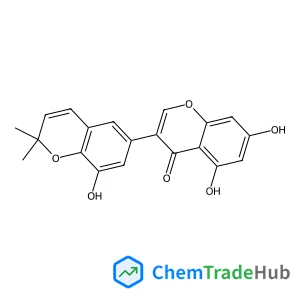
5,7,8'-Trihydroxy-2',2'-dimethyl-2'H,4H-3,6'-bichromen-4-one
CAS Number:
129280-33-7
Molecular Formula:
C20H16O6
Sébastien Rochat, Stephan N. Steinmann, Clémence Corminboeuf, Kay Severin
The commercially available fluorescence dye 8-hydroxypyrene-1,3,6-trisulfonate (HPTS) can be used as a selective molecular probe for the detection of caffeine in aqueous solution.
Christopher M. Lincoln, James D. White, Alexandre F. T. Yokochi
DOI: 10.1039/B412811G
Yuyang Liu, Jing Tang, J. H. Xin
DOI: 10.1039/B412282H
Barbara Binotti, Carla Carfagna, Cristiano Zuccaccia, Alceo Macchioni
DOI: 10.1039/B411214H
W. Matthew Leevy, Michelle E. Weber, Paul H. Schlesinger
DOI: 10.1039/B413588A
DOI: 10.1039/B300963G
Randolf D. Köhn, Zhida Pan, Mary F. Mahon, Gabriele Kociok-Köhn
DOI: 10.1039/B302670A
S. P. Cork, G. Cressey, R. H. Jones, S. J. Teat, V. L. Zholobenko
DOI: 10.1039/B410366C
Stefano Sforza, Tullia Tedeschi, Roberto Corradini, Arnaldo Dossena, Rosangela Marchelli
DOI: 10.1039/B212718K
M. Margarita Castaño-Briones, Andrew P. Bassett, Linette L. Meason, Peter R. Ashton, Zoe Pikramenou
DOI: 10.1039/B412999G
Robin B. Bedford, Duncan W. Bruce, Robert M. Frost, John W. Goodby, Michael Hird
DOI: 10.1039/B413790F
(1R,3S)-1,3-Cyclopentanediol finds applications in various industries. In the ph...
When handling N'-[4-(Dimethylamino)phenyl]-N,N-dimethyl-1,4-benzenediamine, it i...
There are several alternatives to 5-(2,4-Difluorophenyl)-2-methoxypyrimidine in ...
1-(3-Methoxyphenoxy)propan-2-ol (CAS: 382141-68-6) must comply with the Globally...
Tetrodotoxin Citrate is extremely dangerous and should be handled with extreme c...
2-Methyl-2-propanyl [(1R,3S)-3-hydroxycyclopentyl]carbamate (CAS: 225641-84-9) i...
Waste containing 4-(2-Hydroxyhexafluoroisopropyl)Benzoic Acid (CAS: 16261-80-6) ...
2-Methyl-2-proanyl {(2S)-1-[(benzyloxy)amino]-3-hydroxy-3-methyl-1-oxo-2-butanyl...
Benzeneethanamine, α-ethyl-, hydrochloride (1:1) is an organic compound with the...
In the synthesis of compounds similar to 3-{(E)-[4-(Dimethylamino)phenyl]diazeny...

ChemComm publishes urgent research which is of outstanding significance and interest to experts in the field, while also appealing to the journal’s broad chemistry readership. Our communication format is ideally suited to short, urgent studies that are of such importance that they require accelerated publication. Our scope covers all topics in chemistry, and research at the interface of chemistry and other disciplines (such as materials science, nanoscience, physics, engineering and biology) where there is a significant novelty in the chemistry aspects. Major topic areas covered include: Analytical Chemistry Catalysis Chemical Biology and medicinal chemistry Computational Chemistry and Machine Learning Energy and sustainable chemistry Environmental Chemistry Green Chemistry Inorganic Chemistry Materials Chemistry Nanoscience Organic Chemistry Physical Chemistry Polymer Chemistry Supramolecular Chemistry