


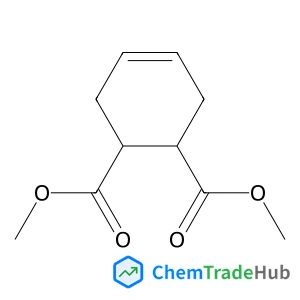
4-Cyclohexene-1,2-dicarboxylic acid, 1,2-dimethyl ester, (1R,2R)-rel-
CAS Number:
17673-68-6
Molecular Formula:
C10H14O4
Joseph P. Patterson, Saghar Khodabakhsh, Rachel K. O'Reilly
Until recently, the primary controlled radical polymerization (CRP) technique used to synthesize side chain semi-conducting block copolymers from vinyl monomer species has been nitroxide-mediated polymerization (NMP). The potential exploitation of reversible addition fragmentation chain transfer (RAFT) polymerization for the preparation of semi-conducting diblocks has not yet been fully realized. In this work a trithiocarbonate chain transfer agent (CTA) has been shown to polymerize both hole transporting (HT) monomers m-vinyltriphenyl amine and p-vinyltriphenyl amine and also a new fluorinated triphenylamine monomer for the first time, affording both homopolymers and diblock copolymers with good control over molecular weight (Mn) and narrow polydispersities (Mw/Mn). The electronic properties of these blocks and diblocks were explored using UV-vis and cyclic voltammetry analysis. The selective self-assembly of these diblocks into solution nanostructures has been explored and characterized by DLS and TEM analysis.

Current Pharmaceutical Biotechnology

Green Chemistry

Advanced Engineering Materials

Molecular Diversity

Coloration Technology

Photochemical & Photobiological Sciences

Angewandte Chemie International Edition

European Journal of Organic Chemistry

Journal of Enzyme inhibition and Medicinal Chemistry

Physical Chemistry Chemical Physics
F. J. Aoiz, M. Brouard, S. D. S. Gordon, B. Nichols, V. Walpole
DOI: 10.1039/C5CP03273C
Jun Ma, Xizi Cao, Xiaopeng Xing, Xuefeng Wang, Joel H. Parks
DOI: 10.1039/C5CP06116D
Martin Dahlqvist, Johanna Rosen
DOI: 10.1039/C5CP06021D
Yong Seok Hwang, Valery I. Levitas
DOI: 10.1039/C5CP04443J
Mohammad Alaghemandi
DOI: 10.1039/C5CP05125H
DOI: 10.1039/C5CP90218E
F. Pedraza, S. A. Mahadik, B. Bouchaud
DOI: 10.1039/C5CP04723D
G. K. S. Prameela, B. V. N. Phani Kumar, A. Pan, V. K. Aswal, J. Subramanian, A. B. Mandal, S. P. Moulik
DOI: 10.1039/C5CP04910E
Yuxiang Han, Xiao Zheng, Mengqi Fu, Dong Pan, Xing Li, Yao Guo, Jianhua Zhao, Qing Chen
DOI: 10.1039/C5CP06139C
3-Fluoro-2-methylbenzylamine is an organic compound with the CAS number 771573-3...
Tert-butyl 2-(oxetan-3-ylidene)acetate is considered safe for its intended uses ...
Proper personal protective equipment (PPE) such as gloves, goggles, and a lab co...
2-Ethyl-4-methyl-1,3-thiazole is commonly synthesized via the reaction of thiour...
This compound should be stored in a cool, dry place away from direct sunlight an...
L-Lysine Acetate Salt (CAS: 52315-92-1) is subject to various regulatory guideli...
6-Fluoro-3-hydroxy-2-pyrazinecarboxamide (CAS: 259793-96-9) is generally conside...
1,1'-Sulfonylbis(1H-imidazole) is a crystalline solid with a molecular weight of...
4-Methyl-7-nitro-1H-indole-3-carbonitrile (CAS: 289483-82-5) is primarily used i...
Waste containing 5-Bromo-3-indolyl-beta-galactoside (CAS: 97753-82-7) should be ...

Polymer Chemistry welcomes submissions in all areas of polymer science that have a strong focus on macromolecular chemistry. Manuscripts may cover a broad range of fields, yet no direct application focus is required.
![(2E)-4-[(1R,2S,8R,19S,21R)-14-Hydroxy-11-isopropenyl-8,23,23-trimethyl-5-(3-methyl-2-buten-1-yl)-16,20-dioxo-3,7,22-trioxaheptacyclo[17.4.1.1~8,12~.0~2,17~.0~2,21~.0~4,15~.0~6,13~]pentacosa-4(15),5,13
,17-tetraen-21-yl]-2-methyl-2-butenoic acid structure](https://static.chemtradehub.com/structs/173/173867-04-4-d2d3.webp "(2E)-4-[(1R,2S,8R,19S,21R)-14-Hydroxy-11-isopropenyl-8,23,23-trimethyl-5-(3-methyl-2-buten-1-yl)-16,20-dioxo-3,7,22-trioxaheptacyclo[17.4.1.1~8,12~.0~2,17~.0~2,21~.0~4,15~.0~6,13~]pentacosa-4(15),5,13
,17-tetraen-21-yl]-2-methyl-2-butenoic acid structure")
![4-[(2,4-Dihydroxyphenyl)diazenyl]-5-hydroxy-2,7-naphthalenedisulfonic acid structure](https://static.chemtradehub.com/structs/362/3627-01-8-79ac.webp "4-[(2,4-Dihydroxyphenyl)diazenyl]-5-hydroxy-2,7-naphthalenedisulfonic acid structure")


