












Highly water repellent aerogels based on cellulose stearoyl esters
Literature Information
Publication Date
2011-05-03
DOI
10.1039/C0PY00309C
Impact Factor
5.582
Authors
Mari Granström, Marjo Kettunen née Pääkkö, Hua Jin, Erkki Kolehmainen, Ilkka Kilpeläinen, Olli Ikkala
View Original
Abstract
Herein we combine in a novel way the physical effect of porous structure of a cellulosic aerogel with the chemical effect of long alkyl tails by a well known homogeneous green esterification method, to achieve purely bio-based and highly water repellent cellulosic materials. As an alternative for a traditional fluoro derivatized hydrophobization, here long fatty acid tails are utilized to lower the surface energy. To minimize the process emission, ionic liquid (IL) 1-allyl-3-methylimidazolium chloride is used for the esterification, due to its non-volatility and recyclability. We have shown here that low degree of substitution (DS) of the fatty acid cellulose material enables the spontaneous formation of aerogels. Additionally, the very low content of the long stearoyl tails combined with the porous aerogel structure resulted in significant increase in hydrophobicity from an aqueous contact angle of 0° up to 124°. We foresee that this approach can allow sustainable and completely bio-based coatings and insulators paving the way for a new green application potential for cellulose based materials.
Recommended Journals
Related Literature
A novel poly(thienylenevinylene) derivative for application in polymer solar cells
Feiyao Qing, Xiaochen Wang, Na Li, Yongfang Li, Xiaoyu Li, Haiqiao Wang
2011-06-25
Paper
DOI: 10.1039/C1PY00192B
Aromatic, microporous polymer networks with high surface area generated in Friedel–Crafts-type polycondensations
Eduard Preis, Christian Widling, Ullrich Scherf, Satish Patil, Gunther Brunklaus, Johannes Schmidt, Arne Thomas
2011-08-15
Communication
DOI: 10.1039/C1PY00251A
Efficient synthesis of benzobisazole terpolymers containing thiophene and fluorene
Jared F. Mike, Jeremy J. Intemann, Min Cai, Teng Xiao, Ruth Shinar, Joseph Shinar, Malika Jeffries-EL
2011-07-18
Paper
DOI: 10.1039/C1PY00218J
Synthesis of heterotelechelic polymers with affinity to glutathione-S-transferase and biotin-tagged proteins by RAFT polymerization and thiol–ene reactions
Cyrille Boyer, Thomas P. Davis
2011-04-15
Paper
DOI: 10.1039/C1PY00049G
Arginine-specific protein modification using α-oxo-aldehyde functional polymers prepared by atom transfer radical polymerization
Maxime Ayer, Justyna Kowal, Frederik R. Wurm, Harm-Anton Klok
2011-03-15
Paper
DOI: 10.1039/C0PY00422G
One-step preparation of reduction-responsive poly(ethylene glycol)-poly(amino acid)s nanogels as efficient intracellular drug delivery platforms
Lin Lin, Li Chen, Chaoliang He, Xiuli Zhuang, Xuesi Chen
2011-10-14
Paper
DOI: 10.1039/C1PY00360G
Examining the UV-vis absorption of RAFT chain transfer agents and their use for polymer analysis
Katja Skrabania, Anna Miasnikova, Achille Mayelle Bivigou-Koumba, Daniel Zehm
2011-06-17
Paper
DOI: 10.1039/C1PY00173F
Temperature and pH responsive hybrid nanoclay grafted with PDMAEMA
Jukka Niskanen, Mikko Karesoja, Teemu Rossi, Heikki Tenhu
2011-06-29
Paper
DOI: 10.1039/C1PY00143D
You might also like
Compound Q&A
What is 3-Fluoro-2-methylbenzylamine (CAS: 771573-36-5)?
3-Fluoro-2-methylbenzylamine is an organic compound with the CAS number 771573-3...
771573-36-53-Fluoro-2-methylben...
Compound Q&A
Is Tert-butyl 2-(oxetan-3-ylidene)acetate (CAS: 1207175-03-8) safe?
Tert-butyl 2-(oxetan-3-ylidene)acetate is considered safe for its intended uses ...
1207175-03-8Tert-butyl 2-(oxetan...
Compound Q&A
What precautions should be taken when handling 4-Acetyl-2-fluorobenzonitrile (CAS: 214760-18-6)?
Proper personal protective equipment (PPE) such as gloves, goggles, and a lab co...
214760-18-64-Acetyl-2-fluoroben...
Compound Q&A
How is 2-Ethyl-4-methyl-1,3-thiazole (CAS: 15679-12-6) typically synthesized?
2-Ethyl-4-methyl-1,3-thiazole is commonly synthesized via the reaction of thiour...
15679-12-62-Ethyl-4-methyl-1,3...
Compound Q&A
How should 5',5''-([2,2'-Bithiophene]-5,5'-diyl)bis(([1,1':3',1''-terphenyl]-4,4''-dicarboxylic acid)) (CAS: 1227780-71-3) be stored?
This compound should be stored in a cool, dry place away from direct sunlight an...
1227780-71-35',5''''-([2,2'-Bith...
Compound Q&A
What regulatory guidelines apply to L-Lysine Acetate Salt (CAS: 52315-92-1)?
L-Lysine Acetate Salt (CAS: 52315-92-1) is subject to various regulatory guideli...
52315-92-1L-LYSINE ACETATE SAL...
Compound Q&A
Is 6-Fluoro-3-hydroxy-2-pyrazinecarboxamide (CAS: 259793-96-9) safe?
6-Fluoro-3-hydroxy-2-pyrazinecarboxamide (CAS: 259793-96-9) is generally conside...
259793-96-96-Fluoro-3-hydroxy-2...
Compound Q&A
What are the physical and chemical properties of 1,1'-Sulfonylbis(1H-imidazole) (CAS: 7189-69-7)?
1,1'-Sulfonylbis(1H-imidazole) is a crystalline solid with a molecular weight of...
7189-69-71,1'-Sulfonylbis(1H-...
Compound Q&A
What industries use 4-methyl-7-nitro-1H-indole-3-carbonitrile (CAS: 289483-82-5)?
4-Methyl-7-nitro-1H-indole-3-carbonitrile (CAS: 289483-82-5) is primarily used i...
289483-82-54-methyl-7-nitro-1H-...
Compound Q&A
How should waste containing 5-Bromo-3-indolyl-beta-galactoside (CAS: 97753-82-7) be handled?
Waste containing 5-Bromo-3-indolyl-beta-galactoside (CAS: 97753-82-7) should be ...
97753-82-75-Bromo-3-indolyl-be...
Source Journal
Polymer Chemistry

CiteScore:
8.6
Self-citation Rate:
7.3%
Articles per Year:
457
Polymer Chemistry welcomes submissions in all areas of polymer science that have a strong focus on macromolecular chemistry. Manuscripts may cover a broad range of fields, yet no direct application focus is required.
Recommended Compounds

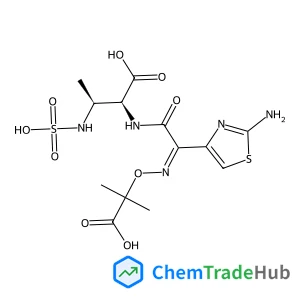
Aztreonam USP Related Compound A (Open-ring Aztreonam)
CAS Number:
87500-74-1
Molecular Formula:
C13H19N5O9S2

(R)-2-(Methylamino)propanoic acid hydrochloride
CAS Number:
1155878-14-0
Molecular Formula:
C4H10ClNO2
Recommended Suppliers






Disclaimer
This page provides academic journal information for reference and research purposes only. We are not affiliated with any journal publishers and do not handle publication submissions. For publication-related inquiries, please contact the respective journal publishers directly.
If you notice any inaccuracies in the information displayed, please contact us at support@chemtradehub.com. We will promptly review and address your concerns.