












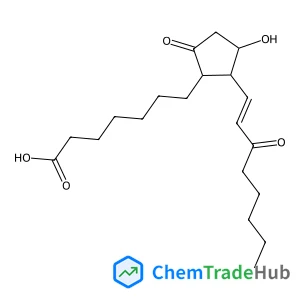
(11alpha,13E)-11-Hydroxy-9,15-dioxoprost-13-en-1-oic acid
CAS Number:
22973-19-9
Molecular Formula:
C20H32O5
Leena Nurmi, Hui Peng, Jukka Seppälä, David M. Haddleton, Idriss Blakey, Andrew K. Whittaker
A series of partly fluorinated polyelectrolytes were synthesized by transition metal mediated living radical polymerization and evaluated for their applicability as corona-forming components in 19F MRI-detectable nanoparticles in aqueous solutions. The polymers were statistical and block copolymers of trifluoroethyl methacrylate (TFEMA) and 2-(dimethylamino)ethyl methacrylate (DMAEMA). The polymers were either directly dissolved in water (statistical copolymers), or assembled into aqueous nanoparticles with PTFEMA cores and P(TFEMA-co-DMAEMA) coronas (block copolymers). The polymer composition, polymer charge density, solution ionic strength and solution pH were varied. The 19F spin–lattice (T1) and spin–spin (T2) relaxation times and 19F image intensities of solutions of the polymers were measured and related to polymer structure and aqueous conformation. The 19F NMR T2 relaxation times were found to be highly indicative of the 19F imaging performance. Maintaining sufficient mobility of the 19F nuclei was important for obtaining images of high intensity. 19F mobility could be increased by preventing their aggregation in water by exploiting electrostatic repulsion between monomer units.
James A. Jarvis, Maria Concistre, Richard W. Bounds, Ilya Kuprov, Marina Carravetta, Philip T. F. Williamson
DOI: 10.1039/C8CP06276E
Christina Kjær, Steen Brøndsted Nielsen
DOI: 10.1039/C8CP07340F
Adrian M. Mak
DOI: 10.1039/C8CP04075C
Cristina García-Iriepa, Madjid Zemmouche, Isabelle Navizet
DOI: 10.1039/C8CP07352J
Shinaj K. Rajagopal, Nagaraj K., Somadrita Deb, Vinayak Bhat, Devika Sasikumar, Ebin Sebastian, Mahesh Hariharan
DOI: 10.1039/C8CP01023D
Stella Gypser, Peter Leinweber, Dirk Freese
DOI: 10.1039/C8CP07168C
Christian Bengs, Joseph T. Hill-Cousins, Lynda J. Brown, Richard C. D. Brown, Giuseppe Pileio, Malcolm H. Levitt
DOI: 10.1039/C9CP00451C
6-(3-Fluorophenyl)picolinic acid is generally considered safe for laboratory use...
(3R)-3-Pyrrolidinol is used in the pharmaceutical industry as a precursor for dr...
When handling (4R,5R)-4,5-Diethoxycarbonyl-2,2-dimethyldioxolane (CAS: 59779-75-...
1-(6-Chloroimidazo[1,2-b]pyridazin-3-yl)ethanone is often synthesized via a mult...
The market for N-Ethyl-3,4-dimethylbenzylamine (CAS: 39180-83-1) remains steady,...
Tert-butyl 3-(pyrrolidin-1-yl)azetidine-1-carboxylate is a chemical compound wit...
1-Bromo-3-chloro-2,4-dimethoxybenzene (CAS: 1228956-93-1) falls under the classi...
The safety of 8-Bromo-2-methyl-3,4-dihydroisoquinolin-1(2H)-one (CAS: 1368622-07...
Benzyl [(3S)-2,6-dioxo-3-piperidinyl]carbamate is generally safe when handled wi...
1-{[4-(4,4,5,5-Tetramethyl-1,3,2-dioxaborolan-2-yl)phenyl]sulfonyl}pyrrolidine s...

Polymer Chemistry welcomes submissions in all areas of polymer science that have a strong focus on macromolecular chemistry. Manuscripts may cover a broad range of fields, yet no direct application focus is required.
![[4-Chloro-3-(diethylcarbamoyl)phenyl]boronic acid structure](https://static.chemtradehub.com/structs/871/871332-68-2-0e3b.webp "[4-Chloro-3-(diethylcarbamoyl)phenyl]boronic acid structure")





