













Influence of high-pressure torsion deformation on the corrosion behaviour of a bioresorbable Mg-based alloy studied by positron annihilation
Literature Information
Publication Date
2021-04-30
DOI
10.1039/D1BM00166C
Impact Factor
6.843
Authors
Philipp Brunner, Florian Brumbauer, Eva-Maria Steyskal, Oliver Renk, Annelie-Martina Weinberg, Hartmuth Schroettner, Roland Würschum
View Original
Abstract
The effect of high-pressure torsion (HPT) on the corrosion behavior of extruded ZX00 (Mg–0.45wt%Zn–0.45wt%Ca) in phosphate buffered saline solution is investigated. MgCaZn alloys are promising candidates for the use as bioresorbable implant materials and, therefore, are in the focus of current research. To improve their strength, severe plastic deformation, e.g. via the technique of HPT, can be used. Positron lifetime spectroscopy (PLS) is applied as sensitive tool for studying open-volume defects which evolve during HPT processing and subsequent corrosion. The studies were complemented by electrochemical impedance spectroscopy (EIS). In the uncorroded state, grain boundaries are the major type of positron trap as quantitatively analysed by means of diffusion-reaction models for positron trapping and annihilation in fine-grained alloys. Upon corrosion, positronium formation and annihilation indicate larger open-volume structures, such as pores and cracks, in the emerging corrosion product and oxide layers. Both PLS and EIS clearly show that HPT-deformation strongly reduces the resistance against corrosion. Evidence is found for corrosion-induced open-volume defects, presumably related to hydrogen, in deeper parts of the material below the corrosion layer.
Related Literature
Synthesis and properties of helically-folded poly(arylenediethynylene)s
Michihisa Toya
2021-05-10
Paper
DOI: 10.1039/D1PY00144B
Initiator-dependent kinetics of lyotropic liquid crystal-templated thermal polymerization
Younes Saadat, Kyungtae Kim, Reza Foudazi
2021-03-11
Paper
DOI: 10.1039/D1PY00127B
Visible light-degradable supramolecular gels comprising cross-linked polyrotaxanes capped with trithiocarbonate groups
Tae Woong Kang, Atsushi Tamura, Yoshinori Arisaka, Nobuhiko Yui
2021-06-09
Paper
DOI: 10.1039/D1PY00569C
Synthesis, characterization and self-assembly of linear and miktoarm star copolymers of exclusively immiscible polydienes
Ioannis Moutsios, Konstantina Tsitoni, Gkreti-Maria Manesi, Nikos Hadjichristidis
2021-04-12
Paper
DOI: 10.1039/D1PY00258A
Efficient synthesis of discrete oligo(fluorenediacetylene)s toward chain-length-dependent optical and structural properties
Xianheng Shi, Min Liu, Lishan Li, Jiandong Zhang, Haiyan Li, Zhihao Huang, Wei Zhang, Zhengbiao Zhang, Nianchen Zhou, Xiulin Zhu
2021-03-31
Paper
DOI: 10.1039/D1PY00165E
Polymer defect engineering – conductive 2D organic platelets from precise thiophene-doped polyethylene
Oksana Suraeva, Beomjin Jeong, Kamal Asadi, Katharina Landfester, Ingo Lieberwirth
2021-03-02
Paper
DOI: 10.1039/D1PY00117E
Polymers and boron neutron capture therapy (BNCT): a potent combination
Anaïs Pitto-Barry
2021-03-23
Review Article
DOI: 10.1039/D0PY01392G
Correlations of nanoscale film morphologies and topological confinement of three-armed cage block copolymers
Brian J. Ree, Yusuke Satoh, Takuya Isono, Toshifumi Satoh
2021-05-25
Paper
DOI: 10.1039/D1PY00421B
You might also like
Compound Q&A
What industries use (1R,3S)-1,3-Cyclopentanediol (CAS: 16326-97-9)?
(1R,3S)-1,3-Cyclopentanediol finds applications in various industries. In the ph...
16326-97-9(1R,3S)-1,3-Cyclopen...
Compound Q&A
What precautions should be taken when handling N'-[4-(Dimethylamino)phenyl]-N,N-dimethyl-1,4-benzenediamine (CAS: 637-31-0)?
When handling N'-[4-(Dimethylamino)phenyl]-N,N-dimethyl-1,4-benzenediamine, it i...
637-31-0N'-[4-(Dimethylamino...
Compound Q&A
Are there alternatives to 5-(2,4-Difluorophenyl)-2-methoxypyrimidine (CAS: 1352318-16-1) in synthesis?
There are several alternatives to 5-(2,4-Difluorophenyl)-2-methoxypyrimidine in ...
1352318-16-15-(2,4-Difluoropheny...
Compound Q&A
What regulatory guidelines apply to 1-(3-Methoxyphenoxy)propan-2-ol (CAS: 382141-68-6)?
1-(3-Methoxyphenoxy)propan-2-ol (CAS: 382141-68-6) must comply with the Globally...
382141-68-61-(3-Methoxyphenoxy)...
Compound Q&A
Is Tetrodotoxin Citrate (CAS: 18660-81-6) safe?
Tetrodotoxin Citrate is extremely dangerous and should be handled with extreme c...
18660-81-6Tetrodotoxin Citrate
Compound Q&A
What are the main uses of 2-Methyl-2-propanyl [(1R,3S)-3-hydroxycyclopentyl]carbamate (CAS: 225641-84-9)?
2-Methyl-2-propanyl [(1R,3S)-3-hydroxycyclopentyl]carbamate (CAS: 225641-84-9) i...
225641-84-92-Methyl-2-propanyl ...
Compound Q&A
How should waste containing 4-(2-Hydroxyhexafluoroisopropyl)Benzoic Acid (CAS: 16261-80-6) be handled?
Waste containing 4-(2-Hydroxyhexafluoroisopropyl)Benzoic Acid (CAS: 16261-80-6) ...
16261-80-64-(2-Hydroxyhexafluo...
Compound Q&A
How is 2-Methyl-2-proanyl {(2S)-1-[(benzyloxy)amino]-3-hydroxy-3-methyl-1-oxo-2-butanyl}carbamate (CAS: 102507-19-7) typically synthesized?
2-Methyl-2-proanyl {(2S)-1-[(benzyloxy)amino]-3-hydroxy-3-methyl-1-oxo-2-butanyl...
102507-19-72-Methyl-2-propanyl ...
Compound Q&A
What is Benzeneethanamine, α-ethyl-, hydrochloride (1:1) (CAS: 20735-15-3)?
Benzeneethanamine, α-ethyl-, hydrochloride (1:1) is an organic compound with the...
20735-15-3Benzeneethanamine, α...
Compound Q&A
Are there alternatives to 3-{(E)-[4-(Dimethylamino)phenyl]diazenyl}benzoic acid (CAS: 20691-84-3) in synthesis?
In the synthesis of compounds similar to 3-{(E)-[4-(Dimethylamino)phenyl]diazeny...
20691-84-33-{(E)-[4-(Dimethyla...
Source Journal
Biomaterials Science

CiteScore:
11.5
Self-citation Rate:
3.4%
Articles per Year:
492
Biomaterials Science is an international high impact journal exploring the science of biomaterials and their translation towards clinical use. Its scope encompasses new concepts in biomaterials design, studies into the interaction of biomaterials with the body, and the use of materials to answer fundamental biological questions. Papers do not necessarily need to report a new biomaterial but should provide novel insight into the biological applications of the biomaterial. Articles that primarily focus on demonstrating novel materials chemistry and bring a molecular picture to bear on a given material’s suitability as a biomaterial are more suited to our companion journal, Journal of Materials Chemistry B. Biomaterials Science publishes primary research and review-type articles in the following areas: molecular design of biomaterials, including translation of emerging chemistries to biomaterials science of cells and materials at the nanoscale and microscale materials as model systems for stem cell and human biology materials for tissue engineering and regenerative medicine (Nano)materials and (nano)systems for therapeutic delivery interactions at the biointerface biologically inspired and biomimetic materials, including bio-inspired self-assembly systems and cell-inspired synthetic tools next-generation biomaterials tools and methods
Recommended Compounds
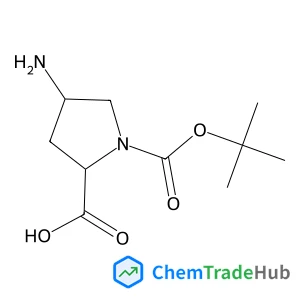
(2R,4R)-1-Boc-4-Aminopyrrolidine-2-carboxylic acid
CAS Number:
132622-98-1
Molecular Formula:
C10H18N2O4


Recommended Suppliers




Disclaimer
This page provides academic journal information for reference and research purposes only. We are not affiliated with any journal publishers and do not handle publication submissions. For publication-related inquiries, please contact the respective journal publishers directly.
If you notice any inaccuracies in the information displayed, please contact us at support@chemtradehub.com. We will promptly review and address your concerns.