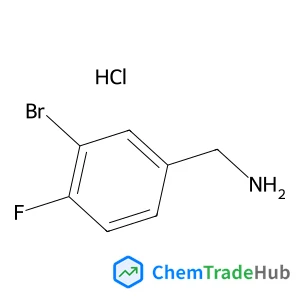
1-(3-Bromo-4-fluorophenyl)methanamine hydrochloride (1:1)
CAS Number:
202865-68-7
Molecular Formula:
C7H8BrClFN
Ferenc Zsila, Ilona Fitos
High-affinity human serum albumin (HSA) binding of the C3-substituted antimalarial 2-hydroxy-1,4-naphthoquinone derivative atovaquone (ATQ) has been demonstrated and studied by circular dichroism (CD), UV/VIS absorption, fluorescence spectroscopy and affinity chromatography methods. The analysis of induced CD data generated upon HSA binding of ATQ revealed two high-affinity binding sites (Ka ≈ 2 × 10⁶ M−1). CD interaction studies and displacement of specific fluorescent and radioactive marker ligands indicated the contribution of both principal drug binding sites of HSA to complexation of ATQ, and also suggested the possibility of simultaneous binding of ATQ and some other drugs (e.g. warfarin, phenylbutazone, diazepam). Comparison of UV/VIS spectra of ATQ measured in aqueous solutions indicated the prevalence of the anionic species formed by dissociation of the 2-hydroxyl group. HSA binding of related natural hydroxynaphthoquinones, lapachol and lawsone also induces similar CD spectra. The much weaker binding affinity of lawsone (Ka ≈ 104 M−1) bearing no C3 substituent highlights the importance of hydrophobic interactions in the strong HSA binding of ATQ and lapachol. Since neither drug exhibited significant binding to serum α1-acid glycoprotein, HSA must be the principal plasma protein for the binding and transportation of 2-hydroxy-1,4-naphthoquinone-type compounds which are ionized at physiological pH values.
Di Liu, Haoqiang Ai, Wan Tong Lou, Feifei Li, Kin Ho Lo
DOI: 10.1039/D0SE00518E
Hao Liu, Huaizhi Gao, Jun Lin, Tasawar Hayat, Ahmed Alsaedi, Zhan'ao Tan
DOI: 10.1039/D0SE00206B
Fernanda dos Santos Depoi, Tiago Charão de Oliveira, Diogo Pompéu de Moraes, Dirce Pozebon
DOI: 10.1039/C1AY05246B
N. Angulakshmi, R. Baby Dhanalakshmi, Paulina Półrolniczak, Mariusz Walkowiak, Pengfei Xie, Xiaohui Tian, Yingke Zhou, A. Manuel Stephan
DOI: 10.1039/D0SE00594K
Meng Yang, Lingjun Zhu, Yexin Zhuo, Jiacheng Liang, Shurong Wang
DOI: 10.1039/D0SE00468E
(1R,3S)-1,3-Cyclopentanediol finds applications in various industries. In the ph...
When handling N'-[4-(Dimethylamino)phenyl]-N,N-dimethyl-1,4-benzenediamine, it i...
There are several alternatives to 5-(2,4-Difluorophenyl)-2-methoxypyrimidine in ...
1-(3-Methoxyphenoxy)propan-2-ol (CAS: 382141-68-6) must comply with the Globally...
Tetrodotoxin Citrate is extremely dangerous and should be handled with extreme c...
2-Methyl-2-propanyl [(1R,3S)-3-hydroxycyclopentyl]carbamate (CAS: 225641-84-9) i...
Waste containing 4-(2-Hydroxyhexafluoroisopropyl)Benzoic Acid (CAS: 16261-80-6) ...
2-Methyl-2-proanyl {(2S)-1-[(benzyloxy)amino]-3-hydroxy-3-methyl-1-oxo-2-butanyl...
Benzeneethanamine, α-ethyl-, hydrochloride (1:1) is an organic compound with the...
In the synthesis of compounds similar to 3-{(E)-[4-(Dimethylamino)phenyl]diazeny...

Organic & Biomolecular Chemistry (OBC) publishes original and high impact research and reviews in organic chemistry. We welcome research that shows new or significantly improved protocols or methodologies in total synthesis, synthetic methodology or physical and theoretical organic chemistry as well as research that shows a significant advance in the organic chemistry or molecular design aspects of chemical biology, catalysis, supramolecular and macromolecular chemistry, theoretical chemistry, mechanism-oriented physical organic chemistry, medicinal chemistry or natural products. Articles published in the journal should report new work which makes a highly-significant impact in the field. Routine and incremental work is generally not suitable for publication in the journal. More details about key areas of our scope are below. In all cases authors should include in their article clear rationale for why their research has been carried out.
![4-[(3-Chloro-2-fluorophenyl)amino]-7-methoxy-6-quinazolinyl acetate structure](https://static.chemtradehub.com/structs/740/740081-22-5-f58f.webp "4-[(3-Chloro-2-fluorophenyl)amino]-7-methoxy-6-quinazolinyl acetate structure")