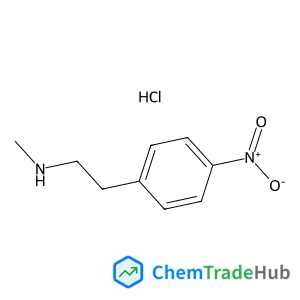
N-Methyl-2-(4-nitrophenyl)ethanamine hydrochloride (1:1)
CAS Number:
166943-39-1
Molecular Formula:
C9H13ClN2O2
The first page of this article is displayed as the abstract.
Fernando Arizti, Susana Sánchez-Gómez, Guillermo Martínez de Tejada, Klaus Brandenburg
DOI: 10.1039/C4AN01324G
DOI: 10.1039/B802679C
Erbo Ying, Erkang Wang
DOI: 10.1039/B806301J
Carolina Carrillo-Carrión, Rafael Lucena, Soledad Cárdenas, Miguel Valcárcel
DOI: 10.1039/B701019B
Ying-Fen Ran, Conor Fields, Julien Muzard, Viktoryia Liauchuk, Michael Carr, William Hall, Gil U. Lee
DOI: 10.1039/C4AN00774C
Johan Rosén, Karl-Erik Hellenäs
DOI: 10.1039/B809231A
Ning Zhang, Yuanyuan Liu, Lili Tong, Kehua Xu, Linhai Zhuo, Bo Tang
DOI: 10.1039/B803226B
Élodie Lahaye, Yun Qin, Thierry Aubry, Olivier Sire
DOI: 10.1039/C4AN00618F
Richard J. C. Brown, Andrew S. Brown
DOI: 10.1039/B806860G
When handling 2-Chloro-1,2-bis(4-methylphenyl)ethanone (CAS: 71193-32-3), it is ...
4-Ethoxy-3-(5-methyl-4-oxo-7-propyl-1,4-dihydroimidazo[5,1-f][1,2,4]triazin-2-yl...
Methyl 3-Oxo-4-Androsten-17-Carboxylate (CAS: 2681-55-2) should be stored in a c...
(R)-3-Amino-4-(3-hexylphenylamino)-4-oxobutylphosphonic acid is primarily used i...
2-Methyl-2-propanyl 3-amino-3-carbamoyl-1-azetidinecarboxylate (CAS: 1254120-14-...
There are alternative reagents that can be used in synthesis instead of (E)-4-(t...
[2-(3-Chlorophenyl)-1,3-thiazol-4-yl]methanol (CAS: 121202-20-8) is a crystallin...
The market and research trends for Methyl (2S)-[(4S)-2,2-dimethyl-1,3-dioxolan-4...
The market for 1-Bromo-2-isocyanatoethane (CAS: 42865-19-0) is driven by its use...
4-Nitro-D-phenylalanine hydrochloride (CAS: 147065-06-3) is primarily used in re...

Physical Chemistry Chemical Physics (PCCP) is an international journal co-owned by 19 physical chemistry and physics societies from around the world. This journal publishes original, cutting-edge research in physical chemistry, chemical physics and biophysical chemistry. To be suitable for publication in PCCP, articles must include significant innovation and/or insight into physical chemistry; this is the most important criterion that reviewers and Editors will judge against when evaluating submissions. The journal has a broad scope and welcomes contributions spanning experiment, theory, computation and data science. Topical coverage includes spectroscopy, dynamics, kinetics, statistical mechanics, thermodynamics, electrochemistry, catalysis, surface science, quantum mechanics, quantum computing and machine learning. Interdisciplinary research areas such as polymers and soft matter, materials, nanoscience, energy, surfaces/interfaces, and biophysical chemistry are welcomed if they demonstrate significant innovation and/or insight into physical chemistry. Joined experimental/theoretical studies are particularly appreciated when complementary and based on up-to-date approaches.