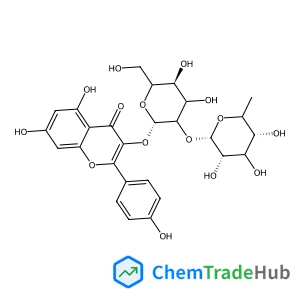
5,7-Dihydroxy-2-(4-hydroxyphenyl)-4-oxo-4H-chromen-3-yl 2-O-(6-deoxy-alpha-L-mannopyranosyl)-beta-D-glucopyranoside
CAS Number:
32602-81-6
Molecular Formula:
C27H30O15
Johan Rosén, Karl-Erik Hellenäs
A highly specific method for the analysis of β-N-methylamino-L-alanine (BMAA) by LC-MS/MS (liquid chromatography tandem mass spectrometry) has been developed and applied for cycad seeds and cyanobacteria. BMAA was analysed as a free fraction or as total BMAA after acidic hydrolysis to release any protein-bound BMAA. Deuterium labelled BMAA was synthesised and used as internal standard. The method comprises HILIC (hydrophilic interaction chromatography) and positive electrospray ionisation of the native compound, i.e. no derivatisation was used. For safe identification five specific product ions (m/z 102, 88, 76, 73 and 44), all derived from a precursor ion of m/z 119 and originating from different parts of the molecule, were detected (typical relative abundance 100%, 16%, 14%, 12% and 22% respectively). Cyanobacteria or muscle tissue was spiked with BMAA (10 to 1000 µg g−1) to validate the method (accuracy 95% to 109%, relative standard deviation 1% to 6%). The detection limit for free and total BMAA in tissue was <1 µg g−1 and <4 µg g−1 respectively. BMAA was successfully identified and quantified in cycad seeds, whereas previously reported findings of BMAA in samples of cyanobacteria could not be confirmed. Instead, the presence of α-,γ-diamino butyric acid (DAB), an isomer of BMAA, was confirmed in one sample. The possible implications of this finding are discussed.
Christoph Nançoz, Giuseppe Licari, Joseph S. Beckwith, Magnus Soederberg, Bogdan Dereka, Arnulf Rosspeintner, Oleksandr Yushchenko, Romain Letrun, Sabine Richert, Bernhard Lang, Eric Vauthey
DOI: 10.1039/C7CP08390D
Belinda J. Boehm, Charles Whidborne, Alexander L. Button, Tara L. Pukala, David M. Huang
DOI: 10.1039/C8CP02385A
Andreas Meyer, Jean Jacques Jassoy, Sebastian Spicher, Andreas Berndhäuser, Olav Schiemann
DOI: 10.1039/C8CP01276H
Satyajit Patra, Christian Anders, Paul Hendrik Schummel, Roland Winter
DOI: 10.1039/C8CP00907D
E. López, D. Ascenzi, P. Tosi, J. M. Bofill, J. de Andrés, M. Albertí, J. M. Lucas, A. Aguilar
DOI: 10.1039/C7CP06911A
Licheng Miao, Luojia Liu, Zhenfeng Shang, Yixin Li, Yong Lu, Fangyi Cheng, Jun Chen
DOI: 10.1039/C8CP00597D
Alexey Koltsov, Jean-Michel Mataigne
DOI: 10.1039/C7CP08636A
Andrea Pica, Giuseppe Graziano
DOI: 10.1039/C7CP07943E
Santhia Carmel, Adhithan Pon, N. Meenakshisundaram, R. Ramesh, Arkaprava Bhattacharyya
DOI: 10.1039/C8CP01435C
Teresa Roncal-Herrero, Alejandro Fernandez-Martinez, Adriana Matamoros-Veloza, Roland Kröger
DOI: 10.1039/C8CP00540K
When handling 2-Chloro-1,2-bis(4-methylphenyl)ethanone (CAS: 71193-32-3), it is ...
4-Ethoxy-3-(5-methyl-4-oxo-7-propyl-1,4-dihydroimidazo[5,1-f][1,2,4]triazin-2-yl...
Methyl 3-Oxo-4-Androsten-17-Carboxylate (CAS: 2681-55-2) should be stored in a c...
(R)-3-Amino-4-(3-hexylphenylamino)-4-oxobutylphosphonic acid is primarily used i...
2-Methyl-2-propanyl 3-amino-3-carbamoyl-1-azetidinecarboxylate (CAS: 1254120-14-...
There are alternative reagents that can be used in synthesis instead of (E)-4-(t...
[2-(3-Chlorophenyl)-1,3-thiazol-4-yl]methanol (CAS: 121202-20-8) is a crystallin...
The market and research trends for Methyl (2S)-[(4S)-2,2-dimethyl-1,3-dioxolan-4...
The market for 1-Bromo-2-isocyanatoethane (CAS: 42865-19-0) is driven by its use...
4-Nitro-D-phenylalanine hydrochloride (CAS: 147065-06-3) is primarily used in re...

Analyst publishes analytical and bioanalytical research that reports premier fundamental discoveries and inventions, and the applications of those discoveries, unconfined by traditional discipline barriers.
![(1R)-3-Bromo-1,7,7-trimethylbicyclo[2.2.1]heptan-2-one structure](https://static.chemtradehub.com/structs/102/10293-06-8-dd8a.webp "(1R)-3-Bromo-1,7,7-trimethylbicyclo[2.2.1]heptan-2-one structure")