












Extraction of lifetime distributions from fluorescence decays with application to DNA-base analogues
Literature Information
Publication Date
2011-01-07
DOI
10.1039/C0CP01779E
Impact Factor
3.676
Authors
Aoife C. Fogarty, Anita C. Jones, Philip J. Camp
View Original
Abstract
Several important aspects of fluorescence decay analysis are addressed and tested against new experimental measurements. A simulated-annealing method is described for deconvoluting the instrument response function from a measured fluorescence decay to yield the true decay, which is more convenient for subsequent fitting. The method is shown to perform well against the conventional approach, which is to fit a convoluted fitting function to the experimentally measured decay. The simulated annealing approach is also successfully applied to the determination of an instrument response function using a known true fluorescence decay (for rhodamine 6G). The analysis of true fluorescence decays is considered critically, focusing specifically on how a distribution of decay constants can be incorporated in to a fit. Various fitting functions are applied to the true fluorescence decays of 2-aminopurine in water–dioxane mixtures, in a dinucleotide, and in DNA duplexes. It is shown how a suitable combination of exponential decays and non-exponential decays (based on a Γ distribution of decay constants) can provide fits of equal quality to the conventional multi-exponential fits used in the majority of previous studies, but with fewer fitting parameters. Crucially, the new approach yields decay-constant distributions that are physically more meaningful than those corresponding to the conventional multi-exponential fit. The methods presented here should find wider application, for example to the analysis of transient-current or optical decays and in Förster resonance energy transfer (FRET).
Related Literature
Molecular qubits based on potentially nuclear-spin-free nickel ions
K. Bader, S. H. Schlindwein, D. Gudat
2016-12-21
Paper
DOI: 10.1039/C6CP08161D
OH production from the photolysis of isoprene-derived peroxy radicals: cross-sections, quantum yields and atmospheric implications
Robert F. Hansen, Tom R. Lewis, Lee Graham
2016-12-12
Paper
DOI: 10.1039/C6CP06718B
The discrete nature of inhomogeneity: the initial stages and local configurations of TiOPc during bilayer growth on Ag(111)
Laura Fernandez, Sebastian Thussing, Alexander Mänz, Jörg Sundermeyer, Gregor Witte, Peter Jakob
2016-12-22
Paper
DOI: 10.1039/C6CP07922A
Hysteresis phenomena in perovskite solar cells: the many and varied effects of ionic accumulation
Daniel A. Jacobs, Yiliang Wu, Heping Shen, Chog Barugkin, Fiona J. Beck, Thomas P. White, Klaus Weber, Kylie R. Catchpole
2017-01-03
Paper
DOI: 10.1039/C6CP06989D
Jahn–Teller effect in LiMn2O4: influence on charge ordering, magnetoresistance and battery performance
K. Ragavendran, H. Xia, P. Mandal, A. K. Arof
2016-12-12
Paper
DOI: 10.1039/C6CP07289E
Internal dynamics in helical molecules studied by X-ray diffraction, NMR spectroscopy and DFT calculations
Martin Dračínský, Jan Storch, Vladimír Církva, Ivana Císařová, Jan Sýkora
2017-01-03
Paper
DOI: 10.1039/C6CP07552E
Double electron–electron resonance with multiple non-selective chirp refocusing
Andrin Doll, Gunnar Jeschke
2016-12-08
Paper
DOI: 10.1039/C6CP07262C
On the ionophoric selectivity of nonactin and related macrotetrolide derivatives
Bruno Martínez-Haya, Juan Ramón Avilés-Moreno, Said Hamad, José Elguero
2016-12-06
Paper
DOI: 10.1039/C6CP05324F
A new potential for methylammonium lead iodide
C. M. Handley, C. L. Freeman
2016-12-08
Paper
DOI: 10.1039/C6CP05829A
You might also like
Compound Q&A
Is 2-(2-chloroacetamido)-3-phenylpropanoic acid (CAS: 7765-11-9) safe?
2-(2-Chloroacetamido)-3-phenylpropanoic acid (CAS: 7765-11-9) is generally consi...
7765-11-92-(2-chloroacetamido...
Compound Q&A
Is 2-(Benzyloxy)-5-bromobenzoic acid (CAS: 62176-31-2) safe?
2-(Benzyloxy)-5-bromobenzoic acid can be handled safely if appropriate precautio...
62176-31-22-(Benzyloxy)-5-brom...
Compound Q&A
What is (4-Methyl-1,2,5-oxadiazol-3-yl)methanamine hydrochloride (CAS: 1159825-48-5)?
(4-Methyl-1,2,5-oxadiazol-3-yl)methanamine hydrochloride is a chemical compound ...
1159825-48-5(4-Methyl-1,2,5-oxad...
Compound Q&A
What is 2-(5-Hexylthiophen-2-yl)-4,4,5,5-tetramethyl-1,3,2-dioxaborolane (CAS: 917985-54-7)?
2-(5-Hexylthiophen-2-yl)-4,4,5,5-tetramethyl-1,3,2-dioxaborolane (CAS: 917985-54...
917985-54-72-(5-Hexylthiophen-2...
Compound Q&A
Are there alternatives to 4-(8-Methyl-9H-1,3-dioxolo[4,5-h][2,3]benzodiazepin-5-yl)benzenamine (CAS: 102771-26-6) in synthesis?
While 4-(8-Methyl-9H-1,3-dioxolo[4,5-h][2,3]benzodiazepin-5-yl)benzenamine (CAS:...
102771-26-64-(8-Methyl-9H-1,3-d...
Compound Q&A
What is the market or research trend for tert-butyl 3-hydroxy-4,5,7,8-tetrahydro-2H-pyrazolo[3,4-d]azepine-6-carboxylate (CAS: 851376-80-2)?
The market for tert-butyl 3-hydroxy-4,5,7,8-tetrahydro-2H-pyrazolo[3,4-d]azepine...
851376-80-2tert-butyl 3-hydroxy...
Compound Q&A
How should waste containing 3,5-Diamino-1H-pyrazole-4-carbonitrile (CAS: 6844-58-2) be handled?
Waste containing 3,5-Diamino-1H-pyrazole-4-carbonitrile (CAS: 6844-58-2) should ...
6844-58-23,5-Diamino-1H-pyraz...
Compound Q&A
How is (6-Fluoro-3-pyridinyl)boronic acid (CAS: 351019-18-6) typically synthesized?
(6-Fluoro-3-pyridinyl)boronic acid can be synthesized through the reaction of 6-...
351019-18-6(6-Fluoro-3-pyridiny...
Compound Q&A
What industries use Dibenzyl carbonimidoylbiscarbamate (CAS: 10065-79-9)?
Dibenzyl carbonimidoylbiscarbamate (CAS: 10065-79-9) finds applications in vario...
10065-79-9Dibenzyl carbonimido...
Compound Q&A
What is the market or research trend for (beta,beta,2,3,4,5,6-~2~H_7_)Phenylalanine (CAS: 74228-83-4)?
The market for (beta,beta,2,3,4,5,6-~2~H_7_)Phenylalanine (CAS: 74228-83-4) is g...
74228-83-4(beta,beta,2,3,4,5,6...
Source Journal
Physical Chemistry Chemical Physics

CiteScore:
5.5
Self-citation Rate:
10.3%
Articles per Year:
3036
Physical Chemistry Chemical Physics (PCCP) is an international journal co-owned by 19 physical chemistry and physics societies from around the world. This journal publishes original, cutting-edge research in physical chemistry, chemical physics and biophysical chemistry. To be suitable for publication in PCCP, articles must include significant innovation and/or insight into physical chemistry; this is the most important criterion that reviewers and Editors will judge against when evaluating submissions. The journal has a broad scope and welcomes contributions spanning experiment, theory, computation and data science. Topical coverage includes spectroscopy, dynamics, kinetics, statistical mechanics, thermodynamics, electrochemistry, catalysis, surface science, quantum mechanics, quantum computing and machine learning. Interdisciplinary research areas such as polymers and soft matter, materials, nanoscience, energy, surfaces/interfaces, and biophysical chemistry are welcomed if they demonstrate significant innovation and/or insight into physical chemistry. Joined experimental/theoretical studies are particularly appreciated when complementary and based on up-to-date approaches.
Recommended Compounds
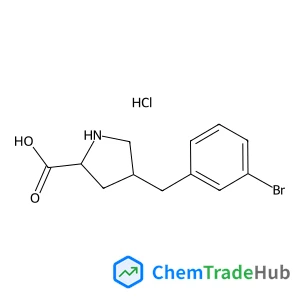
(2S,4R)-4-(3-Bromobenzyl)pyrrolidine-2-carboxylic acid hydrochloride
CAS Number:
1049734-10-2
Molecular Formula:
C12H15BrClNO2
![3-[4-(difluoromethoxy)phenyl]-2-({[(9H-fluoren-9-yl)methoxy]carbonyl}amino)propanoic acid structure](https://static.chemtradehub.com/structs/149/1496564-27-2-952e.webp "3-[4-(difluoromethoxy)phenyl]-2-({[(9H-fluoren-9-yl)methoxy]carbonyl}amino)propanoic acid structure")
3-[4-(difluoromethoxy)phenyl]-2-({[(9H-fluoren-9-yl)methoxy]carbonyl}amino)propanoic acid
CAS Number:
1496564-27-2
Molecular Formula:
C25H21F2NO5
![(3S,4aS,8aS)-2-[(2R,3S)-3-Amino-2-hydroxy-4-phenylbutyl]-N-(2-methyl-2-propanyl)decahydro-3-isoquinolinecarboxamide structure](https://static.chemtradehub.com/structs/136/136522-17-3-4d77.webp "(3S,4aS,8aS)-2-[(2R,3S)-3-Amino-2-hydroxy-4-phenylbutyl]-N-(2-methyl-2-propanyl)decahydro-3-isoquinolinecarboxamide structure")
(3S,4aS,8aS)-2-[(2R,3S)-3-Amino-2-hydroxy-4-phenylbutyl]-N-(2-methyl-2-propanyl)decahydro-3-isoquinolinecarboxamide
CAS Number:
136522-17-3
Molecular Formula:
C24H39N3O2
Recommended Suppliers






Disclaimer
This page provides academic journal information for reference and research purposes only. We are not affiliated with any journal publishers and do not handle publication submissions. For publication-related inquiries, please contact the respective journal publishers directly.
If you notice any inaccuracies in the information displayed, please contact us at support@chemtradehub.com. We will promptly review and address your concerns.