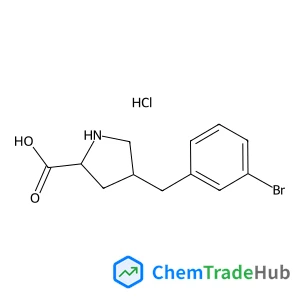
(2S,4R)-4-(3-Bromobenzyl)pyrrolidine-2-carboxylic acid hydrochloride
CAS Number:
1049734-10-2
Molecular Formula:
C12H15BrClNO2
Jianying Shi, Zhaochi Feng, Mingrun Li, Can Li
Various sized ZnS nanocrystals were prepared by treatment under H2S atmosphere. Resonance Raman spectra indicate that the electron–phonon coupling increases with increasing the size of ZnS. Surface and interfacial defects are formed during the treatment processes. Blue, green and orange emissions are observed for these ZnS. The blue emission (430 nm) from ZnS without treatment is attributed to surface states. ZnS sintered at 873 K displays orange luminescence (620 nm) while ZnS treated at 1173 K shows green emission (515 nm). The green luminescence is assigned to the electron transfer from sulfur vacancies to interstitial sulfur states, and the orange emission is caused by the recombination between interstitial zinc states and zinc vacancies. The lifetimes of the orange emission are much slower than that of the green luminescence and sensitively dependent on the treatment temperature. Controlling defect formation makes ZnS a potential material for photoelectrical applications.
Damayanti Bagchi, Tuhin Kumar Maji, Samim Sardar, Chinmoy Bhattacharya, Debjani Karmakar, Samir Kumar Pal
DOI: 10.1039/C6CP08016B
Hongqin Li, Haijun Ye, Zheng Xu, Chuanyi Wang, Jiao Yin
DOI: 10.1039/C6CP07569J
DOI: 10.1039/C6CP07374C
Yoan M. Delavoux, Mark Gilmore, Martin P. Atkins, Małgorzata Swadźba-Kwaśny, John D. Holbrey
DOI: 10.1039/C6CP07790K
Masakazu Furuta, Tomotsumi Fujisawa, Hiroyasu Urago, Takahiro Eguchi, Takahito Shingae, Satoshi Takahashi, Ewan W. Blanch, Masashi Unno
DOI: 10.1039/C6CP07828A
Simon Loftager, Juan María García-Lastra, Tejs Vegge
DOI: 10.1039/C6CP06312H
Deivis Plausinaitis, Linas Sinkevicius, Lina Mikoliunaite, Valentina Plausinaitiene, Almira Ramanaviciene
DOI: 10.1039/C6CP06545G
Kazuhiko Matsumoto, Ryojun Nonaka, Yushen Wang, Gleb Veryasov, Rika Hagiwara
DOI: 10.1039/C6CP07992J
Kyoungmin Min, Seung-Woo Seo, You Young Song, Hyo Sug Lee, Eunseog Cho
DOI: 10.1039/C6CP06270A
2-(2-Chloroacetamido)-3-phenylpropanoic acid (CAS: 7765-11-9) is generally consi...
2-(Benzyloxy)-5-bromobenzoic acid can be handled safely if appropriate precautio...
(4-Methyl-1,2,5-oxadiazol-3-yl)methanamine hydrochloride is a chemical compound ...
2-(5-Hexylthiophen-2-yl)-4,4,5,5-tetramethyl-1,3,2-dioxaborolane (CAS: 917985-54...
While 4-(8-Methyl-9H-1,3-dioxolo[4,5-h][2,3]benzodiazepin-5-yl)benzenamine (CAS:...
The market for tert-butyl 3-hydroxy-4,5,7,8-tetrahydro-2H-pyrazolo[3,4-d]azepine...
Waste containing 3,5-Diamino-1H-pyrazole-4-carbonitrile (CAS: 6844-58-2) should ...
(6-Fluoro-3-pyridinyl)boronic acid can be synthesized through the reaction of 6-...
Dibenzyl carbonimidoylbiscarbamate (CAS: 10065-79-9) finds applications in vario...
The market for (beta,beta,2,3,4,5,6-~2~H_7_)Phenylalanine (CAS: 74228-83-4) is g...

Physical Chemistry Chemical Physics (PCCP) is an international journal co-owned by 19 physical chemistry and physics societies from around the world. This journal publishes original, cutting-edge research in physical chemistry, chemical physics and biophysical chemistry. To be suitable for publication in PCCP, articles must include significant innovation and/or insight into physical chemistry; this is the most important criterion that reviewers and Editors will judge against when evaluating submissions. The journal has a broad scope and welcomes contributions spanning experiment, theory, computation and data science. Topical coverage includes spectroscopy, dynamics, kinetics, statistical mechanics, thermodynamics, electrochemistry, catalysis, surface science, quantum mechanics, quantum computing and machine learning. Interdisciplinary research areas such as polymers and soft matter, materials, nanoscience, energy, surfaces/interfaces, and biophysical chemistry are welcomed if they demonstrate significant innovation and/or insight into physical chemistry. Joined experimental/theoretical studies are particularly appreciated when complementary and based on up-to-date approaches.
![Ethyl ({[(2-methyl-2-propanyl)oxy]carbonyl}amino)(2-pyridinyl)acetate structure](https://static.chemtradehub.com/structs/313/313490-90-3-dd15.webp "Ethyl ({[(2-methyl-2-propanyl)oxy]carbonyl}amino)(2-pyridinyl)acetate structure")
![3-[4-(difluoromethoxy)phenyl]-2-({[(9H-fluoren-9-yl)methoxy]carbonyl}amino)propanoic acid structure](https://static.chemtradehub.com/structs/149/1496564-27-2-952e.webp "3-[4-(difluoromethoxy)phenyl]-2-({[(9H-fluoren-9-yl)methoxy]carbonyl}amino)propanoic acid structure")