













The photodissociation of NO2 by visible and ultraviolet light
Literature Information
Publication Date
2010-11-16
DOI
10.1039/C0CP01551B
Impact Factor
3.676
Authors
Iain Wilkinson, Ivan Anton Garcia, Benjamin J. Whitaker, Jean-Benoît Hamard, Valérie Blanchet
View Original
Abstract
We present velocity map images of the NO, O(3PJ) and O(1S0) photofragments from NO2 excited in the range 7.6 to 9.0 eV. The molecule was initially pumped with a visible photon between 2.82–2.95 eV (440–420 nm), below the first dissociation threshold. A second ultraviolet laser with photon energies between 4.77 and 6.05 eV (260–205 nm) was used to pump high-lying excited states of neutral NO2 and/or probe neutral photoproducts. Analysis of the kinetic energy release spectra revealed that the NO photofragments were predominantly formed in their ground electronic state with little kinetic energy. The O(3PJ) and O(1S0) kinetic energy distributions were also dominated by kinetically ‘cold’ fragments. We discuss the possible excitation schemes and conclude that the unstable photoexcited states probed in the experiment were Rydberg states coupled to dissociative valence states. We compare our results with recent time-resolved studies using similar excitation and probe photon energies.
Related Literature
Experimental and simulation studies of the electron transfer reaction between [Ru(NH3)5pz]2+ and [Co(C2O4)3]3−
Pilar Pérez-Tejeda, Francisco-Javier Franco, Antonio Sánchez, Manuel Morillo, Claus Denk, Francisco Sánchez
2001-03-06
Paper
DOI: 10.1039/B009004M
A theoretical study of the thermal decomposition of fluoromethanethiol (CH2FSH)
Paper
DOI: 10.1039/A904748D
Predicting the binding energies of H-bonded complexes: A comparative DFT study
Paper
DOI: 10.1039/A904357H
A theoretical study of molecular titanium oxide clusters: structure, bonding, vibrations and stability
Paper
DOI: 10.1039/A904269E
ATR-IR spectroscopic studies of the formation of sulfuric acid and sulfuric acid monohydrate films
Paper
DOI: 10.1039/A904544I
The photoexcited triplet state of free-base porphycene: a time-resolved EPR and electron spin echo investigation
Paper
DOI: 10.1039/A903382C
Molecular simulation of the vapour–liquid phase coexistence of neon and argon using ab initio potentials
Patrick S. Vogt, Rail Liapine, Barbara Kirchner, Anthony J. Dyson, Hanspeter Huber, Gianluca Marcelli, Richard J. Sadus
2001-03-02
Paper
DOI: 10.1039/B008061F
Chromium silsesquioxane based synthesis and characterization of a microporous Cr–Si–O material
Paper
DOI: 10.1039/A903684I
You might also like
Compound Q&A
What are the main uses of 4-Nitrophenyl phosphate disodium salt hexahydrate (CAS: 333338-18-4)?
4-Nitrophenyl phosphate disodium salt hexahydrate is primarily used as a substra...
333338-18-44-Nitrophenyl phosph...
Compound Q&A
What are the main uses of 2-(Trifluoromethyl)-1,3-oxazole-4-carboxylic Acid (CAS: 1060816-01-4)?
2-(Trifluoromethyl)-1,3-oxazole-4-carboxylic Acid (CAS: 1060816-01-4) is widely ...
1060816-01-42-(Trifluoromethyl)-...
Compound Q&A
How should 2-Fluoro-4-biphenylcarboxylic acid (CAS: 137045-30-8) be stored?
2-Fluoro-4-biphenylcarboxylic acid should be stored in a cool, dry place at room...
137045-30-82-Fluoro-4-biphenylc...
Compound Q&A
What industries use Prednisolone-21-Carboxylic Acid (CAS: 61549-70-0)?
Prednisolone-21-Carboxylic Acid is primarily used in the pharmaceutical industry...
61549-70-0Prednisolone-21-Carb...
Compound Q&A
How should 4-(Hydrazinomethyl)-1,2,3-benzenetriol (CAS: 3614-72-0) be stored?
4-(Hydrazinomethyl)-1,2,3-benzenetriol (CAS: 3614-72-0) should be stored in a co...
3614-72-04-(Hydrazinomethyl)-...
Compound Q&A
What industries use 4-Amino-1-methyl-1H-pyrazole-5-carboxylic acid hydrochloride (CAS: 92534-70-8)?
4-Amino-1-methyl-1H-pyrazole-5-carboxylic acid hydrochloride (CAS: 92534-70-8) i...
92534-70-84-Amino-1-methyl-1H-...
Compound Q&A
What regulatory guidelines apply to dehydropachymic acid (CAS: 77012-31-8)?
Dehydropachymic acid (CAS: 77012-31-8) is regulated by various agencies. It fall...
77012-31-8Dehydropachymic acid
Compound Q&A
What is the market or research trend for 6-[(2,2-Dimethylpropanoyl)amino]nicotinic acid (CAS: 898561-66-5)?
The market and research trends for 6-[(2,2-Dimethylpropanoyl)amino]nicotinic aci...
898561-66-56-[(2,2-Dimethylprop...
Compound Q&A
How should 1,10-Phenanthroline-2,9-dicarbaldehyde (CAS: 57709-62-3) be stored?
1,10-Phenanthroline-2,9-dicarbaldehyde should be stored in a cool, dry place awa...
57709-62-31,10-Phenanthroline-...
Compound Q&A
How is 5-Carbamoyl-11-oxo-10,11-dihydro-5H-dibenzo[b,f]azepin-10-yl acetate (CAS: 113952-21-9) typically synthesized?
5-Carbamoyl-11-oxo-10,11-dihydro-5H-dibenzo[b,f]azepin-10-yl acetate can be synt...
113952-21-95-Carbamoyl-11-oxo-1...
Source Journal
Physical Chemistry Chemical Physics

CiteScore:
5.5
Self-citation Rate:
10.3%
Articles per Year:
3036
Physical Chemistry Chemical Physics (PCCP) is an international journal co-owned by 19 physical chemistry and physics societies from around the world. This journal publishes original, cutting-edge research in physical chemistry, chemical physics and biophysical chemistry. To be suitable for publication in PCCP, articles must include significant innovation and/or insight into physical chemistry; this is the most important criterion that reviewers and Editors will judge against when evaluating submissions. The journal has a broad scope and welcomes contributions spanning experiment, theory, computation and data science. Topical coverage includes spectroscopy, dynamics, kinetics, statistical mechanics, thermodynamics, electrochemistry, catalysis, surface science, quantum mechanics, quantum computing and machine learning. Interdisciplinary research areas such as polymers and soft matter, materials, nanoscience, energy, surfaces/interfaces, and biophysical chemistry are welcomed if they demonstrate significant innovation and/or insight into physical chemistry. Joined experimental/theoretical studies are particularly appreciated when complementary and based on up-to-date approaches.
Recommended Compounds
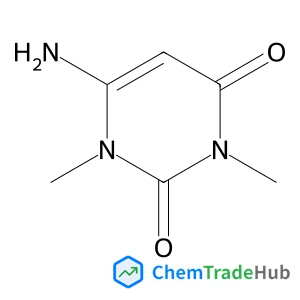
6-amino-1,3-dimethyl-1,2,3,4-tetrahydropyrimidine-2,4-dione
CAS Number:
6642-31-5
Molecular Formula:
C6H9N3O2
Recommended Suppliers





Disclaimer
This page provides academic journal information for reference and research purposes only. We are not affiliated with any journal publishers and do not handle publication submissions. For publication-related inquiries, please contact the respective journal publishers directly.
If you notice any inaccuracies in the information displayed, please contact us at support@chemtradehub.com. We will promptly review and address your concerns.