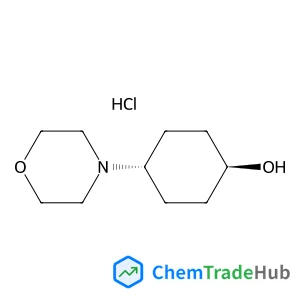
trans-4-(4-Morpholinyl)cyclohexanol hydrochloride (1:1)
CAS Number:
1588441-09-1
Molecular Formula:
C10H20ClNO2
Carolina Estarellas, Antonio Bauzá, Antonio Frontera, David Quiñonero, Pere M. Deyà
The directionality of two important noncovalent interactions involving aromatic rings (namely anion–π and cation–π) is investigated. It has been recently published that the anion–π interactions observed in X-ray structures where the anion is located exactly over the center of the ring are scarce compared to cation–π interactions. To explain this behavior, we have analyzed how the interaction energy (RI-MP2/aug-cc-pVDZ level of theory) is affected by moving the anion from the center of the ring to several directions in anion–π complexes of chloride with either hexafluorobenzene or trifluoro-s-triazine. We have compared the results with the directionality of the cation–π interaction in the sodium–benzene complex. The results are useful to explain the experimental differences between both ion–π interactions. We have also computed the van der Waals radii of several halide anions and we have compared them to the neutral halogen atoms.

Journal of Heterocyclic Chemistry

Proceedings of the National Academy of Sciences of the United States of America

Journal of Medicinal Chemistry

Pure and Applied Chemistry

Organic Preparations and Procedures International

Pharmacological Reviews

Journal of Catalysis

Israel Journal of Chemistry

Kinetics and Catalysis

Journal of Physics and Chemistry of Solids
Paulina Sierra-Rosales, Alvaro Muñoz-Castro, José Heráclito Zagal, Fernando Mendizábal
DOI: 10.1039/C6CP06156G
Zhicong Liang, Xiaofeng Fan
DOI: 10.1039/C6CP04984B
Gunnar Jeschke, Maxim Yulikov
DOI: 10.1039/C6CP05904J
Wenjuan Wang, Xiehuang Sheng, Shaolong Zhang, Fang Huang, Chuanzhi Sun, Jianbiao Liu, Dezhan Chen
DOI: 10.1039/C6CP05594J
David A. Tompsett, Mayeul d'Avezac, Gregory J. Offer, Nigel P. Brandon, Nicholas M. Harrison
DOI: 10.1039/C6CP04694K
Andrea Bianco, Giorgio Ferrari, Rossella Castagna, Andrea Rossi, Marco Carminati, Giorgio Pariani, Matteo Tommasini
DOI: 10.1039/C6CP05609A
Shuguang Chen, Hailang Jia, Mengxi Zheng, Kang Shen, Hegen Zheng
DOI: 10.1039/C6CP05173A
Rafael L. H. Freire, Adam Kiejna, Juarez L. F. Da Silva
DOI: 10.1039/C6CP05620B
Xiaojie Liu, Cai-Zhuang Wang, Myron Hupalo, Kai-Ming Ho, Patricia A. Thiel, Michael C. Tringides
DOI: 10.1039/C6CP05639C
Ethyl 4-chlorothieno[2,3-b]pyridine-5-carboxylate (CAS: 59713-58-5) can be synth...
5-Methyl-1H-indole-3-carbaldehyde (CAS: 52562-50-2) is subject to various regula...
(1,3-Dimethyl-2,4-dioxo-1,2,3,4-tetrahydro-5-pyrimidinyl)boronic acid is a white...
Waste containing Sulfocostunolide A (CAS: 1016983-51-9) should be handled with c...
When handling Murraxocin (CAS: 88478-44-8), ensure proper personal protective eq...
Formvar (CAS: 63148-64-1) is an alkyd resin characterized by a high molecular we...
(S)-4-benzyl-2-((benzyloxy)methyl)morpholine is generally safe when handled with...
Methyl 1-(5-bromo-2-pyrimidinyl)cyclopropanecarboxylate (CAS: 1447607-69-3) is p...
2-Methyl-1-phenyl-1-propanamine hydrochloride (CAS: 24290-47-9) is generally con...
3-(4-Bromophenyl)-2-methylpropanoic acid is synthesized through a multi-step pro...

Physical Chemistry Chemical Physics (PCCP) is an international journal co-owned by 19 physical chemistry and physics societies from around the world. This journal publishes original, cutting-edge research in physical chemistry, chemical physics and biophysical chemistry. To be suitable for publication in PCCP, articles must include significant innovation and/or insight into physical chemistry; this is the most important criterion that reviewers and Editors will judge against when evaluating submissions. The journal has a broad scope and welcomes contributions spanning experiment, theory, computation and data science. Topical coverage includes spectroscopy, dynamics, kinetics, statistical mechanics, thermodynamics, electrochemistry, catalysis, surface science, quantum mechanics, quantum computing and machine learning. Interdisciplinary research areas such as polymers and soft matter, materials, nanoscience, energy, surfaces/interfaces, and biophysical chemistry are welcomed if they demonstrate significant innovation and/or insight into physical chemistry. Joined experimental/theoretical studies are particularly appreciated when complementary and based on up-to-date approaches.
![4-{1-[4-(4,4,5,5-Tetramethyl-1,3,2-dioxaborolan-2-yl)phenyl]cyclopropyl}morpholine structure](https://static.chemtradehub.com/structs/120/1206594-08-2-7afb.webp "4-{1-[4-(4,4,5,5-Tetramethyl-1,3,2-dioxaborolan-2-yl)phenyl]cyclopropyl}morpholine structure")
![4-[(1-Methyl-1H-pyrrol-2-yl)methylene]-1,3(2H,4H)-isoquinolinedione structure](https://static.chemtradehub.com/structs/110/1104546-89-5-a600.webp "4-[(1-Methyl-1H-pyrrol-2-yl)methylene]-1,3(2H,4H)-isoquinolinedione structure")