












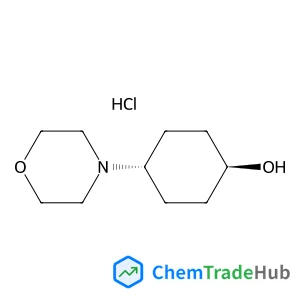
trans-4-(4-Morpholinyl)cyclohexanol hydrochloride (1:1)
CAS Number:
1588441-09-1
Molecular Formula:
C10H20ClNO2
A graphical abstract is available for this content
Hashem Shahroosvand, Fahimeh Nasouti, Ahmad Sousaraei, Ezeddin Mohajerani, Amir Khabbazi
DOI: 10.1039/C3CP51141C
Dage Sundholm
DOI: 10.1039/C3CP51042E
Monika Stolar, Thomas Baumgartner
DOI: 10.1039/C3CP51379C
Yingchao Yu, Weidong Zhou, Hao Chen, Francis J. DiSalvo, Héctor D. Abruña
DOI: 10.1039/C3CP51551F
Jonas Elm, Solvejg Jørgensen, Merete Bilde, Kurt V. Mikkelsen
DOI: 10.1039/C3CP50192B
Kritapas Laohhasurayotin, Duangkamon Viboonratanasri
DOI: 10.1039/C3CP50872B
Nadine Hauptmann, Christian Hamann, Richard Berndt
DOI: 10.1039/C3CP51023A
Indrek Must, Urmas Johanson, Friedrich Kaasik, Inga Põldsalu, Andres Punning, Alvo Aabloo
DOI: 10.1039/C3CP51526E
Wenliang Wang, Daodao Hu, Jian Lü
DOI: 10.1039/C3CP51275D
Deby Fapyane, Soo-Jin Lee, Seo-Hee Kang, Du-Hyun Lim, Kwon-Koo Cho, Tae-hyun Nam, Jae-Pyoung Ahn, Jou-Hyeon Ahn, Seon-Won Kim, In Seop Chang
DOI: 10.1039/C3CP51864G
Ethyl 4-chlorothieno[2,3-b]pyridine-5-carboxylate (CAS: 59713-58-5) can be synth...
5-Methyl-1H-indole-3-carbaldehyde (CAS: 52562-50-2) is subject to various regula...
(1,3-Dimethyl-2,4-dioxo-1,2,3,4-tetrahydro-5-pyrimidinyl)boronic acid is a white...
Waste containing Sulfocostunolide A (CAS: 1016983-51-9) should be handled with c...
When handling Murraxocin (CAS: 88478-44-8), ensure proper personal protective eq...
Formvar (CAS: 63148-64-1) is an alkyd resin characterized by a high molecular we...
(S)-4-benzyl-2-((benzyloxy)methyl)morpholine is generally safe when handled with...
Methyl 1-(5-bromo-2-pyrimidinyl)cyclopropanecarboxylate (CAS: 1447607-69-3) is p...
2-Methyl-1-phenyl-1-propanamine hydrochloride (CAS: 24290-47-9) is generally con...
3-(4-Bromophenyl)-2-methylpropanoic acid is synthesized through a multi-step pro...

Physical Chemistry Chemical Physics (PCCP) is an international journal co-owned by 19 physical chemistry and physics societies from around the world. This journal publishes original, cutting-edge research in physical chemistry, chemical physics and biophysical chemistry. To be suitable for publication in PCCP, articles must include significant innovation and/or insight into physical chemistry; this is the most important criterion that reviewers and Editors will judge against when evaluating submissions. The journal has a broad scope and welcomes contributions spanning experiment, theory, computation and data science. Topical coverage includes spectroscopy, dynamics, kinetics, statistical mechanics, thermodynamics, electrochemistry, catalysis, surface science, quantum mechanics, quantum computing and machine learning. Interdisciplinary research areas such as polymers and soft matter, materials, nanoscience, energy, surfaces/interfaces, and biophysical chemistry are welcomed if they demonstrate significant innovation and/or insight into physical chemistry. Joined experimental/theoretical studies are particularly appreciated when complementary and based on up-to-date approaches.
![4-[(1-Methyl-1H-pyrrol-2-yl)methylene]-1,3(2H,4H)-isoquinolinedione structure](https://static.chemtradehub.com/structs/110/1104546-89-5-a600.webp "4-[(1-Methyl-1H-pyrrol-2-yl)methylene]-1,3(2H,4H)-isoquinolinedione structure")
![9H-Fluoren-9-ylmethyl [(2S)-1-hydroxy-3-(1H-indol-3-yl)-2-propanyl]carbamate structure](https://static.chemtradehub.com/structs/153/153815-60-2-a67d.webp "9H-Fluoren-9-ylmethyl [(2S)-1-hydroxy-3-(1H-indol-3-yl)-2-propanyl]carbamate structure")




