












Electrochemical formation and investigation of a self-assembled [60]fullerene monolayer
Literature Information
Publication Date
2010-10-18
DOI
10.1039/C0CP01360A
Impact Factor
3.676
Authors
J. G. Limon-Petersen, R. G. Compton
View Original
Abstract
The formation and characterisation of a C60 monolayer at the electrode|electrolyte interface has been studied by cyclic voltammetry, potential step chronoamperometry and ac voltammetry. The presence of the monolayer is evidenced by the presence of a very sharp peak P in the voltammogram, attributed to the faradaic phase formation of an ordered monolayer, and of a reduction post peak Q associated with the reduction of adsorbed species. The chronoamperograms exhibit a well-defined maximum, characteristic of a nucleation and growth mechanism. By comparison with existing models of phase transitions, a progressive polynucleation and growth mechanism is demonstrated. The monolayer is proposed to consist of a 2D fulleride salt. It is suggested that the formation of the monolayer can take place for a broad range of solution compositions, but requires an atomically smooth substrate such as mercury.
Related Literature
An in situ cross-linked 1D/3D perovskite heterostructure improves the stability of hybrid perovskite solar cells for over 3000 h operation
Ning Yang, Cheng Zhu, Yihua Chen, Huachao Zai, Chenyue Wang, Xi Wang, Hao Wang, Sai Ma, Ziyan Gao, Xueyun Wang, Jiawang Hong, Yang Bai, Huanping Zhou
2020-09-28
Paper
DOI: 10.1039/D0EE01736A
Potential and limitations of CsBi3I10 as a photovoltaic material
Paz Sebastia-Luna, María C. Gélvez-Rueda, Chris Dreessen, Michele Sessolo, Ferdinand C. Grozema, Francisco Palazon, Henk J. Bolink
2020-05-12
Communication
DOI: 10.1039/D0TA02237C
The intrinsic thermal-oxidative stabilization effect of chemically reduced graphene oxide on polypropylene
Junlong Yang, Yajiang Huang, Yadong Lv, Pengfei Zhao, Qi Yang, Guangxian Li
2013-07-24
Paper
DOI: 10.1039/C3TA11989K
Natural product modulators of human sensations and mood: molecular mechanisms and therapeutic potential
Tomáš Pluskal
2017-09-21
Review Article
DOI: 10.1039/C7CS00411G
Function-oriented synthesis of two-dimensional (2D) covalent organic frameworks – from 3D solids to 2D sheets
Xing Li, Priya Yadav, Kian Ping Loh
2020-06-03
Review Article
DOI: 10.1039/D0CS00236D
Biomimetic electro-oxidation of alkyl sulfides from exfoliated molybdenum disulfide nanosheets
Lahcene Maachou, Kun Qi, Eddy Petit, Zhaodan Qin, Yang Zhang, Didier Cot, Valérie Flaud, Corine Reibel, Heba El-Maghrbi, Lei Li, Philippe Miele, Daniel Kaplan, Manish Chhowalla, Nicolas Onofrio, Damien Voiry
2020-11-10
Paper
DOI: 10.1039/D0TA09045J
Facile synthesis of Pd–Pt alloy concave nanocubes with high-index facets as electrocatalysts for methanol oxidation
Fangwei Zhan, Ting Bian, Wengao Zhao, Hui Zhang, Mingshang Jin, Deren Yang
2014-01-09
Paper
DOI: 10.1039/C3CE42362J
Diffusion NMR of molecular cages and capsules
Liat Avram, Yoram Cohen
2014-08-11
Review Article
DOI: 10.1039/C4CS00197D
You might also like
Compound Q&A
What are the main uses of (5-Sulfamoyl-3-pyridinyl)boronic acid (CAS: 951233-61-7)?
(5-Sulfamoyl-3-pyridinyl)boronic acid is primarily used in chemical synthesis, p...
951233-61-7(5-Sulfamoyl-3-pyrid...
Compound Q&A
How is Benzyl 2-methyl-2-(methylsulfonyl)-4-pentenoate (CAS: 1942858-50-5) typically synthesized?
Benzyl 2-methyl-2-(methylsulfonyl)-4-pentenoate is typically synthesized via est...
1942858-50-5Benzyl 2-methyl-2-(m...
Compound Q&A
What precautions should be taken when handling 8-Fluoroquinolin-6-ol (CAS: 209353-22-0)?
When handling 8-Fluoroquinolin-6-ol (CAS: 209353-22-0), it is important to use p...
209353-22-08-Fluoroquinolin-6-o...
Compound Q&A
What are the physical and chemical properties of 1,3-Dibromo-5-(2-methyl-2-propanyl)benzene (CAS: 129316-09-2)?
1,3-Dibromo-5-(2-methyl-2-propanyl)benzene (CAS: 129316-09-2) is a crystalline c...
129316-09-21,3-Dibromo-5-(2-met...
Compound Q&A
What industries use Ethyl 7-chloro-4-oxo-1-(1,3-thiazol-2-yl)-1,4-dihydro-1,8-naphthyridine-3-carboxylate (CAS: 174726-87-5)?
Ethyl 7-chloro-4-oxo-1-(1,3-thiazol-2-yl)-1,4-dihydro-1,8-naphthyridine-3-carbox...
174726-87-5Ethyl 7-chloro-4-oxo...
Compound Q&A
What precautions should be taken when handling Delta-7-Avenasterol (CAS: 23290-26-8)?
When handling Delta-7-Avenasterol (CAS: 23290-26-8), it is important to wear app...
23290-26-8Delta-7-Avenasterol
Compound Q&A
What precautions should be taken when handling N-({(5R)-3-[3-Fluoro-4-(4-morpholinyl)phenyl]-2-oxo-1,3-oxazolidin-5-yl}methyl)acetamide (CAS: 872992-20-6)?
Proper handling involves the use of personal protective equipment such as gloves...
872992-20-6N-({(5R)-3-[3-Fluoro...
Compound Q&A
What precautions should be taken when handling 2-Methyl-2-proanyl 4-[(2-aminophenyl)amino]-1-piperidinecarboxylate (CAS: 79099-00-6)?
When handling 2-Methyl-2-proanyl 4-[(2-aminophenyl)amino]-1-piperidinecarboxylat...
79099-00-62-Methyl-2-propanyl ...
Compound Q&A
What is N-Methyl-4-chlorobenzylamine hydrochloride (CAS: 65542-24-7)?
N-Methyl-4-chlorobenzylamine hydrochloride (CAS: 65542-24-7) is a organic compou...
65542-24-7N-Methyl-4-chloroben...
Compound Q&A
Is [2-(Dodecyloxy)ethoxy]acetic acid (CAS: 27306-90-7) safe?
[2-(Dodecyloxy)ethoxy]acetic acid (CAS: 27306-90-7) is generally considered safe...
27306-90-7[2-(Dodecyloxy)ethox...
Source Journal
Physical Chemistry Chemical Physics

CiteScore:
5.5
Self-citation Rate:
10.3%
Articles per Year:
3036
Physical Chemistry Chemical Physics (PCCP) is an international journal co-owned by 19 physical chemistry and physics societies from around the world. This journal publishes original, cutting-edge research in physical chemistry, chemical physics and biophysical chemistry. To be suitable for publication in PCCP, articles must include significant innovation and/or insight into physical chemistry; this is the most important criterion that reviewers and Editors will judge against when evaluating submissions. The journal has a broad scope and welcomes contributions spanning experiment, theory, computation and data science. Topical coverage includes spectroscopy, dynamics, kinetics, statistical mechanics, thermodynamics, electrochemistry, catalysis, surface science, quantum mechanics, quantum computing and machine learning. Interdisciplinary research areas such as polymers and soft matter, materials, nanoscience, energy, surfaces/interfaces, and biophysical chemistry are welcomed if they demonstrate significant innovation and/or insight into physical chemistry. Joined experimental/theoretical studies are particularly appreciated when complementary and based on up-to-date approaches.
Recommended Compounds
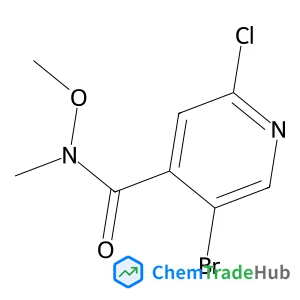
5-Bromo-2-chloro-N-methoxy-N-methylisonicotinamide
CAS Number:
1256790-08-5
Molecular Formula:
C8H8BrClN2O2
Recommended Suppliers






Disclaimer
This page provides academic journal information for reference and research purposes only. We are not affiliated with any journal publishers and do not handle publication submissions. For publication-related inquiries, please contact the respective journal publishers directly.
If you notice any inaccuracies in the information displayed, please contact us at support@chemtradehub.com. We will promptly review and address your concerns.