












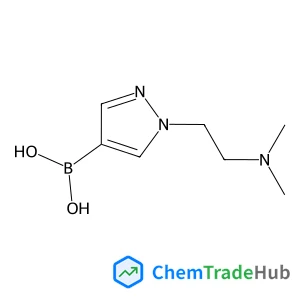
(1-(2-(Dimethylamino)ethyl)-1H-pyrazol-4-yl)boronic acid
CAS Number:
1086063-73-1
Molecular Formula:
C7H14BN3O2
Bruce J. Tatarchuk
The intellectually and technically challenging pursuit of the emerging global environmentally “green” and energy-efficient infrastructure of the 21st century requires the development of a worldwide network of low- to medium-power fuel cell (FC) based portable electric power-generating devices and high-power biomass/clean coal “electric+chemical plants” with zero carbon footprint utilizing integrated coal gasification combined cycle with geologic carbon sequestration (IGCC-GCS) under energy-efficient low-temperature conditions. These emerging technologies require the deep and ultradeep desulfurization of gaseous feeds, since sulfur compounds, especially hydrogen sulfide H2S are highly corrosive and poisonous to both technological processes and the environment. Therefore, it is of crucial importance for both academic and industrial research communities to have a solid understanding of the atomic-level structures of active sites and molecular-level mechanisms of surface chemical reactions of the novel deep and ultradeep desulfurization materials, especially desulfurization sorbents. This review critically analyzes the recent literature (last ∼20 years) on the experimental determination of molecular and atomic-level nature of adsorption sites, effects of desulfurization promoters, mechanisms of chemical reactions of H2S, COS and CS2 and physical processes during and upon regeneration of “spent” low-temperature H2S sorbents based on ZnO that were developed for desulfurization of fuel reformates, syngas and similar streams. Recent trends in research on the ultradeep H2S sorbents are discussed with an impetus on real-time in situ and Operando techniques of instrumental chemical analysis, and the challenges of direct determination of the structure of active sites and of the experimental mechanistic studies in general are described.
Hongyu Shi, Yuhong Liu, Qingdao Zeng, Yanlian Yang, Chen Wang, Xinchun Lu
DOI: 10.1039/C6CP06759J
G. Carrone, L. Zayat, L. D. Slep, R. Etchenique
DOI: 10.1039/C6CP06580E
Ángel Martín Pendás, José Manuel Guevara-Vela, Daniel Menéndez Crespo, Aurora Costales, Evelio Francisco
DOI: 10.1039/C6CP07617C
João P. Prates Ramalho, Francesc Illas, José R. B. Gomes
DOI: 10.1039/C6CP06971A
Damayanti Bagchi, Tuhin Kumar Maji, Samim Sardar, Chinmoy Bhattacharya, Debjani Karmakar, Samir Kumar Pal
DOI: 10.1039/C6CP08016B
Bolong Huang, Dengfeng Peng, Caofeng Pan
DOI: 10.1039/C6CP07472C
Dongxia Ma, Congjie Zhang, Zhe-Ning Chen, Xin Xu
DOI: 10.1039/C6CP06215F
Michael Dommett, Rachel Crespo-Otero
DOI: 10.1039/C6CP07541J
Qiang Sun
DOI: 10.1039/C6CP07589D
Stanislav V. Sokolov, Shaltiel Eloul, Enno Kätelhön, Christopher Batchelor-McAuley, Richard G. Compton
DOI: 10.1039/C6CP07788A
2-(2-Chloroacetamido)-3-phenylpropanoic acid (CAS: 7765-11-9) is generally consi...
2-(Benzyloxy)-5-bromobenzoic acid can be handled safely if appropriate precautio...
(4-Methyl-1,2,5-oxadiazol-3-yl)methanamine hydrochloride is a chemical compound ...
2-(5-Hexylthiophen-2-yl)-4,4,5,5-tetramethyl-1,3,2-dioxaborolane (CAS: 917985-54...
While 4-(8-Methyl-9H-1,3-dioxolo[4,5-h][2,3]benzodiazepin-5-yl)benzenamine (CAS:...
The market for tert-butyl 3-hydroxy-4,5,7,8-tetrahydro-2H-pyrazolo[3,4-d]azepine...
Waste containing 3,5-Diamino-1H-pyrazole-4-carbonitrile (CAS: 6844-58-2) should ...
(6-Fluoro-3-pyridinyl)boronic acid can be synthesized through the reaction of 6-...
Dibenzyl carbonimidoylbiscarbamate (CAS: 10065-79-9) finds applications in vario...
The market for (beta,beta,2,3,4,5,6-~2~H_7_)Phenylalanine (CAS: 74228-83-4) is g...

Physical Chemistry Chemical Physics (PCCP) is an international journal co-owned by 19 physical chemistry and physics societies from around the world. This journal publishes original, cutting-edge research in physical chemistry, chemical physics and biophysical chemistry. To be suitable for publication in PCCP, articles must include significant innovation and/or insight into physical chemistry; this is the most important criterion that reviewers and Editors will judge against when evaluating submissions. The journal has a broad scope and welcomes contributions spanning experiment, theory, computation and data science. Topical coverage includes spectroscopy, dynamics, kinetics, statistical mechanics, thermodynamics, electrochemistry, catalysis, surface science, quantum mechanics, quantum computing and machine learning. Interdisciplinary research areas such as polymers and soft matter, materials, nanoscience, energy, surfaces/interfaces, and biophysical chemistry are welcomed if they demonstrate significant innovation and/or insight into physical chemistry. Joined experimental/theoretical studies are particularly appreciated when complementary and based on up-to-date approaches.

![Heptadecanoic Acid 3-[2-[4-(6-Fluoro-1,2-benzisoxazol-3-yl)-1-piperidinyl]ethyl]-6,7,8,9-tetrahydro-2-methyl-4-oxo-4H-pyrido[1,2-a]pyrimidin-9-yl Ester structure](https://static.chemtradehub.com/structs/140/1404053-62-8-9da4.webp "Heptadecanoic Acid 3-[2-[4-(6-Fluoro-1,2-benzisoxazol-3-yl)-1-piperidinyl]ethyl]-6,7,8,9-tetrahydro-2-methyl-4-oxo-4H-pyrido[1,2-a]pyrimidin-9-yl Ester structure")




