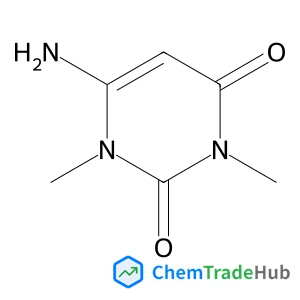
6-amino-1,3-dimethyl-1,2,3,4-tetrahydropyrimidine-2,4-dione
CAS Number:
6642-31-5
Molecular Formula:
C6H9N3O2
Friederike Agel, Fee Pitsch, Florian Felix Krull, Peter Schulz, Matthias Wessling, Thomas Melin, Peter Wasserscheid
Properties of the room-temperature liquid complex salt [Ag(propene)x][Tf2N] have been studied to probe its suitability for acting as active separation layer in immobilised liquid membrane (ILM) concepts for propane/propene separation. The pressure/temperature range of complex formation has been determined and the thermal properties of Ag[Tf2N] and [Ag(propene)x][Tf2N] have been studied by DSC (differential scanning calorimetry) and TGA (thermogravimetric analysis) measurements. Pressure dependent measurements of solubility and diffusivity showed that the observed membrane selectivity is dominated by the solubility selectivity. The self-diffusion coefficient of propene is always smaller compared to propane as propene is temporarily bound to the silver ion in the [Ag(propene)x][Tf2N] ionic liquid.
DOI: 10.1039/A902819F
Jens Spanget-Larsen, Kristine B. Andersen
DOI: 10.1039/B009728O
Piangtawan Phoungtawee, Daniel Crespy
DOI: 10.1039/D1PY00649E
DOI: 10.1039/A904269E
Yasuyuki Matsumura, Naoki Tode
DOI: 10.1039/B008854O
DOI: 10.1039/B009743H
C. Deisl, K. Swamy, S. Penner, E. Bertel
DOI: 10.1039/B007770O
4-Nitrophenyl phosphate disodium salt hexahydrate is primarily used as a substra...
2-(Trifluoromethyl)-1,3-oxazole-4-carboxylic Acid (CAS: 1060816-01-4) is widely ...
2-Fluoro-4-biphenylcarboxylic acid should be stored in a cool, dry place at room...
Prednisolone-21-Carboxylic Acid is primarily used in the pharmaceutical industry...
4-(Hydrazinomethyl)-1,2,3-benzenetriol (CAS: 3614-72-0) should be stored in a co...
4-Amino-1-methyl-1H-pyrazole-5-carboxylic acid hydrochloride (CAS: 92534-70-8) i...
Dehydropachymic acid (CAS: 77012-31-8) is regulated by various agencies. It fall...
The market and research trends for 6-[(2,2-Dimethylpropanoyl)amino]nicotinic aci...
1,10-Phenanthroline-2,9-dicarbaldehyde should be stored in a cool, dry place awa...
5-Carbamoyl-11-oxo-10,11-dihydro-5H-dibenzo[b,f]azepin-10-yl acetate can be synt...

Physical Chemistry Chemical Physics (PCCP) is an international journal co-owned by 19 physical chemistry and physics societies from around the world. This journal publishes original, cutting-edge research in physical chemistry, chemical physics and biophysical chemistry. To be suitable for publication in PCCP, articles must include significant innovation and/or insight into physical chemistry; this is the most important criterion that reviewers and Editors will judge against when evaluating submissions. The journal has a broad scope and welcomes contributions spanning experiment, theory, computation and data science. Topical coverage includes spectroscopy, dynamics, kinetics, statistical mechanics, thermodynamics, electrochemistry, catalysis, surface science, quantum mechanics, quantum computing and machine learning. Interdisciplinary research areas such as polymers and soft matter, materials, nanoscience, energy, surfaces/interfaces, and biophysical chemistry are welcomed if they demonstrate significant innovation and/or insight into physical chemistry. Joined experimental/theoretical studies are particularly appreciated when complementary and based on up-to-date approaches.