












![7-Bromo-5-chloro-1H-pyrazolo[4,3-b]pyridine structure](https://static.chemtradehub.com/structs/135/1351813-70-1-a716.webp "7-Bromo-5-chloro-1H-pyrazolo[4,3-b]pyridine structure")
Benzocarbazole anions intercalated layered double hydroxide and its tunable fluorescence
Literature Information
Publication Date
2010-10-20
DOI
10.1039/C0CP00854K
Impact Factor
3.676
Authors
Dongpeng Yan, Jun Lu, Jing Ma, Min Wei, David G. Evans, Xue Duan
View Original
Abstract
Luminescent benzocarbazole anions (BCZC) intercalated into the interlayer region of Mg–Al-layered double hydroxides (BCZC/LDH) with different layered charge densities (LCD) were prepared. The structure and chemical composition of the composites were characterized by X-ray diffraction, elemental analysis, thermogravimetry and differential thermal analysis (TG-DTA), infrared spectra (FT-IR), UV-vis absorption and fluorescence spectroscopy. The photoemission behavior of BCZC in the LDH matrix with high (Mg/Al ratio = 1.801) and low (Mg/Al ratio = 3.132) LCD is similar to that of BCZC solid and aqueous solution states respectively, indicating that the luminescence performances of the intercalated dye anions can be tuned by adjusting the LCD of the LDH layer. Moreover, the thermal stability and stacking order of BCZC are largely improved upon intercalation, and the BCZC/LDH thin film exhibits well polarized luminescence with the luminescent anisotropy of 0.15–0.20. In addition, molecular dynamics (MD) simulation was employed to calculate the basal spacing and molecular arrangement of the intercalated BCZC within the LDH matrix. The simulation results show that the distribution of BCZC anions is much broader in the gallery of Mg–Al-LDH with high LCD, while BCZC anions exhibit a more ordered arrangement in LDH with low LCD. Furthermore, the radial distribution functions of interlayer water molecules were also studied. Based on the combination of experiment and theoretical simulation, this work provides a detailed understanding of the tunable photoluminescence, orientation and diffusion behavior of the luminescent molecules confined within the gallery of a 2D inorganic matrix.
Related Literature
High fluorescence selectivity and visual detection ofG-quadruplex structures by a novel dinuclear ruthenium complex
Liang Xu, Dan Zhang, Jing Huang, Minggang Deng, Ming Zhang
2009-11-26
Communication
DOI: 10.1039/B918045A
Unraveling the structural and morphological stability of oxygen vacancy engineered leaf-templated CaTiO3 towards photocatalytic H2 evolution and N2 fixation reactions
Ashish Kumar, Manish Kumar, Vempuluru Navakoteswara Rao, Muthukonda Venkatakrishnan Shankar, Saswata Bhattacharya, Venkata Krishnan
2021-08-02
Paper
DOI: 10.1039/D1TA04180K
“Protrusions” or “holes” in graphene: which is the better choice for sodium ion storage?‡
Yijun Yang, Dai-Ming Tang, Chao Zhang, Yihui Zhang, Qifeng Liang, Shimou Chen, Qunhong Weng, Min Zhou, Yanming Xue, Jiangwei Liu, Jinghua Wu, Qiu Hong Cui, Chao Lian, Guolin Hou, Fangli Yuan, Xi Wang
2017-03-15
Paper
DOI: 10.1039/C7EE00329C
Diffusion NMR of molecular cages and capsules
Liat Avram, Yoram Cohen
2014-08-11
Review Article
DOI: 10.1039/C4CS00197D
The preparation of graft copolymers of cellulose and cellulose derivatives using ATRP under homogeneous reaction conditions
Osama M. Musa
2014-07-14
Review Article
DOI: 10.1039/C4CS00053F
Template-assisted generation of three-dimensionally branched titaniananotubes on a substrate
Kevin R. Moonoosawmy, Martha Es-Souni, Robert Minch, Matthias Dietze, Mohammed Es-Souni
2011-10-26
Paper
DOI: 10.1039/C1CE06064C
Nanoparticle counting: towards accurate determination of the molar concentration
Jing Shang, Xiaohu Gao
2014-08-07
Tutorial Review
DOI: 10.1039/C4CS00128A
Peptide turns through just ‘one atom’! A sulfamide group nucleates folding and stabilizes new supramolecular topologies in short peptides
Pushparathinam Gopinath, Venkatachalam Ramkumar, Kannoth Manheri Muraleedharan
2014-09-25
Communication
DOI: 10.1039/C4CE01938E
Pushing the limits of concertedness. A waltz of wandering carbocations
Marta Castiñeira Reis, Carlos Silva López, Olalla Nieto Faza, Dean J. Tantillo
2018-12-11
Edge Article
DOI: 10.1039/C8SC03567A
You might also like
Compound Q&A
What are the main uses of (5-Sulfamoyl-3-pyridinyl)boronic acid (CAS: 951233-61-7)?
(5-Sulfamoyl-3-pyridinyl)boronic acid is primarily used in chemical synthesis, p...
951233-61-7(5-Sulfamoyl-3-pyrid...
Compound Q&A
How is Benzyl 2-methyl-2-(methylsulfonyl)-4-pentenoate (CAS: 1942858-50-5) typically synthesized?
Benzyl 2-methyl-2-(methylsulfonyl)-4-pentenoate is typically synthesized via est...
1942858-50-5Benzyl 2-methyl-2-(m...
Compound Q&A
What precautions should be taken when handling 8-Fluoroquinolin-6-ol (CAS: 209353-22-0)?
When handling 8-Fluoroquinolin-6-ol (CAS: 209353-22-0), it is important to use p...
209353-22-08-Fluoroquinolin-6-o...
Compound Q&A
What are the physical and chemical properties of 1,3-Dibromo-5-(2-methyl-2-propanyl)benzene (CAS: 129316-09-2)?
1,3-Dibromo-5-(2-methyl-2-propanyl)benzene (CAS: 129316-09-2) is a crystalline c...
129316-09-21,3-Dibromo-5-(2-met...
Compound Q&A
What industries use Ethyl 7-chloro-4-oxo-1-(1,3-thiazol-2-yl)-1,4-dihydro-1,8-naphthyridine-3-carboxylate (CAS: 174726-87-5)?
Ethyl 7-chloro-4-oxo-1-(1,3-thiazol-2-yl)-1,4-dihydro-1,8-naphthyridine-3-carbox...
174726-87-5Ethyl 7-chloro-4-oxo...
Compound Q&A
What precautions should be taken when handling Delta-7-Avenasterol (CAS: 23290-26-8)?
When handling Delta-7-Avenasterol (CAS: 23290-26-8), it is important to wear app...
23290-26-8Delta-7-Avenasterol
Compound Q&A
What precautions should be taken when handling N-({(5R)-3-[3-Fluoro-4-(4-morpholinyl)phenyl]-2-oxo-1,3-oxazolidin-5-yl}methyl)acetamide (CAS: 872992-20-6)?
Proper handling involves the use of personal protective equipment such as gloves...
872992-20-6N-({(5R)-3-[3-Fluoro...
Compound Q&A
What precautions should be taken when handling 2-Methyl-2-proanyl 4-[(2-aminophenyl)amino]-1-piperidinecarboxylate (CAS: 79099-00-6)?
When handling 2-Methyl-2-proanyl 4-[(2-aminophenyl)amino]-1-piperidinecarboxylat...
79099-00-62-Methyl-2-propanyl ...
Compound Q&A
What is N-Methyl-4-chlorobenzylamine hydrochloride (CAS: 65542-24-7)?
N-Methyl-4-chlorobenzylamine hydrochloride (CAS: 65542-24-7) is a organic compou...
65542-24-7N-Methyl-4-chloroben...
Compound Q&A
Is [2-(Dodecyloxy)ethoxy]acetic acid (CAS: 27306-90-7) safe?
[2-(Dodecyloxy)ethoxy]acetic acid (CAS: 27306-90-7) is generally considered safe...
27306-90-7[2-(Dodecyloxy)ethox...
Source Journal
Physical Chemistry Chemical Physics

CiteScore:
5.5
Self-citation Rate:
10.3%
Articles per Year:
3036
Physical Chemistry Chemical Physics (PCCP) is an international journal co-owned by 19 physical chemistry and physics societies from around the world. This journal publishes original, cutting-edge research in physical chemistry, chemical physics and biophysical chemistry. To be suitable for publication in PCCP, articles must include significant innovation and/or insight into physical chemistry; this is the most important criterion that reviewers and Editors will judge against when evaluating submissions. The journal has a broad scope and welcomes contributions spanning experiment, theory, computation and data science. Topical coverage includes spectroscopy, dynamics, kinetics, statistical mechanics, thermodynamics, electrochemistry, catalysis, surface science, quantum mechanics, quantum computing and machine learning. Interdisciplinary research areas such as polymers and soft matter, materials, nanoscience, energy, surfaces/interfaces, and biophysical chemistry are welcomed if they demonstrate significant innovation and/or insight into physical chemistry. Joined experimental/theoretical studies are particularly appreciated when complementary and based on up-to-date approaches.
Recommended Compounds

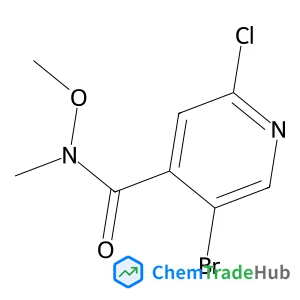
5-Bromo-2-chloro-N-methoxy-N-methylisonicotinamide
CAS Number:
1256790-08-5
Molecular Formula:
C8H8BrClN2O2
Recommended Suppliers





Disclaimer
This page provides academic journal information for reference and research purposes only. We are not affiliated with any journal publishers and do not handle publication submissions. For publication-related inquiries, please contact the respective journal publishers directly.
If you notice any inaccuracies in the information displayed, please contact us at support@chemtradehub.com. We will promptly review and address your concerns.