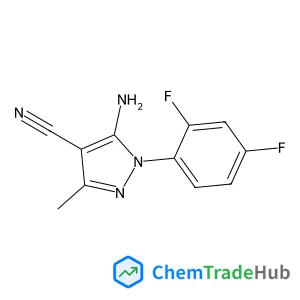
5-Amino-1-(2,4-difluorophenyl)-3-methyl-1H-pyrazole-4-carbonitrile
CAS Number:
1020057-92-4
Molecular Formula:
C11H8F2N4
L. J. Ding, H. H. Fu
The zero- and low-temperature behaviors of a quasi-one-dimensional organic polymer proposed as a symmetrical periodic Anderson-like chain model, in which the localized f orbitals hybridize with the conduction orbitals at even sites, are investigated by means of many-body Green's function theory. In the absence of magnetic field, the ground state of the system turns out to be ferrimagnetic. The temperature-induced phase diagrams have been explored, where the competition between the Hubbard repulsion U on the localized f orbital and the hybridization strength V makes an important impact on the transition temperature. In a magnetic field, it is found that a 1/3 magnetization plateau appears and two critical fields indicating the insulator–metal transitions at zero temperature emerge, which are closely related to the energy bands. Furthermore, the single-site entanglement entropy is a good indicator of quantum phase transitions. The temperature-field-induced phase diagram has also been attained, wherein the magnetization plateau state, the gapless phase and the spin polarized state are revealed. The temperature dependence of thermodynamic quantities such as the magnetization, susceptibility and specific heat are calculated to characterize the corresponding phases. It is also found that the up-spin and down-spin hole excitations are responsible for the thermodynamic properties.
Wolfgang Knolle, Uwe Müller, Reiner Mehnert
DOI: 10.1039/A907162H
Yingqiu Liang
DOI: 10.1039/A909317F
Rajendran Amarnath Praphakar, Harshavardhan Shakila, Vijayan N. Azger Dusthackeer, Murugan A. Munusamy, Suresh Kumar, Mariappan Rajan
DOI: 10.1039/C8PY90009D
Jochen Willersinn, Bernhard V. K. J. Schmidt
DOI: 10.1039/C7PY01214D
Weizhi Chen, Liling Su, Peng Zhang, Cheng Li, Dan Zhang, Wei Wu, Xiqun Jiang
DOI: 10.1039/C7PY01389B
Hassan Bohra, Peizhou Li, Cangjie Yang, Yanli Zhao, Mingfeng Wang
DOI: 10.1039/C8PY00025E
DOI: 10.1039/A909729E
Ethyl 4-chlorothieno[2,3-b]pyridine-5-carboxylate (CAS: 59713-58-5) can be synth...
5-Methyl-1H-indole-3-carbaldehyde (CAS: 52562-50-2) is subject to various regula...
(1,3-Dimethyl-2,4-dioxo-1,2,3,4-tetrahydro-5-pyrimidinyl)boronic acid is a white...
Waste containing Sulfocostunolide A (CAS: 1016983-51-9) should be handled with c...
When handling Murraxocin (CAS: 88478-44-8), ensure proper personal protective eq...
Formvar (CAS: 63148-64-1) is an alkyd resin characterized by a high molecular we...
(S)-4-benzyl-2-((benzyloxy)methyl)morpholine is generally safe when handled with...
Methyl 1-(5-bromo-2-pyrimidinyl)cyclopropanecarboxylate (CAS: 1447607-69-3) is p...
2-Methyl-1-phenyl-1-propanamine hydrochloride (CAS: 24290-47-9) is generally con...
3-(4-Bromophenyl)-2-methylpropanoic acid is synthesized through a multi-step pro...

Physical Chemistry Chemical Physics (PCCP) is an international journal co-owned by 19 physical chemistry and physics societies from around the world. This journal publishes original, cutting-edge research in physical chemistry, chemical physics and biophysical chemistry. To be suitable for publication in PCCP, articles must include significant innovation and/or insight into physical chemistry; this is the most important criterion that reviewers and Editors will judge against when evaluating submissions. The journal has a broad scope and welcomes contributions spanning experiment, theory, computation and data science. Topical coverage includes spectroscopy, dynamics, kinetics, statistical mechanics, thermodynamics, electrochemistry, catalysis, surface science, quantum mechanics, quantum computing and machine learning. Interdisciplinary research areas such as polymers and soft matter, materials, nanoscience, energy, surfaces/interfaces, and biophysical chemistry are welcomed if they demonstrate significant innovation and/or insight into physical chemistry. Joined experimental/theoretical studies are particularly appreciated when complementary and based on up-to-date approaches.
![2-(Methylsulfonyl)-2,4,5,6-tetrahydropyrrolo[3,4-c]pyrazole structure](https://static.chemtradehub.com/structs/122/1226781-80-1-09d5.webp "2-(Methylsulfonyl)-2,4,5,6-tetrahydropyrrolo[3,4-c]pyrazole structure")
![2-Methyl-2-propanyl 1,6-diazaspiro[3.4]octane-6-carboxylate structure](https://static.chemtradehub.com/structs/115/1158749-79-1-81ee.webp "2-Methyl-2-propanyl 1,6-diazaspiro[3.4]octane-6-carboxylate structure")