












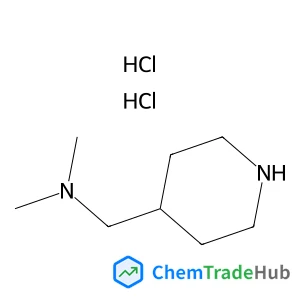
N,N-dimethyl(piperidin-4-yl)methanamine hydrochloride
CAS Number:
172281-72-0
Molecular Formula:
C8H20Cl2N2
Demeter Tzeli, Ioannis D. Petsalakis, Giannoula Theodorakopoulos
The electronic and geometric structures of dibenzo-12-crown-4, dibenzo-18-crown-6, and dibenzo-24-crown-8 ethers, and dibenzo-18-crown-6 ether of fullero-N-methylpyrrolidine and their complexes with (CH3)xNH+4−x, x = 0–4 were investigated by employing density functional theory (B3LYP, M05-2X, M06-2X, MPWBIK and B2PLYP-D) in conjunction with three basis sets. Different energetic minima have been identified for all of the above molecules and complexes in the gas phase as well as in CHCl3 solvent. We report geometries, complexation energies and some thermochemical data. For increasing values of x, the complexation energies, corrected for the basis set superposition error range from 3.29 to 0.73 eV in the gas phase and from 1.56 to 0.13 eV in the CHCl3 solvent. In the case of the largest crown ethers, the 24-crown-8 ethers are folded around the ammonium cation so as to maximize the number of hydrogen bonds formed and present the largest complexation energies. Finally, the presence of fullero-N-methylpyrrolidine, attached to the crown ethers, does not change the complexation energies substantially.
Yogesh Jaiswal, Yogesh Kumar, Amit Kumar
DOI: 10.1039/C9OB01082C
Shasha Zheng, Gu Lingyue, Michelle Jui Hsien Ong, Denis Jacquemin, Jean-Alexandre Richard, Rajavel Srinivasan
DOI: 10.1039/C9OB00568D
Rajnish Budhwan, Suman Yadav, Sandip Murarka
DOI: 10.1039/C9OB00694J
Radhey M. Singh
DOI: 10.1039/C9OB00841A
Yulia V. Nelyubina, Alexey Yu. Sukhorukov, Sema L. Ioffe, Andrey A. Tabolin
DOI: 10.1039/C9OB01005J
Zhenzhen Zhan, Haojie Ma, Xinfeng Cui, Pengbo Jiang, Jinghong Pu, Yixin Zhang, Guosheng Huang
DOI: 10.1039/C9OB00531E
Vinicius Sobral Silva, Terezinha Alves Tolentino, Tiago Costa Alves Fontoura Rodrigues, Fernanda Ferrari Martins Santos, Daniel Francisco Scalabrini Machado, Wender Alves Silva, Heibbe Cristhian Benedito de Oliveira, Angelo Henrique Lira Machado
DOI: 10.1039/C9OB00533A
Xi-Yang Cui, Choon-Hong Tan, Dasheng Leow
DOI: 10.1039/C8OB02240B
Zhenjie Su, Zengyang Xie, Shan Wang, Naili Luo, Cunde Wang
DOI: 10.1039/C9OB01308C
1-(2,4,6-Trifluorophenyl)ethanol is an organic compound with the CAS number 1250...
1-(2,4-Dimethoxybenzyl)-4-(hydroxymethyl)-2-pyrrolidinone (CAS: 919111-34-5) is ...
(7S,15R)-6β,15-Diacetoxy-7α,20-epoxy-7-hydroxykaura-2,16-dien-1-one is a crystal...
The compound rac-ethyl (1r,4r)-4-hydroxycyclohexane-1-carboxylate, trans (CAS: 3...
The market for 2-(2,4-Difluorophenoxy)-3-nitropyridine (CAS: 175135-62-3) is cur...
The main uses of 6-Diazo-5-oxo-L-norleucine (CAS: 157-03-9) include research in ...
When handling 2-Aminoethyl-mono-amide-DOTA-tris(tBu ester) (CAS: 173308-19-5), i...
5-Methylimidazo[1,2-a]pyridine-3-carbaldehyde (CAS: 178488-37-4) can be synthesi...
There are alternative reagents that can be used in the synthesis of 2,4,6-Trihyd...
(2Z)-3-(5-Fluoro-1H-indol-3-yl)-2-sulfanylacrylic acid is a chemical compound wi...

Physical Chemistry Chemical Physics (PCCP) is an international journal co-owned by 19 physical chemistry and physics societies from around the world. This journal publishes original, cutting-edge research in physical chemistry, chemical physics and biophysical chemistry. To be suitable for publication in PCCP, articles must include significant innovation and/or insight into physical chemistry; this is the most important criterion that reviewers and Editors will judge against when evaluating submissions. The journal has a broad scope and welcomes contributions spanning experiment, theory, computation and data science. Topical coverage includes spectroscopy, dynamics, kinetics, statistical mechanics, thermodynamics, electrochemistry, catalysis, surface science, quantum mechanics, quantum computing and machine learning. Interdisciplinary research areas such as polymers and soft matter, materials, nanoscience, energy, surfaces/interfaces, and biophysical chemistry are welcomed if they demonstrate significant innovation and/or insight into physical chemistry. Joined experimental/theoretical studies are particularly appreciated when complementary and based on up-to-date approaches.
![9,9'-Spirobi[fluoren]-2-amine structure](https://static.chemtradehub.com/structs/118/118951-68-1-0d14.webp "9,9'-Spirobi[fluoren]-2-amine structure")

![2-(Methylsulfonyl)-2,4,5,6-tetrahydropyrrolo[3,4-c]pyrazole structure](https://static.chemtradehub.com/structs/122/1226781-80-1-09d5.webp "2-(Methylsulfonyl)-2,4,5,6-tetrahydropyrrolo[3,4-c]pyrazole structure")



