












![[4-Amino-2-(methylsulfanyl)-5-pyrimidinyl]methanol structure](https://static.chemtradehub.com/structs/588/588-36-3-fc73.webp "[4-Amino-2-(methylsulfanyl)-5-pyrimidinyl]methanol structure")
Investigation of the structures and chemical ordering of small Pd–Au clusters as a function of composition and potential parameterisation
Literature Information
Publication Date
2010-07-12
DOI
10.1039/C004044D
Impact Factor
3.676
Authors
Ramli Ismail, Roy L. Johnston
View Original
Abstract
The energetics, structures and segregation of Pd–Au nanoalloys (all compositions for 34- and 38-atoms) have been studied using a genetic algorithm global optimization technique with the Gupta empirical potential. Three modifications of the Pd–Au parameters have been studied: parameter set I in which all parameters (A, ξ, p, q and r0) in the Gupta potential are weighted in a symmetrical fashion; parameter set II (symmetric weighting of only the pair and many-body energy scaling parameters A and ξ); and parameter set III (antisymmetric weighting of A and ξ). Structural analysis reveals competition between a range of structural families; decahedra, polyicosahedra and truncated octahedra (for 34 atoms) and incomplete-icosahedra-Mackay, decahedra, polyicosahedra (low-symmetry), six-fold-polyicosahedra and a mixed octahedron–icosahedron (Oh–Ih) structure (for 38 atoms). It is shown that, by finely tuning the Gupta potential, it is possible to qualitatively reproduce the results observed at higher levels of theory (e.g. Density Functional Theory). There are four main types of chemical ordering which are observed: core–shell; spherical cap; ball-and-cup; and mixed. It is shown that the chemical ordering and the proportion of Pd–Au heteronuclear bonds in these clusters are strongly dependent on the potential parameters. Comparison of the results from parameter set III and two previously fitted potentials shows that the DFT-fit potential gives rise to similar results for energies, and lowest energy structures and homotops to those for parameter set III with wa = 0.8, but the exp-fit potential gives rise to qualitatively different results.
Recommended Journals
Related Literature
Exploiting hydrogen bonding interactions to probe smaller linear and cyclic diamines binding to G-quadruplexes: a DFT and molecular dynamics study
Anik Sen
2017-04-07
Paper
DOI: 10.1039/C7CP00472A
From oxidative degradation to direct oxidation: size regimes in the consecutive reaction of cationic tantalum clusters with dioxygen
J. F. Eckhard, D. Neuwirth, M. Tschurl, U. Heiz
2017-04-04
Paper
DOI: 10.1039/C7CP01293D
A theoretical study on hot charge-transfer states and dimensional effects of organic photocells based on an ideal diode model
2017-04-19
Paper
DOI: 10.1039/C7CP01455D
Towards improved magnetic fluid hyperthermia: major-loops to diminish variations in local heating
Cristina Munoz-Menendez, Juan M. Ruso, Daniel Baldomir
2017-05-11
Paper
DOI: 10.1039/C7CP01442B
Time-resolved measurements of product formation in the low-temperature (550–675 K) oxidation of neopentane: a probe to investigate chain-branching mechanism
Ivan O. Antonov, Leonid Sheps, John D. Savee, David L. Osborn, Craig A. Taatjes
2017-05-03
Paper
DOI: 10.1039/C7CP01366C
Buckling behaviour of composites with double walled nanotubes from carbon and phosphorus
Jing Wan, Likui Yang, Ning Wei, Jiao Shi, Qing-Hua Qin
2017-03-28
Paper
DOI: 10.1039/C7CP01274H
An approximate full-dimensional quantum dynamics study of the mode specificity in the dissociative chemisorption of D2O on rigid Cu(111)
Tianhui Liu, Bina Fu, Dong H. Zhang
2017-04-11
Paper
DOI: 10.1039/C7CP01770G
The effect of Y3+ substitution on the structural, optical band-gap, and magnetic properties of cobalt ferrite nanoparticles
H. V. S. Pessoni, A. Franco Jr.
2017-06-01
Paper
DOI: 10.1039/C7CP02167D
Growth of low doped monolayer graphene on SiC(0001) via sublimation at low argon pressure
Périne Landois, Tianlin Wang, Abir Nachawaty, Maxime Bayle, Jean-Manuel Decams, Wilfried Desrat, Ahmed-Azmi Zahab, Benoît Jouault, Matthieu Paillet, Sylvie Contreras
2017-05-12
Paper
DOI: 10.1039/C7CP01012E
You might also like
Compound Q&A
How should waste containing N-Methoxy-N-methyl-1,3-thiazole-5-carboxamide (CAS: 898825-89-3) be handled?
Waste containing N-Methoxy-N-methyl-1,3-thiazole-5-carboxamide (CAS: 898825-89-3...
898825-89-3N-Methoxy-N-methyl-1...
Compound Q&A
How should N-(4-Biphenylyl)dibenzo[b,d]furan-4-amine (CAS: 1318338-47-4) be stored?
N-(4-Biphenylyl)dibenzo[b,d]furan-4-amine should be stored in a tightly sealed c...
1318338-47-4N-(4-Biphenylyl)dibe...
Compound Q&A
What is the market or research trend for 3-Acetamido-5-amino-2,4,6-triiodobenzoic acid (CAS: 1713-07-1)?
The market for 3-Acetamido-5-amino-2,4,6-triiodobenzoic acid (CAS: 1713-07-1) is...
1713-07-13-Acetamido-5-amino-...
Compound Q&A
How should Benzyl 2-O-acetyl-3,4,6-tri-O-benzyl-beta-D-galactopyranoside (CAS: 61820-03-9) be stored?
Benzyl 2-O-acetyl-3,4,6-tri-O-benzyl-beta-D-galactopyranoside (CAS: 61820-03-9) ...
61820-03-9Benzyl 2-O-acetyl-3,...
Compound Q&A
What regulatory guidelines apply to 2-Ethylpiperazine dihydrochloride (CAS: 438050-52-3)?
2-Ethylpiperazine dihydrochloride (CAS: 438050-52-3) is regulated under the Glob...
438050-52-32-Ethylpiperazine di...
Compound Q&A
What regulatory guidelines apply to 1,1'-[1,3-Phenylenebis(methylene)]bis(3-methyl-1H-pyrrole-2,5-dione) (CAS: 119462-56-5)?
1,1'-[1,3-Phenylenebis(methylene)]bis(3-methyl-1H-pyrrole-2,5-dione) (CAS: 11946...
119462-56-51,1'-[1,3-Phenyleneb...
Compound Q&A
Are there alternatives to 5-Fluoro-2-(1-pyrrolidinyl)pyridine (CAS: 1287217-79-1) in synthesis?
Several alternatives can be used in the synthesis of 5-Fluoro-2-(1-pyrrolidinyl)...
1287217-79-15-Fluoro-2-(1-pyrrol...
Compound Q&A
What precautions should be taken when handling 1-((2R,3R,4R,5R)-5-((bis(4-methoxyphenyl)(phenyl)methoxy)methyl)-4-hydroxy-3-methoxytetrahydrofuran-2-yl)-5-methylpyrimidine-2,4(1H,3H)-dione (CAS: 153631-19-7)?
Proper personal protective equipment (PPE) must be worn when handling this compo...
153631-19-71-((2R,3R,4R,5R)-5-(...
Compound Q&A
What precautions should be taken when handling 6-Bromoimidazo[1,2-a]pyridin-8-amine (CAS: 676371-00-9)?
When handling 6-Bromoimidazo[1,2-a]pyridin-8-amine, it is important to wear appr...
676371-00-96-Bromoimidazo[1,2-a...
Compound Q&A
Are there alternatives to (2S,4R)-4-(4-Nitrobenzyl)pyrrolidine-2-carboxylic acid hydrochloride (CAS: 1049740-22-8) in synthesis?
Alternatives to (2S,4R)-4-(4-Nitrobenzyl)pyrrolidine-2-carboxylic acid hydrochlo...
1049740-22-8(2S,4R)-4-(4-Nitrobe...
Source Journal
Physical Chemistry Chemical Physics

CiteScore:
5.5
Self-citation Rate:
10.3%
Articles per Year:
3036
Physical Chemistry Chemical Physics (PCCP) is an international journal co-owned by 19 physical chemistry and physics societies from around the world. This journal publishes original, cutting-edge research in physical chemistry, chemical physics and biophysical chemistry. To be suitable for publication in PCCP, articles must include significant innovation and/or insight into physical chemistry; this is the most important criterion that reviewers and Editors will judge against when evaluating submissions. The journal has a broad scope and welcomes contributions spanning experiment, theory, computation and data science. Topical coverage includes spectroscopy, dynamics, kinetics, statistical mechanics, thermodynamics, electrochemistry, catalysis, surface science, quantum mechanics, quantum computing and machine learning. Interdisciplinary research areas such as polymers and soft matter, materials, nanoscience, energy, surfaces/interfaces, and biophysical chemistry are welcomed if they demonstrate significant innovation and/or insight into physical chemistry. Joined experimental/theoretical studies are particularly appreciated when complementary and based on up-to-date approaches.
Recommended Compounds

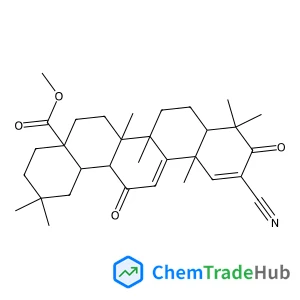
Methyl 2-cyano-3,12-dioxooleana-1,9(11)-dien-28-oate
CAS Number:
218600-53-4
Molecular Formula:
C32H43NO4
![[4-(Heptyloxy)phenyl]boronic acid structure](https://static.chemtradehub.com/structs/136/136370-19-9-ad33.webp "[4-(Heptyloxy)phenyl]boronic acid structure")
Recommended Suppliers





Disclaimer
This page provides academic journal information for reference and research purposes only. We are not affiliated with any journal publishers and do not handle publication submissions. For publication-related inquiries, please contact the respective journal publishers directly.
If you notice any inaccuracies in the information displayed, please contact us at support@chemtradehub.com. We will promptly review and address your concerns.