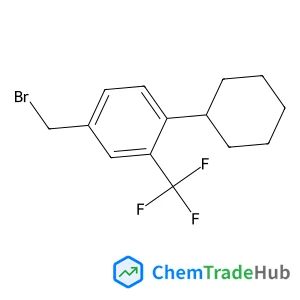
4-(Bromomethyl)-1-cyclohexyl-2-(trifluoromethyl)benzene
CAS Number:
800381-60-6
Molecular Formula:
C14H16BrF3
Piotr Kowalczyk, Piotr A. Gauden, Artur P. Terzyk, Sylwester Furmaniak
To model the equilibrium and transport properties of carbonaceous molecular sieves (CMS) (i.e., carbon membranes, coals, activated carbons with ink-bottle pore geometry, etc.) the new microscopic turbostratic carbon pore model (TCPM) is developed. Analysis of experimental Gibbs excess of methane adsorption on Shirasagi CMS 3K-161 at 298 K indicates that investigated CMS is structurally a heterogonous material (i.e., it is composed of slit-shaped and turbostratic carbon nanopores of different sizes). The predicted absolute methane isotherm, total pore volume of 0.22 cm3 g−1, enthalpy of methane adsorption of 17.5–18.6 kJ mol−1 on Shirasagi CMS 3K-161 at 298 K are in good agreement with existing experimental and theoretical data. Applying TCPM, we model the equilibrium and kinetic separation of hydrogen and methane mixtures adsorbed in CMS turbostratic carbon nanopores at infinite dilution and 194.7, 293.2, 313.2, 423.2, and 573.2 K. We found that near ambient temperatures one can reach equilibrium selectivity of methane over hydrogen (CH4/H2) of 102 in the turbostratic carbon nanopores having effective cage sizes of ≈5 Å. Lowering an operating temperature down to the dry ice one increases the equilibrium CH4/H2 selectivity in these nanopores up to 103. The kinetic selectivity of hydrogen over several investigated fluids, including: methane, argon, xenon, nitrogen, and carbon dioxide at studied operating conditions does not depend on the size of the carbon nanopore cage. This simply means that the kinetic separation factor is controlled by the size of the carbon nanopore constriction. Taking this into account, we predicted the effective size of the carbon nanopore constriction of real CMS from the experimentally measured kinetic H2/CH4 selectivities at infinite dilution. The high kinetic H2/CH4 selectivity of 102–103 corresponds to the effective size of the carbon nanopore constriction of ≤2.958 Å (i.e., lower or equal to the collision diameter of hydrogen molecule). However, decreasing/increasing of the effective size of the carbon nanopore constriction by ≈0.1–0.2 Å exponentially increases/decreases kinetic H2/CH4 separation factor. Finally, we showed that the efficiency of kinetic separation at 298 K and infinite dilution depends on the σH2/σX and not only on σH2 (where σ denotes the collision diameter of hydrogen and the mentioned above fluids, respectively).
Jingjing Liu, Jiaxi Xu, Zhenjiang Li, Songquan Xu, Xin Wang, Haixin Wang, Tianfo Guo, Yu Gao, Lei Zhang, Kai Guo
DOI: 10.1039/C7PY01671A
Adérito J. R. Amaral, George Pasparakis
DOI: 10.1039/C7PY01386H
A. Gutierres, S. Pascual, L. Fontaine, S. Piogé, L. Benyahia
DOI: 10.1039/C7PY02118F
Lincan Yang, Hongwei Ma, Li Han, Xinyu Hao, Pibo Liu, Heyu Shen, Yang Li
DOI: 10.1039/C7PY01837A
Eisuke Goto, Yuto Ochiai, Chen-Tsyr Lo, Tomoyuki Koganezawa, Mitsuru Ueda, Tomoya Higashihara
DOI: 10.1039/C7PY01416C
Ting Zeng, Duanguang Yang, Chong Cheng
DOI: 10.1039/C7PY02067H
Yu-Lin Tsai, Yu-Chao Tseng, Yan-Miao Chen, Tain-Ching Wen, Jeng-Shiung Jan
DOI: 10.1039/C7PY01167A
Na Liu, Rui-Wen Sun, Hao-Jun Lu, Xue-Liang Li, Chun-Hua Liu, Zong-Quan Wu
DOI: 10.1039/C7PY01633F
Guolin Lu, Hao Guo, Xiaoyu Huang
DOI: 10.1039/C7PY01666B
Ville Hynninen, Antoine Niederberger, André H. Gröschel
DOI: 10.1039/C7PY01814B
When handling lithium chloride hydrate (1:1:1) (CAS: 16712-20-2), it is importan...
4-(4H-1,2,4-Triazol-4-yl)piperidine is generally considered safe for use in phar...
Waste containing 1,3-Thiazole-2-carboxamide (CAS: 16733-85-0) should be collecte...
5-(Difluoromethyl)-2-fluorobenzonitrile (CAS: 934175-58-3) is subject to regulat...
Methyl 3-acetamido-2-thiophenecarboxylate can be synthesized by the reaction of ...
4-Isoquinolinecarbonitrile is a chemical compound with the CAS number 34846-65-6...
Store Methyl 1H-1,2,3-triazole-4-carboxylate (CAS: 877309-59-6) in a cool, dry p...
6-Bromo[1,3]thiazolo[5,4-b]pyridin-2-amine (CAS: 1160791-13-8) is subject to the...
(2S,3S)-2-Ammonio-3-(3,4-dihydroxyphenyl)-3-hydroxypropanoate (CAS: 23651-95-8) ...
7-Bromo-3-methyl-3,4-dihydroquinazolin-4-one is a solid with a crystalline form....

Physical Chemistry Chemical Physics (PCCP) is an international journal co-owned by 19 physical chemistry and physics societies from around the world. This journal publishes original, cutting-edge research in physical chemistry, chemical physics and biophysical chemistry. To be suitable for publication in PCCP, articles must include significant innovation and/or insight into physical chemistry; this is the most important criterion that reviewers and Editors will judge against when evaluating submissions. The journal has a broad scope and welcomes contributions spanning experiment, theory, computation and data science. Topical coverage includes spectroscopy, dynamics, kinetics, statistical mechanics, thermodynamics, electrochemistry, catalysis, surface science, quantum mechanics, quantum computing and machine learning. Interdisciplinary research areas such as polymers and soft matter, materials, nanoscience, energy, surfaces/interfaces, and biophysical chemistry are welcomed if they demonstrate significant innovation and/or insight into physical chemistry. Joined experimental/theoretical studies are particularly appreciated when complementary and based on up-to-date approaches.
![1-[4-(4-Methyl-1H-imidazol-1-yl)phenyl]ethanone structure](https://static.chemtradehub.com/structs/142/142161-53-3-7f55.webp "1-[4-(4-Methyl-1H-imidazol-1-yl)phenyl]ethanone structure")
![(R)-N-[(S)-1-[2-(Diphenylphosphino)phenyl]ethyl]-2-methylpropane-2-sulfinamide structure](https://static.chemtradehub.com/structs/159/1595319-98-4-33e7.webp "(R)-N-[(S)-1-[2-(Diphenylphosphino)phenyl]ethyl]-2-methylpropane-2-sulfinamide structure")