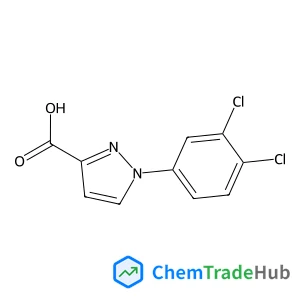
1-(3,4-Dichlorophenyl)-1H-pyrazole-3-carboxylic acid
CAS Number:
1152949-12-6
Molecular Formula:
C10H6Cl2N2O2
Keyarash Sadeghian, Marco Bocola, Martin Schütz
Based on QM/MM calculations using a combination of time-dependent Hartree–Fock and coupled cluster response theory a mechanism is proposed for the photocycle of blue light using flavin (BLUF) domains in the signaling/light adapted conformation. In analogy to the dark-adapted form, a charge transfer state drives proton transfer from the highly conserved tyrosine residue to the flavin chromophore. The latter step is mediated by the adjacent glutamine residue, which, in the light adapted conformation, exists as its imidic tautomer. However, before the proton transfer is even halfway completed, a conical intersection seam between the charge transfer and ground state is reached. Two channels for the decay back to the initial light-adapted conformation are open, a rapid one leading directly through the funnel of the conical intersection, bypassing the formation of the biradical intermediate, and a slower one via the biradical intermediate. The mechanism as proposed here: (i) explains the very rapid photocycle; and (ii) confirms the concept of photoirreversibility, both of which have been experimentally observed for BLUF domains in their light-adapted conformations.
Alexander M. Khenkin, Irena Efremenko, Jan M. L. Martin, Ronny Neumann
DOI: 10.1039/C7CP08610E
Lizhe Liu, Li Wang, Guangsheng Luo, Chunlan Mo, Chenliang Chang
DOI: 10.1039/C8CP02069H
Chang Zhu, Qian Wang, Jiena Yun, Qiaoli Hu, Gang Yang
DOI: 10.1039/C8CP02286K
Sayyed Jalil Mahdizadeh, Golnoosh Akhlamadi
DOI: 10.1039/C8CP02820F
Adam Orłowski, Lior Artzi, Pierre-Andre Cazade, Melissabye Gunnoo, Edward A. Bayer, Damien Thompson
DOI: 10.1039/C7CP07764E
Matthias Grünbacher, Lukas Schlicker, Maged F. Bekheet, Aleksander Gurlo, Bernhard Klötzer, Simon Penner
DOI: 10.1039/C8CP04350G
Iwona Grądzka, Mateusz Gierszewski, Marcin Ziółek
DOI: 10.1039/C8CP00258D
Yusuke Matsuura, Naoko Ouchi, Ayako Nakamura, Haruhisa Kato
DOI: 10.1039/C7CP08332G
Hung Tan Pham, Thi Tuyet Mai Dang, Long Van Duong
DOI: 10.1039/C8CP00380G
W. Siebrand, Z. Smedarchina, D. Ferro-Costas, E. Martínez-Núñez, A. Fernández-Ramos
DOI: 10.1039/C8CP00519B
Waste containing N-Methoxy-N-methyl-1,3-thiazole-5-carboxamide (CAS: 898825-89-3...
N-(4-Biphenylyl)dibenzo[b,d]furan-4-amine should be stored in a tightly sealed c...
The market for 3-Acetamido-5-amino-2,4,6-triiodobenzoic acid (CAS: 1713-07-1) is...
Benzyl 2-O-acetyl-3,4,6-tri-O-benzyl-beta-D-galactopyranoside (CAS: 61820-03-9) ...
2-Ethylpiperazine dihydrochloride (CAS: 438050-52-3) is regulated under the Glob...
1,1'-[1,3-Phenylenebis(methylene)]bis(3-methyl-1H-pyrrole-2,5-dione) (CAS: 11946...
Several alternatives can be used in the synthesis of 5-Fluoro-2-(1-pyrrolidinyl)...
Proper personal protective equipment (PPE) must be worn when handling this compo...
When handling 6-Bromoimidazo[1,2-a]pyridin-8-amine, it is important to wear appr...
Alternatives to (2S,4R)-4-(4-Nitrobenzyl)pyrrolidine-2-carboxylic acid hydrochlo...

Physical Chemistry Chemical Physics (PCCP) is an international journal co-owned by 19 physical chemistry and physics societies from around the world. This journal publishes original, cutting-edge research in physical chemistry, chemical physics and biophysical chemistry. To be suitable for publication in PCCP, articles must include significant innovation and/or insight into physical chemistry; this is the most important criterion that reviewers and Editors will judge against when evaluating submissions. The journal has a broad scope and welcomes contributions spanning experiment, theory, computation and data science. Topical coverage includes spectroscopy, dynamics, kinetics, statistical mechanics, thermodynamics, electrochemistry, catalysis, surface science, quantum mechanics, quantum computing and machine learning. Interdisciplinary research areas such as polymers and soft matter, materials, nanoscience, energy, surfaces/interfaces, and biophysical chemistry are welcomed if they demonstrate significant innovation and/or insight into physical chemistry. Joined experimental/theoretical studies are particularly appreciated when complementary and based on up-to-date approaches.