


CDASE—A reliable scheme to explain the reactivity sequence between Diels–Alder pairs
Literature Information
Publication Date
2010-07-02
DOI
10.1039/B925441B
Impact Factor
3.676
Authors
Soumen Saha, Ram Kinkar Roy, Sourav Pal
View Original
Abstract
The reliability of the Comprehensive Decomposition Analysis of Stabilization Energy (CDASE) scheme, proposed recently (Phys. Chem. Chem. Phys., 2009, 11, 8306), has been demonstrated in the present study. Reactivity sequence among more than 100 pairs, taking part in Diels–Alder (DA) reaction, is successfully generated by this scheme. The diene series consisted mainly of cis-1,3-butadiene and different substituted butadienes whereas dienophiles are mainly ethylene and its different substitutions. Both the positive energy component (i.e., the energy parameter defined as ‘internal assistance’) and the negative energy component could generate the expected reactivity trend among the chosen DA pairs, which is also supported by the global electrophilicities of dienes and dienophiles and the corresponding charge-transfer values (ΔN). The numerical values of these components are capable of predicting even the ‘normal electron demand’ (NED) and ‘inverse electron demand’ (IED) nature of the corresponding DA reaction. The method is also capable of reproducing the lower reactivity of acetylene as dienophile when compared to that of ethylene. The reason for the success of CDASE-scheme in explaining intermolecular reactivity sequence is also analysed.
Recommended Journals

Journal of the Chinese Chemical Society

Corrosion Science

Chemistry of Heterocyclic Compounds

Bulletin of the Chemical Society of Japan

Canadian Metallurgical Quarterly

Australian Journal of Chemistry

Advances in Colloid and Interface Science

Biopolymers

Doklady Chemistry

Anti-Corrosion Methods and Materials
Related Literature
Ketonization of the remarkably strongly acidic elongated enol generated by flash photolytic decarboxylation of p-benzoylphenylacetic acid in aqueous solution
Yvonne Chiang, A. Jerry Kresge, Ikenna Onyido, John P. Richard, Peter Wan, Musheng Xu
2005-07-27
Communication
DOI: 10.1039/B506706E
Solid-state 87Rb NMR signatures for rubidium cations bound to a G-quadruplex
Ramsey Ida, Gang Wu
2005-08-02
Communication
DOI: 10.1039/B505674H
Chemistry of aluminium(i)
Herbert W. Roesky, S. Shravan Kumar
2005-07-13
Feature Article
DOI: 10.1039/B505307B
t-Bu-Amphos–RhCl3·3H2O: a highly recyclable catalyst system for the cross-coupling of aldehydes and aryl- and alkenylboronic acids in aqueous solvents
Rongcai Huang, Kevin H. Shaughnessy
2005-08-03
Communication
DOI: 10.1039/B509406B
Enantiomerically pure P-chiral phosphinoselenoic chlorides: inversion of configuration at the P-chirogenic center in the synthesis and reaction of these substances
Tsutomu Kimura, Toshiaki Murai
2005-07-13
Communication
DOI: 10.1039/B507755A
The synthesis of enantiomerically pure 4-substituted [2.2]paracyclophane derivatives by sulfoxide–metal exchange
Peter B. Hitchcock, Gareth J. Rowlands, Rakesh Parmar
2005-07-25
Communication
DOI: 10.1039/B507394D
Chiral azide-bridged two-dimensional Cu(ii) compounds showing a field-induced spin–flop transition
Young Sin You, Jung Hee Yoon, Hyoung Chan Kim, Chang Seop Hong
2005-07-15
Communication
DOI: 10.1039/B507051A
Preparation of biohybrid amphiphiles via the copper catalysed Huisgen [3 + 2] dipolar cycloaddition reaction
A. J. (Ton) Dirks, Sander S. van Berkel, Nikos S. Hatzakis, Joost A. Opsteen, Floris L. van Delft, Jeroen J. L. M. Cornelissen, Alan E. Rowan, Jan C. M. van Hest, Floris P. J. T. Rutjes, Roeland J. M. Nolte
2005-08-02
Communication
DOI: 10.1039/B508428H
Organogel of an 8-quinolinol platinum(ii) chelate derivative and its efficient phosphorescence emission effected by inhibition of dioxygen quenching
Michihiro Shirakawa, Norifumi Fujita, Takahiro Tani, Kenji Kaneko, Seiji Shinkai
2005-07-04
Communication
DOI: 10.1039/B506148B
You might also like
Compound Q&A
How should waste containing N-Methoxy-N-methyl-1,3-thiazole-5-carboxamide (CAS: 898825-89-3) be handled?
Waste containing N-Methoxy-N-methyl-1,3-thiazole-5-carboxamide (CAS: 898825-89-3...
898825-89-3N-Methoxy-N-methyl-1...
Compound Q&A
How should N-(4-Biphenylyl)dibenzo[b,d]furan-4-amine (CAS: 1318338-47-4) be stored?
N-(4-Biphenylyl)dibenzo[b,d]furan-4-amine should be stored in a tightly sealed c...
1318338-47-4N-(4-Biphenylyl)dibe...
Compound Q&A
What is the market or research trend for 3-Acetamido-5-amino-2,4,6-triiodobenzoic acid (CAS: 1713-07-1)?
The market for 3-Acetamido-5-amino-2,4,6-triiodobenzoic acid (CAS: 1713-07-1) is...
1713-07-13-Acetamido-5-amino-...
Compound Q&A
How should Benzyl 2-O-acetyl-3,4,6-tri-O-benzyl-beta-D-galactopyranoside (CAS: 61820-03-9) be stored?
Benzyl 2-O-acetyl-3,4,6-tri-O-benzyl-beta-D-galactopyranoside (CAS: 61820-03-9) ...
61820-03-9Benzyl 2-O-acetyl-3,...
Compound Q&A
What regulatory guidelines apply to 2-Ethylpiperazine dihydrochloride (CAS: 438050-52-3)?
2-Ethylpiperazine dihydrochloride (CAS: 438050-52-3) is regulated under the Glob...
438050-52-32-Ethylpiperazine di...
Compound Q&A
What regulatory guidelines apply to 1,1'-[1,3-Phenylenebis(methylene)]bis(3-methyl-1H-pyrrole-2,5-dione) (CAS: 119462-56-5)?
1,1'-[1,3-Phenylenebis(methylene)]bis(3-methyl-1H-pyrrole-2,5-dione) (CAS: 11946...
119462-56-51,1'-[1,3-Phenyleneb...
Compound Q&A
Are there alternatives to 5-Fluoro-2-(1-pyrrolidinyl)pyridine (CAS: 1287217-79-1) in synthesis?
Several alternatives can be used in the synthesis of 5-Fluoro-2-(1-pyrrolidinyl)...
1287217-79-15-Fluoro-2-(1-pyrrol...
Compound Q&A
What precautions should be taken when handling 1-((2R,3R,4R,5R)-5-((bis(4-methoxyphenyl)(phenyl)methoxy)methyl)-4-hydroxy-3-methoxytetrahydrofuran-2-yl)-5-methylpyrimidine-2,4(1H,3H)-dione (CAS: 153631-19-7)?
Proper personal protective equipment (PPE) must be worn when handling this compo...
153631-19-71-((2R,3R,4R,5R)-5-(...
Compound Q&A
What precautions should be taken when handling 6-Bromoimidazo[1,2-a]pyridin-8-amine (CAS: 676371-00-9)?
When handling 6-Bromoimidazo[1,2-a]pyridin-8-amine, it is important to wear appr...
676371-00-96-Bromoimidazo[1,2-a...
Compound Q&A
Are there alternatives to (2S,4R)-4-(4-Nitrobenzyl)pyrrolidine-2-carboxylic acid hydrochloride (CAS: 1049740-22-8) in synthesis?
Alternatives to (2S,4R)-4-(4-Nitrobenzyl)pyrrolidine-2-carboxylic acid hydrochlo...
1049740-22-8(2S,4R)-4-(4-Nitrobe...
Source Journal
Physical Chemistry Chemical Physics

CiteScore:
5.5
Self-citation Rate:
10.3%
Articles per Year:
3036
Physical Chemistry Chemical Physics (PCCP) is an international journal co-owned by 19 physical chemistry and physics societies from around the world. This journal publishes original, cutting-edge research in physical chemistry, chemical physics and biophysical chemistry. To be suitable for publication in PCCP, articles must include significant innovation and/or insight into physical chemistry; this is the most important criterion that reviewers and Editors will judge against when evaluating submissions. The journal has a broad scope and welcomes contributions spanning experiment, theory, computation and data science. Topical coverage includes spectroscopy, dynamics, kinetics, statistical mechanics, thermodynamics, electrochemistry, catalysis, surface science, quantum mechanics, quantum computing and machine learning. Interdisciplinary research areas such as polymers and soft matter, materials, nanoscience, energy, surfaces/interfaces, and biophysical chemistry are welcomed if they demonstrate significant innovation and/or insight into physical chemistry. Joined experimental/theoretical studies are particularly appreciated when complementary and based on up-to-date approaches.
Recommended Compounds

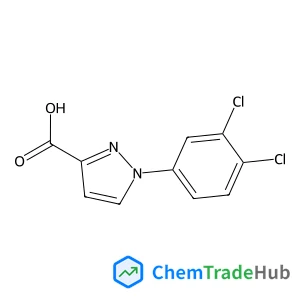
1-(3,4-Dichlorophenyl)-1H-pyrazole-3-carboxylic acid
CAS Number:
1152949-12-6
Molecular Formula:
C10H6Cl2N2O2
![[(5-Methyl-1,3,4-thiadiazol-2-yl)sulfanyl]acetic acid structure](https://static.chemtradehub.com/structs/509/50918-26-8-4ce8.webp "[(5-Methyl-1,3,4-thiadiazol-2-yl)sulfanyl]acetic acid structure")
[(5-Methyl-1,3,4-thiadiazol-2-yl)sulfanyl]acetic acid
CAS Number:
50918-26-8
Molecular Formula:
C5H6N2O2S2
Recommended Suppliers





Disclaimer
This page provides academic journal information for reference and research purposes only. We are not affiliated with any journal publishers and do not handle publication submissions. For publication-related inquiries, please contact the respective journal publishers directly.
If you notice any inaccuracies in the information displayed, please contact us at support@chemtradehub.com. We will promptly review and address your concerns.