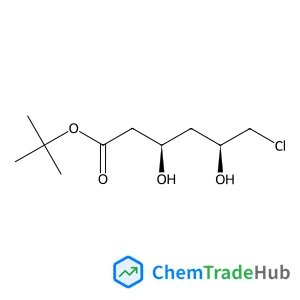
2-Methyl-2-propanyl (3R,5S)-6-chloro-3,5-dihydroxyhexanoate
CAS Number:
154026-93-4
Molecular Formula:
C10H19ClO4
Miguel A. San-Miguel, P. Mark Rodger
Molecular dynamics simulations have been used to study the behaviour of a liquid mixture of octacosane and heptane between two planar hematite surfaces; one of the surfaces was coated by a monolayer of an imidazoline-based corrosion inhibitor (CI). It was found that the octacosane could be inserted into the CI monolayer when it was aligned with the alkyl tails of the CIs, but the rate for such an insertion was slow. Potential of mean force calculations confirmed that there is a free energy barrier to insertion of octacosane into the CI film, and identified a secondary minimum about 13 Å from the surface as a metastable intermediate for insertion. A much more rapid process was adsorption of the octacosane onto the exposed hematite (102) surface, forming multiple layers and with a packing that was reminiscent of the octacosane crystal structure but with an orientation that matched the topology of the haematite surface.
DOI: 10.1039/D2RE00044J
Jing Song, Chencan Du, Junjie Wang, Yongjin Cui, Yujun Wang, Jian Deng, Guangsheng Luo
DOI: 10.1039/D2RE00224H
M. F. Sanakousar, Vidyasagar C. C, Víctor M. Jiménez-Pérez, Mounesh, A. H. Shridhar
DOI: 10.1039/D2RE00117A
Aseem Partap Singh Gill, Jason Tai Hong Kwan, David P. Wilkinson
DOI: 10.1039/D2RE00216G
Yuuki Mochizuki, Javzandolgor Bud, Enkhsaruul Byambajav, Naoto Tsubouchi
DOI: 10.1039/D2RE00003B
Jianguo Liu, Xinghua Zhang, Lungang Chen, Longlong Ma, Qi Zhang
DOI: 10.1039/D2RE00180B
Shiqing Wang, Xiaocheng Lan, Shiyong Xing, Babar Ali, Tiefeng Wang
DOI: 10.1039/D2RE00055E
Flavio Tollini, Alice Occhetta, Francesca Broglia, Vincenzo Calemma, Stefano Carminati, Giuseppe Storti, Mattia Sponchioni, Davide Moscatelli
DOI: 10.1039/D2RE00191H
(1R,3S)-1,3-Cyclopentanediol finds applications in various industries. In the ph...
When handling N'-[4-(Dimethylamino)phenyl]-N,N-dimethyl-1,4-benzenediamine, it i...
There are several alternatives to 5-(2,4-Difluorophenyl)-2-methoxypyrimidine in ...
1-(3-Methoxyphenoxy)propan-2-ol (CAS: 382141-68-6) must comply with the Globally...
Tetrodotoxin Citrate is extremely dangerous and should be handled with extreme c...
2-Methyl-2-propanyl [(1R,3S)-3-hydroxycyclopentyl]carbamate (CAS: 225641-84-9) i...
Waste containing 4-(2-Hydroxyhexafluoroisopropyl)Benzoic Acid (CAS: 16261-80-6) ...
2-Methyl-2-proanyl {(2S)-1-[(benzyloxy)amino]-3-hydroxy-3-methyl-1-oxo-2-butanyl...
Benzeneethanamine, α-ethyl-, hydrochloride (1:1) is an organic compound with the...
In the synthesis of compounds similar to 3-{(E)-[4-(Dimethylamino)phenyl]diazeny...

Physical Chemistry Chemical Physics (PCCP) is an international journal co-owned by 19 physical chemistry and physics societies from around the world. This journal publishes original, cutting-edge research in physical chemistry, chemical physics and biophysical chemistry. To be suitable for publication in PCCP, articles must include significant innovation and/or insight into physical chemistry; this is the most important criterion that reviewers and Editors will judge against when evaluating submissions. The journal has a broad scope and welcomes contributions spanning experiment, theory, computation and data science. Topical coverage includes spectroscopy, dynamics, kinetics, statistical mechanics, thermodynamics, electrochemistry, catalysis, surface science, quantum mechanics, quantum computing and machine learning. Interdisciplinary research areas such as polymers and soft matter, materials, nanoscience, energy, surfaces/interfaces, and biophysical chemistry are welcomed if they demonstrate significant innovation and/or insight into physical chemistry. Joined experimental/theoretical studies are particularly appreciated when complementary and based on up-to-date approaches.